Introduction
Maintaining a complete, healthy smile is essential for overall well-being, yet millions of individuals navigate the functional and structural challenges of missing teeth. When a permanent tooth is lost due to decay, periodontal disease, or unexpected trauma, the surrounding oral ecosystem shifts. Over time, missing teeth can cause neighboring teeth to drift out of alignment, disrupt your natural bite pattern, accelerate localized jawbone loss, and complicate standard chewing and clear speech.In this comprehensive guide, readers will learn about the baseline functions of dental restorations, the primary types of bridges available, what to expect during the clinical procedure, and how to safely maintain long-term oral hygiene. To begin exploring highly rated restorative care options, verifying specialist credentials, and accessing comprehensive patient education materials, you can visit BESTDENTALHOSPITALS, a dedicated educational restorative dentistry and hospital guide designed to support your healthcare research journey.
What Is a Dental Bridge?
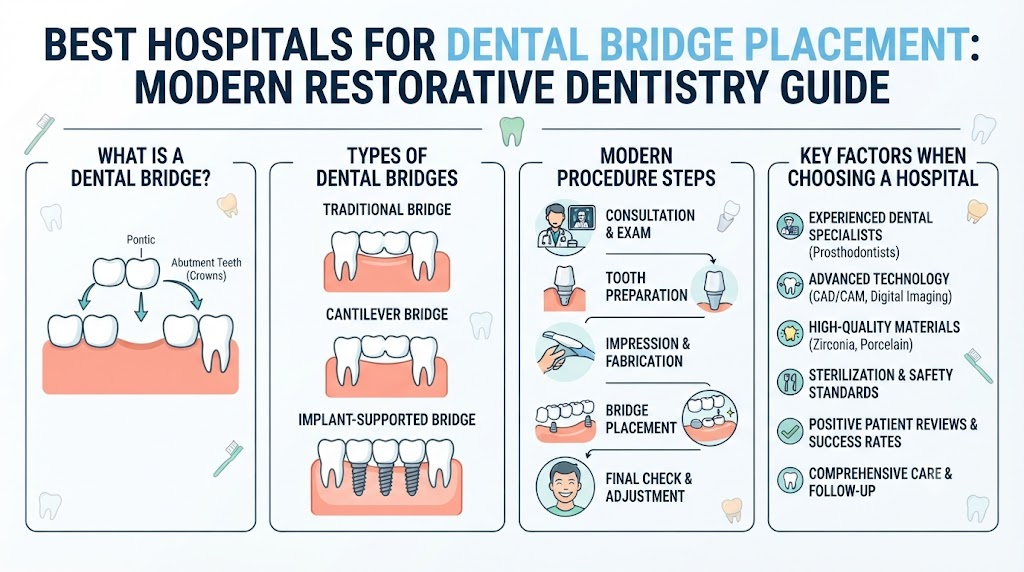
A dental bridge is a highly sophisticated, fixed dental restoration used to replace one or more consecutive missing teeth. Unlike removable partial dentures, which must be taken out daily for cleaning, a dental bridge is permanently anchored within the mouth, providing a stable structure that closely mimics the strength and look of natural teeth. The primary purpose of this fixed restoration is to bridge the physical gap created by tooth loss, evenly redistributing biting forces across the dental arch and preventing adjacent teeth from shifting into the vacant space.
Components of a Standard Dental Bridge
A standard dental bridge system consists of two primary anatomical parts:
- The Abutments: These are the stabilizing anchors for the bridge. In a traditional configuration, the abutments are the healthy natural teeth situated on either side of the missing tooth gap. These teeth are carefully prepared and capped with dental crowns to securely support the artificial teeth between them. Alternatively, in areas lacking healthy teeth, surgically placed dental implants can serve as the structural abutments.
- The Pontic: This is the artificial tooth suspended in the middle of the bridge structure that fills the empty space. Crafted from medical-grade ceramic, porcelain fused to metal, or high-strength zirconia, the pontic is custom-shaped and color-matched to blend seamlessly with the patient’s remaining natural teeth.
Modern dental bridge selection is never a one-size-fits-all process. The exact type of restoration, the selection of materials, and the structural configuration depend entirely on the patient’s individual oral health, the number of missing teeth, bone and gum health, and a comprehensive clinical evaluation.
Types of Dental Bridges
Restorative dentistry has advanced significantly, offering several distinct device configurations engineered to align with specific anatomical and clinical needs.
Traditional Dental Bridge
The traditional dental bridge is the most widely utilized configuration in restorative dentistry. It consists of a custom-fabricated pontic held in place by dental crowns that are permanently cemented onto the natural abutment teeth on both sides of the gap. This style provides exceptional structural strength and longevity, making it highly effective for replacing missing molars that endure heavy chewing forces. However, it requires the permanently reshaping of healthy enamel on the adjacent teeth to accommodate the supporting crowns.
Maryland Bridge
The Maryland bridge, also known as a resin-bonded bridge, is a conservative alternative primarily utilized for replacing missing front teeth. Instead of using full dental crowns that wrap around the adjacent teeth, a Maryland bridge uses a pontic that is anchored by thin metal or porcelain extensions called “wings.” These wings are bonded securely to the back surfaces of the neighboring teeth.
- Advantages: It requires minimal modification of the adjacent healthy teeth, preserving natural enamel.
- Limitations: It possesses lower structural load-bearing capacity, making it unsuitable for the back of the mouth where heavy grinding occurs.
Cantilever Bridge
A cantilever bridge is implemented when there is a healthy abutment tooth available on only one side of the missing tooth gap. The custom pontic is cantilevered out over the empty space, supported entirely by a single crown or a series of joined crowns on that lone adjacent anchor tooth. This design is highly restricted to limited clinical situations, typically involving low-stress front teeth, as it can exert excessive leverage and structural strain on a single anchor tooth if used incorrectly.
Implant-Supported Bridge
An implant-supported bridge represents a major technological leap in full-mouth reconstruction. Instead of anchoring the restoration to natural teeth, the bridge is secured entirely to surgically placed dental implants. Typically, one titanium implant is anchored into the jawbone for every missing tooth, and the custom bridge is then screwed or cemented directly onto these stable metallic roots. This approach is highly recommended for patients missing multiple teeth in a row or those who have inadequate jawbone strength to support traditional removable appliances.
Dental Bridge Types Comparison Table
| Bridge Type | Primary Purpose | Suitable For | Key Limitation / Advantage |
| Traditional Bridge | Replaces one or more missing teeth | Healthy natural teeth on both sides of the gap | Provides high strength but requires adjacent enamel removal |
| Maryland Bridge | Conservative front tooth replacement | Selected front teeth with low biting stress | Preserves natural tooth structure but lacks heavy grinding strength |
| Cantilever Bridge | Supported by one adjacent tooth | Limited clinical situations (e.g., low-impact front teeth) | Can exert significant structural leverage on the single anchor |
| Implant-Supported | Replaces multiple missing teeth | Patients with adequate jawbone density and multiple gaps | Offers maximum stability without altering adjacent natural teeth |
Services Offered by Leading Dental Hospitals
Comprehensive dental centers provide an end-to-end continuum of care that spans from advanced pre-operative diagnostics through lifetime restoration maintenance.
Advanced Diagnostics and Prosthodontic Evaluations
Before any structural intervention is planned, patients undergo a thorough non-invasive evaluation. This includes standard digital examinations to evaluate current oral health and extended three-dimensional Cone Beam Computed Tomography (CBCT) imaging to track bone density, nerve paths, and root health within the jaw. A comprehensive gum health evaluation is also performed to ensure the foundational tissue can safely support a new device. For complex or ambiguous cases, a prosthodontist will run specialized digital smile design tracking to map out exact facial contours and bite parameters.
Restorative and Cosmetic Dental Execution
When the clinical necessity is established, the bridge preparation is scheduled within a dedicated, highly sterile clinic room. Following successful preparation and digital scanning, clinicians utilize advanced digital tools to custom-program the bridge’s physical shape. They adjust parameter values like tooth shade, margin thickness, occlusal height, and contact points to align with the patient’s exact physical profile and daily chewing patterns.
Long-Term Follow-Up and Maintenance Support
A modern dental restoration requires consistent, routine monitoring to ensure structural and mechanical integrity. Specialized hospitals establish comprehensive follow-up programs that combine physical clinic visits with advanced preventive hygiene care. Patients receive detailed guidance regarding specialized interdental cleaning wands and floss threaders designed specifically for fixed bridges. This structured oversight allows the clinical team to spot subtle changes early, ensuring proper care continuity for both the restoration and the underlying natural teeth.
Advanced Technologies Used
The high safety profiles and long-term success rates observed in modern dental care are supported by the integration of state-of-the-art technologies within digital prosthodontic suites.
- Digital Intraoral Scanners: Modern handpieces utilize high-definition video capture to generate exact 3D digital impressions of the prepared teeth, completely eliminating the need for uncomfortable, messy traditional putty molds.
- CAD/CAM Dental Restorations: Computer-Aided Design and Computer-Aided Manufacturing software allows dental technicians or in-house milling machines to sculpt precision restorations from single blocks of zirconia with exceptional speed and accuracy.
- High-Strength Zirconia and Ceramics: Leading facilities avoid low-grade metals, opting for highly biocompatible, industrial-strength zirconia matrices that resist fracturing under extreme biting pressures while mimicking the natural translucency of enamel.
- Cone Beam Computed Tomography (CBCT): This specialized 3D X-ray system provides bright, low-dose visualization of the underlying bone structure, which is essential for safely placing implants to anchor an implant-supported bridge.
- Digital Smile Design Software: Combining pre-operative portrait photography with structural intraoral scans allows prosthodontists to plan the aesthetics of your smile with millimeter precision before fabrication begins.
- Modern Hospital Sterilization Protocols: Operating within a fully regulated healthcare environment guarantees that all clinical tools and surfaces undergo systematic medical sterilization between patient sessions.
How to Choose the Best Hospital for Dental Bridge Placement
Selecting the right hospital for a dental procedure involves evaluating several structural and professional markers of quality care. Patients and families should focus on institutions that emphasize medical safety, clinical transparency, and structured follow-up.
Specialist Credentials and Prosthodontic Infrastructure
The single most important factor is the training and experience of the medical team. Patients should seek out hospitals that employ dedicated, board-certified prosthodontists—dentists who have completed years of advanced specialized residency training focusing exclusively on the restoration and replacement of teeth. Look for facilities that feature dedicated, state-of-the-art restorative dental laboratories that are integrated directly into the clinic rather than using distant commercial labs.
Comprehensive Technology and Material Quality
A premier dental facility must possess comprehensive diagnostic support. Having advanced intraoral scanners, 3D CBCT imaging machinery, and CAD/CAM software on-site provides an indispensable asset that ensures a precise fit and minimizes chairside adjustment time. Furthermore, top institutions utilize high-grade, biocompatible ceramic and zirconia materials that are certified for long-term safety within the human body.
Long-Term Care Continuity and Preventive Support
Because a fixed bridge interacts continuously with your natural gum tissue and anchor teeth, the hospital’s operational follow-up infrastructure is vital. Confirm that the institution features a structured preventive care department that actively manages routine cleanings, provides direct lines of communication for technical questions, and systematically coordinates long-term follow-up visits.
Hospital Selection Checklist
| Feature | Why It Matters | What to Look For |
| Prosthodontic Specialists | Ensures accurate diagnosis, optimal device selection, and safe placement | Board certifications, extensive procedure history, dedicated restoration focus |
| Advanced Digital Technology | Minimizes procedural errors through optimal visual and technical support | High-definition intraoral scanners, 3D CBCT imaging matrices |
| In-House Dental Laboratory | Provides rapid modifications and exact customized color matching | Dedicated CAD/CAM milling setups, professional ceramicists on staff |
| High-Quality Materials | Delivers maximum structural strength and lifelike appearance | Availability of monolithic zirconia and advanced glass ceramics |
| Comprehensive Oral Care | Guarantees the foundation remains free from gum disease and decay | Integrated periodontal support and regular dental hygienist care |
| Strict Infection Control | Protects patient health through rigorous corporate cleaning guidelines | Regulated hospital-grade sterilization rooms and single-use supplies |
Preparing for Dental Bridge Placement
Proper pre-operative preparation ensures that the procedure can be performed safely and efficiently with minimal risk of avoidable complications.
Clinical History and Structural Assessment
In the days leading up to the procedure, the dental care team conducts an exhaustive review of your complete oral health. You will undergo standard high-resolution digital X-rays or 3D scans to evaluate the internal health of the proposed abutment teeth, verifying that the roots are structurally sound and free from hidden infections. A comprehensive gum evaluation is also documented to serve as a reference for the placement team.
Impression Capture and Tooth Preparation
One of the most critical preparatory steps involves coordinating the supporting structure. If you are receiving a traditional bridge, the prosthodontist will gently reshape the anchor teeth during your preparation visit, removing a precise layer of outer enamel to make space for the supporting crowns. Once the teeth are prepared, the clinic will capture high-precision digital intraoral scans or physical impressions to map the exact relationship of your bite.
Temporary Bridge Placement and Comfort Maintenance
Because the fabrication of a custom dental bridge inside a laboratory takes a few days, the clinical team will typically place a comfortable temporary bridge using a lightweight acrylic material. This temporary device protects the exposed dentin of the prepared anchor teeth, prevents thermal sensitivity, and maintains proper tooth spacing until your custom permanent restoration is fully completed.
What Happens During the Procedure?
Dental bridge placement is typically performed under local anesthesia inside a specialized dental clinic room, maintaining a highly structured and safe clinical sequence.
[Clinical Evaluation & Mapping] ➔ [Local Anesthetic Application] ➔ [Abutment Tooth Preparation] ➔ [Precision Intraoral Scanning] ➔ [Temporary Bridge Cementation] ➔ [Custom Fabrication & Final Fit]
Step 1: Admission and Local Numbing
Once positioned comfortably in the treatment chair, the clinical team reviews the day’s treatment plan and answers any outstanding questions. A highly effective topical numbing gel is applied to the gum tissue, followed by a local anesthetic injection around the target teeth. This ensures that the entire area is completely numb and that you remain comfortable throughout the procedure.
Step 2: Abutment Tooth Preparation
The prosthodontist uses highly precise dental handpieces to gently recontour the natural abutment teeth situated on either side of the empty gap. They carefully remove a calculated layer of enamel and dentin, creating a smooth, tapered shape that will allow the hollow crowns of the permanent bridge to slide over them smoothly without looking bulky or misaligned.
Step 3: Precision Scanning or Impression Capture
Once the anchor teeth are prepared, the team utilizes an advanced digital intraoral camera to sweep over your arches, capturing thousands of real-time images to generate a 3D color model of your mouth. This digital impression documents the prepared anchors, the gum line, and how your upper and lower teeth meet when you chew. The digital file is instantly uploaded to the laboratory software.
Step 4: Temporary Placement and Final Cementation
The doctor places a temporary acrylic bridge over the prepared anchors using a gentle, non-permanent cement, allowing you to chew comfortably while your permanent device is crafted. A few days later, you return for the final fitting. The temporary bridge is removed, the prepared teeth are cleaned, and the new custom zirconia or ceramic bridge is placed. The prosthodontist meticulously checks your bite alignment using articulating paper, makes micro-adjustments, and permanently secures the restoration with high-strength dental cement.
Recovery and Aftercare
Adapting to a new fixed dental restoration is generally a smooth process, provided that patients follow a few straightforward post-operative guidelines during the initial healing phases.
Immediate Post-Placement Sensitivities
Immediately following the final cementation, it is entirely normal to experience mild, localized tooth sensitivity to hot or cold temperatures, as well as slight tenderness along the surrounding gum line. This minor irritation typically subsides within a few days as the nerve tissues adapt to the new structure. Patients are advised to stick to soft foods for the first 24 to 48 hours, avoiding excessively crunchy, hard, or sticky foods that could stress the fresh dental cement.
Essential Daily Hygiene Routines
Because a dental bridge is a single, joined unit, standard dental floss cannot pass vertically between the teeth. This design means that meticulous specialized cleaning is required to prevent decay from forming beneath the edges of the anchor crowns:
- Floss Threaders: Utilize a flexible plastic floss threader to pull standard dental floss horizontally through the open space between the pontic and your gum tissue, clearing away hidden plaque daily.
- Interdental Brushes: Use tiny, specialized rubber-coated interdental wands to gently slide beneath the bridge framework to clear food debris.
- Water Flossers: Incorporate a high-quality oral irrigator directed along the margins of the bridge to flush out loose debris comfortably.
- Twice-Daily Brushing: Brush thoroughly for two full minutes twice a day using a soft-bristled toothbrush and a non-abrasive fluoride toothpaste, paying close attention to the gum line where the artificial crowns meet natural tissue.
Possible Risks and Complications
While serious complications are uncommon and significantly reduced through experienced clinical care teams and regular follow-up, it is important to understand the potential risks associated with any structural dental restoration.
- Localized Tooth Sensitivity: The anchor teeth can sometimes experience persistent mild sensitivity to thermal changes during the early weeks. This is carefully monitored and typically resolves naturally as the dentin seals.
- Recurrent Decay Around Crowns: If oral hygiene is neglected, harmful bacteria can accumulate at the margin where the crown meets the natural tooth, leading to new decay beneath the restoration that can compromise the anchor.
- Localized Gum Irritation: Plaque buildup under the pontic can cause chronic inflammation of the gum tissue (gingivitis), presenting as localized swelling, redness, or bleeding during brushing.
- Bridge Loosening or Debonding: Over time, heavy grinding forces or the degradation of dental cement can cause the bridge to become loose or detach from one of the anchors, requiring prompt re-cementation by a professional.
- Structural Material Fractures: Although rare with monolithic zirconia, extreme forces from accidental trauma or severe nighttime teeth grinding (bruxism) can occasionally chip the outer porcelain layer of the restoration.
- Future Root Canal Requirement: The mechanical reshaping of the abutment teeth can occasionally cause the internal nerve tissue to become inflamed over time, requiring a root canal procedure through the top of the crown to secure the tooth.
Engaging in meticulous daily oral hygiene and scheduling routine checkups are the most effective ways to minimize these risks.
How BESTDENTALHOSPITALS Helps Patients
Navigating complex restorative treatment paths can feel overwhelming for patients and families. BESTDENTALHOSPITALS serves as an objective, educational platform designed to streamline your search for high-quality oral care.
Verified Hospital and Specialist Discovery
The platform provides access to a comprehensive directory of medical centers featuring specialized prosthodontic and restorative dentistry departments. Users can explore facility locations, evaluate operational infrastructure, and review the medical credentials of practicing prosthodontists without needing to sort through unverified online sources.
Transparent Care Comparison and Educational Libraries
Through easy-to-read guides and comprehensive facility overviews, the platform allows you to evaluate dental centers based on objective quality markers, such as international healthcare accreditations, procedural safety track records, and the availability of advanced technologies like digital intraoral scanners. This helps clarify complex dental terms, ensuring you know exactly what options to discuss with your doctor.
Direct Access to Practical Information
Beyond serving as a trusted educational resource, the platform allows users to easily submit requests for general treatment information and facility quotes. By facilitating communication between families and accredited healthcare systems, the platform helps you manage the logistical and financial planning of your restorative journey smoothly and confidently.
Common Mistakes People Make
Avoiding common behavioral errors after being recommended for a dental restoration can protect you from preventable complications and ensure a smoother recovery.
Delaying the Replacement of a Missing Tooth
Ignoring an empty tooth gap because there is no immediate pain is a serious mistake. Over time, the adjacent teeth will naturally tip and drift into the open space, distorting your bite and making future restoration procedures significantly more complex and costly.
Choosing a Treatment Center Based Only on the Lowest Cost
Opting for low-cost clinics that utilize low-grade base metals or outdated impression methods frequently leads to poorly fitting bridges, chronic gum irritation, and premature restoration failures.
Neglecting Specialized Hygiene Under the Bridge
Assuming that a dental bridge can be brushed exactly like natural teeth without cleaning underneath the pontic is a major misconception. Skipping interdental flossing allows plaque to accumulate, leading to decay on the anchor teeth.
Skipping Scheduled Follow-Up and Cleanings
Believing that artificial teeth are immune to problems and skipping bi-annual dental checkups prevents your doctor from evaluating the integrity of the dental cement and monitoring the health of the supporting bone.
Ignoring Chronic Signs of Nighttime Teeth Grinding
Failing to inform your prosthodontist that you grind your teeth at night (bruxism) can result in excessive structural stress on your new bridge, potentially causing premature chipping or loosening if a protective nightguard is not worn.
Common Myths vs. Facts
Myth: Dental bridges are purely cosmetic devices used only to improve the look of a smile.
Fact: While bridges do look great, their primary role is functional—they restore proper chewing efficiency, enable clear speech, and keep your remaining teeth from shifting out of alignment.
Myth: Once a fixed dental bridge is cemented into place, it will last forever without ever needing replacement.
Fact: While modern bridges are highly durable, their lifespan depends heavily on oral hygiene and wear. They typically require replacement or modification after several years due to natural structural changes.
Myth: The structural placement of a traditional dental bridge is an intensely painful surgical procedure.
Fact: The procedure is highly manageable. Modern local anesthetics completely numb the area during tooth preparation, and post-treatment sensitivity is typically mild and easily managed.
Myth: Artificial dental bridges do not require any daily cleaning or professional maintenance.
Fact: Regular care is vital. Plaque can easily accumulate along the gum line and underneath the artificial tooth, making daily interdental flossing and routine dental cleanings essential for longevity.
Real-Life Educational Scenarios
Scenario A: Restoring Functional Chewing Efficiency
An individual struggled to chew comfortably after losing a lower first molar, which caused the adjacent teeth to tip inward over time. After visiting a specialized dental hospital, they received a traditional three-unit zirconia bridge. The fixed device filled the empty gap, stabilized the neighboring teeth, and fully restored their natural chewing function.
Scenario B: Conservative Front Tooth Restoration
A young adult lost a single front incisor due to a sports injury but wished to avoid altering the healthy teeth next to it. Their prosthodontist recommended a Maryland bridge. The custom porcelain pontic was secured using conservative wings bonded discreetly to the back of the adjacent teeth, beautifully restoring their smile with minimal alterations.
Scenario C: Full Arch Reconstruction with Implants
A patient experienced extensive tooth loss across an upper arch due to advanced historical decay, leaving them with inadequate natural anchors for a traditional bridge. They chose a dental center equipped with 3D CBCT technology and received an implant-supported bridge. The device provided exceptional stability, allowing them to speak and smile with complete confidence.
Scenario D: Selecting a Specialized Restorative Center
A family sought comprehensive care for a relative who needed multiple complex dental restorations. By utilizing educational resources to compare accredited clinics, they selected a dental hospital featuring an in-house CAD/CAM laboratory and board-certified prosthodontists. The specialized team completed the bridge placement efficiently with excellent fit and color matching.
FAQs (Frequently Asked Questions)
1.What is a dental bridge?
A dental bridge is a fixed, permanent dental restoration used to replace one or more missing teeth by anchoring an artificial tooth (pontic) to adjacent natural teeth or surgically placed implants.
2.Who is a good candidate for a dental bridge?
A good candidate is anyone missing one to four consecutive teeth who possesses healthy adjacent anchor teeth or adequate jawbone density to support stabilizing dental implants.
3.What are the main types of dental bridges available?
The four primary configurations are traditional bridges (anchored by crowns), Maryland bridges (bonded with thin wings), cantilever bridges (using a single anchor), and implant-supported bridges.
4.How long does the dental bridge placement process take?
The process typically requires two primary clinic visits spaced over one to two weeks—the first visit for tooth preparation and scanning, and the second for final fitting and cementation.
5.Is the bridge placement procedure painful?
No. The procedure is performed under local anesthesia to completely numb the area during tooth preparation. Mild post-treatment sensitivity is common but typically resolves within a few days.
6.How long can a modern dental bridge last?
With excellent daily oral hygiene and routine professional cleanings, a high-quality dental bridge can last for many years before requiring evaluation or routine replacement.
7.How do I clean underneath a fixed dental bridge?
Because standard floss cannot pass vertically, you must use specialized tools like floss threaders, interdental brushes, or water flossers to clear away food particles and plaque daily.
8.Can a dental bridge replace multiple missing teeth?
Yes. A dental bridge can successfully replace multiple missing teeth in a row, though longer spans often require dental implants to provide adequate structural support.
9.What is the main difference between a bridge and an implant?
A traditional bridge anchors to adjacent teeth and requires reshaping their enamel, while a dental implant is a standalone titanium root surgically placed into the bone, leaving neighboring teeth untouched.
10.Are dental bridges commonly covered by insurance plans?
Many dental insurance policies cover a portion of fixed bridge placement, as it is classified as a standard restorative procedure. Always verify your specific benefits with your provider beforehand.
11.What high-strength materials are used to make modern bridges?
Bridges are typically fabricated from modern medical-grade materials, including monolithic zirconia, porcelain fused to noble metals, or high-strength lithium disilicate ceramics.
12.What primary complications can occur if hygiene is poor?
Potential risks include recurrent tooth decay forming beneath the anchor crowns, localized gum inflammation (gingivitis), bridge loosening, or material chipping under extreme grinding forces.
13.How do I choose the right hospital for dental bridge placement?
Look for accredited dental centers that employ board-certified prosthodontists, feature on-site digital scanners and CAD/CAM labs, use premium materials, and maintain rigorous sterilization standards.
14.What specific technologies improve the bridge placement process?
Key advancements include digital intraoral video scanners, 3D Cone Beam Computed Tomography (CBCT) imaging, and computer-aided design and manufacturing (CAD/CAM) milling software.
15.How does BESTDENTALHOSPITALS help patients find dental care?
The platform acts as a trusted educational guide, providing verified directories of dental hospitals, listing specialist credentials, sharing treatment overviews, and simplifying the process of requesting care information.
Final Thoughts
Addressing tooth loss promptly through professional restorative care is a vital step toward protecting your long-term oral health and facial structure. A dental bridge remains an exceptionally dependable, time-tested fixed solution that offers profound functional and aesthetic benefits when managed by experienced prosthodontic teams. By selecting specialized dental hospitals equipped with modern digital laboratories and comprehensive follow-up programs, you ensure that every stage of your care—from the initial 3D scan through permanent cementation—is guided by clinical expertise and safety.