Introduction
In the contemporary healthcare landscape, aesthetic wellness has emerged as a significant component of overall personal confidence and quality of life. Among various dental interventions, the demand for cosmetic dentistry has experienced substantial global growth. A balanced, harmonious smile is often perceived as a reflection of physical vitality and meticulous personal care, prompting individuals to seek clinical solutions that refine their dental presentation without compromising oral structural integrity.This educational guide details the clinical parameters of enamel reshaping, compares contouring with alternative aesthetic interventions, and outlines the criteria for selecting an accredited healthcare facility. While exploring these clinical pathways, digital platforms like BestDentalHospitals can help connect patients with detailed insights into cosmetic dentistry, smile enhancement procedures, patient education, and modern dental care services.
What Is Cosmetic Teeth Contouring?
Cosmetic teeth contouring, formally designated in clinical dentistry as enamel reshaping, odontoplasty, or enameloplasty, is a precise, conservative cosmetic procedure designed to alter the shape, length, or surface texture of natural teeth. This intervention focuses exclusively on modifying the outermost layer of the tooth structure—the dental enamel—to resolve minor visual discrepancies and enhance overall smile balance.
During the procedure, a qualified cosmetic dentist uses specialized high-speed precision instruments to remove tiny, microscopic amounts of dental enamel. Because enamel lacks living nerve fibers, this process is entirely physical and non-invasive, requiring no local anesthesia. The professional carefully contours uneven edges, balances asymmetrical lengths, and smooths out surface imperfections, finishing the treated areas with specialized polishing discs to match the natural sheen of the surrounding dentition.
[ Cross-Section of a Healthy Tooth Structure ]
+--------------------------------------------+
|  [ ENAMEL ]  <-- Outer protective layer     |
|   [ Dentin ] <-- Sensitive inner layer     |
|    [ Pulp ]  <-- Contains nerves & vessels |
+--------------------------------------------+
* Contouring is strictly confined to the microscopic surface of the ENAMEL layer.
It is essential to understand the clinical difference between cosmetic contouring and restorative dentistry:
- Cosmetic Contouring: A elective procedure performed on completely healthy, structurally sound teeth to address minor visual imperfections. It does not replace missing tooth structure, nor does it treat active pathology like decay, infection, or structural trauma.
- Restorative Dentistry: A therapeutic intervention required to repair damaged, decayed, or fractured teeth. Procedures such as fillings, root canals, and crowns focus on rebuilding structural strength, restoring chewing function, and stopping disease progression.
Because enamel does not regenerate once removed, enameloplasty must be approached with caution. Dental specialists limit enamel reduction to a fraction of a millimeter, ensuring the underlying, highly sensitive dentin layer remains fully protected from thermal changes and bacterial infiltration.
Who May Be a Good Candidate?
Cosmetic teeth contouring is a selective procedure suitable only for patients who present with specific anatomical characteristics and maintain excellent baseline oral health.
- Minor Chipped Teeth: Individuals with small, superficial chips along the biting edges of the front teeth, provided the fracture does not extend near the dentin or compromise structural integrity.
- Uneven Tooth Edges: Patients whose front teeth exhibit slight variations in length, ridges, or pointed corners, resulting in an asymmetrical or jagged smile line.
- Slightly Irregular Tooth Shapes: Individuals presenting with minor natural variations, such as unusually sharp canine teeth or square lateral incisors, who desire a softer, more uniform look.
- Minor Overlapping or Crowding: Selected cases where a slight overlap between two adjacent teeth can be visually softened by contouring the enamel borders, without requiring orthodontic alignment.
- Small Cosmetic Imperfections: Individuals looking to correct minor surface pits, superficial grooves, or minor developmental ridges on the enamel surface.
- Healthy Teeth and Gums: Candidates must have strong dental structures, free from active tooth decay, advanced gum disease, root exposure, or severe enamel thinning.
- Realistic Treatment Expectations: Patients must understand that contouring resolves only minor, superficial irregularities and is not designed to correct major alignment issues or severe discoloration.
                  +-----------------------------------+
                  |  IDEAL CANDIDATE FOUNDATIONS      |
                  +-----------------------------------+
                   /               |                 \
                  /                |                  \
      [ Thick Enamel Layer ] [ Zero Active Disease ] [ Minor Surface Defects ]
       - Measured via X-ray   - No decay or tracking  - Chips, rough borders,
       - Protects the dentin    periodontal bone loss   or length asymmetry
Determining eligibility requires an in-person diagnostic evaluation by a professional dentist. If a patient exhibits thin enamel layers, history of chronic tooth sensitivity, or structural weakness caused by grinding (bruxism), alternative, additive procedures must be explored to prevent long-term complications.
Cosmetic Teeth Contouring vs Other Cosmetic Procedures
| Procedure | Primary Clinical Purpose | Best For | Structural Approach |
| Teeth Contouring | Minor surface and border reshaping | Small cosmetic imperfections, minor chips, uneven edges | Subtractive; removes microscopic amounts of natural enamel |
| Dental Bonding | Repairing chips and closing gaps using composite resin | Moderate cosmetic corrections and localized structural rebuilding | Additive; applies a shade-matched composite material directly to tissue |
| Veneers | Complete visual smile transformation | Multiple cosmetic concerns, severe stains, internal cracks | Custom porcelain facings bonded to minimally prepped tooth fronts |
| Crowns | Rebuilding heavily damaged or decayed teeth | Significant tooth damage, structural fractures, post-root canal care | Full coverage cap enclosing the entire remaining tooth structure |
| Orthodontics | Correcting structural malocclusion and alignment | Moderate to severe crowding, bite misalignments, spacing issues | Structural movement of tooth roots within the alveolar bone |
Benefits of Cosmetic Teeth Contouring
When recommended for appropriately screened patients, cosmetic teeth contouring offers several clinical and practical advantages over more extensive cosmetic dental interventions.
              [ Core Benefits of Enamel Reshaping ]
  ==============================================================
   Conservative | Fast Execution | Zero Sedation | Cost-Efficient
  ==============================================================
   Preserves natural | Completed in a | Entirely painless; | Minimizes financial
   tooth structures  | single setting | requires no needles | overhead and lab fees
  ==============================================================
- Conservative Tissue Preservation: Unlike procedures such as crowns or veneers, which require removing substantial amounts of natural tooth structure, contouring preserves the vast majority of the natural tooth, removing only a microscopic layer of enamel.
- Rapid Single-Visit Execution: Enamel reshaping is a highly efficient procedure, typically completed in a single clinical appointment lasting 30 to 45 minutes, with no need for temporary restorations or lab wait times.
- Entirely Painless Experience: Because the procedure is strictly confined to the non-living outer enamel layer, patients experience no pain, eliminating the need for local anesthesia injections or post-procedural recovery down-time.
- Immediate Aesthetic Improvement: The visual enhancements—such as balanced tooth lengths, smooth borders, and improved symmetry—are visible immediately, providing an instant boost to the patient’s smile dynamics.
- Enhanced Long-Term Oral Hygiene: Smoothing out rough borders, minor chips, or overlapping edges eliminates tight traps where plaque and food particles collect, making it easier to clean the teeth and reducing the risk of localized gum inflammation.
- Boosted Personal Confidence: Resolving focal defects that a patient may have hidden for years supports a more natural smile, enhancing self-esteem in professional and social interactions.
Advanced Cosmetic Dentistry Technologies
The safety and precision of modern enamel reshaping rely heavily on specialized diagnostic and treatment technologies available at advanced cosmetic dental hospitals.
Digital Diagnostics and Visual Planning
- Digital Smile Design (DSD): An advanced planning tool that utilizes high-resolution digital photographs and intraoral videos of the patient to analyze facial proportions and dental dynamics. Using specialized software, dentists can plan precise adjustments mathematically, allowing patients to view a reliable simulation of their potential smile enhancement before treatment begins.
- Digital Intraoral Scanning: Replaces traditional, uncomfortable putty impressions with a high-speed optical camera system. The scanner captures thousands of three-dimensional data points within seconds, generating an accurate, high-definition digital model of the dentition. This model allows specialists to analyze enamel thickness and tooth positioning with exceptional accuracy.
[ Intraoral Scan Data ] ---> Accurate Enamel Measurement ---> Safer, Minimal Reduction
[ High-Speed Instruments ] -> Controlled Diamond Shaping   ---> Ultra-Smooth Finish
High-Precision Execution Tools
- Laser Dentistry Systems: Specialized hard-tissue lasers can be utilized in selected cases to modify enamel surfaces with exceptional precision. The laser operates without the vibration or noise of traditional drills, minimizing microscopic micro-fractures in the surrounding enamel rods. Soft-tissue lasers may also be used concurrently to reshape uneven gum contours, improving overall smile symmetry.
- High-Speed Precision Instruments: Specialized handpieces equipped with ultra-fine, diamond-grit burrs allow dentists to shape enamel with micro-level control. These tools allow the specialist to smooth surfaces evenly, preventing heat buildup and protecting the tooth from structural stress.
- CAD/CAM Technology: Computer-Aided Design and Computer-Aided Manufacturing systems integrate seamlessly with intraoral scanners. While contouring is a subtractive procedure, having CAD/CAM technology on-site ensures that if a patient requires a combined treatment—such as combining contouring with a custom ceramic veneer or inlay—the restoration can be designed, milled, and placed within a single visit.
Technology Comparison Table
| Technology | Clinical Purpose | Key Patient Benefit |
| Digital Smile Design | Creates advanced architectural blueprints of the mouth using facial proportions | Allows patients to visualize planned smile enhancements before any enamel is altered |
| Intraoral Scanner | Captures detailed three-dimensional digital maps of dental structures | Replaces uncomfortable putty trays with a fast, accurate digital scanning process |
| Laser Dentistry | Shapes enamel and contours gum borders with specialized light energy | Offers high precision during soft and hard tissue modifications with minimal vibration |
| CAD/CAM Technology | Designs and mills custom ceramic dental restorations on-site | Enables efficient, single-visit treatments when combining contouring with additive restorations |
What Happens During Cosmetic Teeth Contouring?
Understanding the sequence of a typical enamel reshaping treatment can help patients feel more comfortable and confident as they approach their clinical appointment.
  [ Step 1: Initial Assessment ] -> Comprehensive exam, X-rays, and enamel measurements
               |
  [ Step 2: Smile Mapping ] ------> Marking treatment borders directly on the tooth surface
               |
  [ Step 3: Precision Shaping ] --> Careful removal of microscopic enamel layers using diamond tools
               |
  [ Step 4: Fine Polishing ] -----> Smoothing treated surfaces to match natural luster
               |
  [ Step 5: Final Evaluation ] ---> Verifying bite alignment and structural integrity
Step 1: Initial Consultation and Oral Examination
The care process begins with a comprehensive clinical evaluation. The dentist examines the patient’s teeth and gums, checks for active decay or structural instabilities, and takes digital dental X-rays. These images are essential for measuring the exact thickness of the enamel layer and confirming that the underlying pulp chamber is located at a safe distance from the planned treatment area.
Step 2: Smile Mapping and Planning
Once eligibility is confirmed, the dentist maps out the specific treatment areas. Using a specialized water-soluble marker, the specialist draws directly on the tooth surfaces to identify the exact areas of enamel to be reshaped. This visual guide ensures precise symmetry and aligns the planned modifications with the natural proportions of the patient’s face and lips.
Step 3: Precision Enamel Reshaping
Using high-speed handpieces equipped with ultra-fine diamond burrs, the dentist gently removes the targeted, superficial sections of enamel. The process feels similar to having a fingernail filed—patients feel mild vibration but no pain or sharp discomfort. The dentist works conservatively, assessing the tooth from multiple angles throughout the process to ensure tissue reduction remains within safe limits.
Step 4: Finishing and Fine Polishing
After achieving the desired shape and length, the dentist transitions to specialized finishing tools. Using progressively finer polishing discs, rubber cups, and polishing pastes, the specialist smooths all contoured edges. This step eliminates microscopic roughness where plaque could accumulate, protects the lips and tongue from sharp corners, and restores a natural, high-luster shine to the tooth surface.
Step 5: Final Evaluation and Bite Verification
The appointment concludes with a thorough functional evaluation. The patient bites down on specialized articulating paper to verify that the reshaped teeth align properly during normal chewing, talking, and resting positions. Ensuring that the new contours do not alter the patient’s natural bite mechanics is essential for preventing future joint strain or uneven wear on the teeth.
Recovery and Aftercare
Because cosmetic teeth contouring is a non-invasive, conservative procedure, it requires no downtime or formal recovery period. Patients can return to work, speak normally, and consume foods immediately following their clinical appointment.
Managing Temporary Sensitivity
In rare instances, some patients may experience mild, temporary sensitivity to hot or cold temperatures for 24 to 48 hours after treatment. This occurs as the newly exposed enamel matrix adapts to the oral environment.
To manage this minor symptom:
- Brush with a gentle, desensitizing toothpaste containing potassium nitrate.
- Avoid consuming extremely hot or ice-cold beverages for the first two days.
- Use a soft-bristled toothbrush to prevent mechanical irritation of the gums.
Daily Oral Hygiene and Habits
Long-term success depends on maintaining meticulous daily oral care habits. Patients should continue brushing twice daily with a fluoride toothpaste and flossing once daily to keep the contoured surfaces clean and free from plaque.
Additionally, it is essential to avoid harmful non-functional habits that place excessive structural stress on the teeth, such as chewing on ice cubes, crunching hard candies, biting plastic pen caps, or using your teeth as tools to open packages.
                  [ CONSERVATIVE AFTERCARE PILLARS ]
  =============================================================
   Gentle Cleansing | Habit Awareness | Protective Splints
  =============================================================
   Soft toothbrush;  | Avoid chewing on| Custom nightguards
   fluoride paste to  | hard objects like| for patients with a
   strengthen tissue | ice or pen caps  | history of bruxism
  =============================================================
Regular Professional Monitoring
Attending regular, bi-annual dental checkups and professional cleanings allows your care team to monitor your results consistently. During these visits, the dentist checks the structural integrity of the contoured enamel, verifies that your bite remains well-balanced, and provides routine preventative care to support long-term oral health.
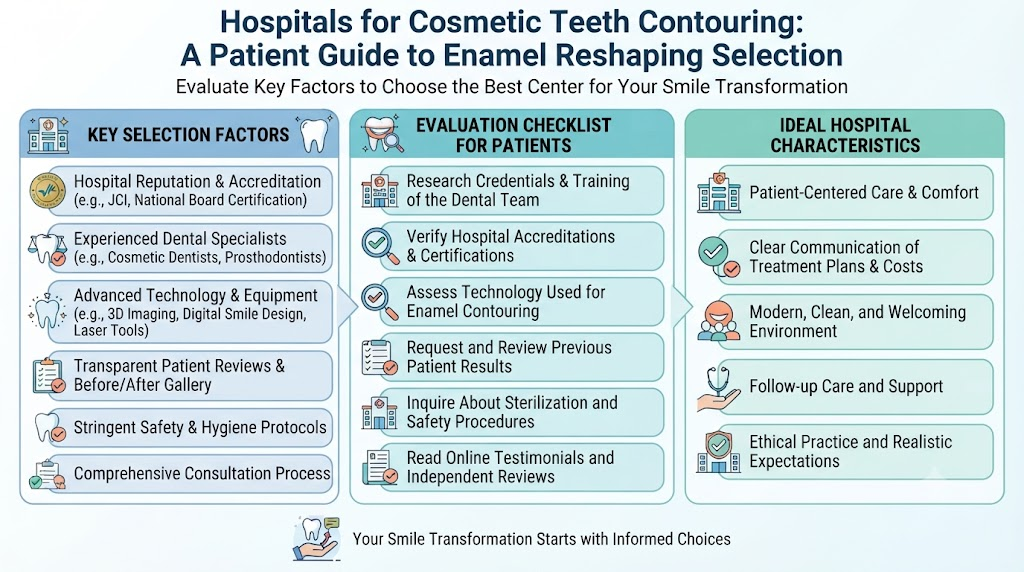
Choosing the Right Cosmetic Dental Hospital
Selecting the right healthcare facility for cosmetic enamel reshaping is essential for protecting your dental health and ensuring a balanced, natural-looking result.
Evaluate Specialist Credentials and Experience
The most important factor in your care is the expertise of the dental team. Ensure the hospital is staffed by accredited cosmetic dentists who have completed advanced training in aesthetic dentistry and smile design. Reviewing a comprehensive portfolio of a dentist’s previous work during your consultation can help you evaluate their technique and aesthetic style.
Confirm Facility Safety Standards and Technology
A reputable dental hospital should feature modern diagnostic and treatment technology, including digital intraoral scanners, high-resolution digital X-rays, and advanced smile-simulation software.
Furthermore, ensure the facility adheres strictly to infection control standards set by national health organizations, utilizing advanced sterilization autoclaves and maintaining a clean, professional clinical environment.
       [ ACCREDITED COSMETIC HOSPITAL ]
 (Certified Specialists + Advanced Tech + Strict Sterilization)
                       |
       [ SUPPORTED CARE PATHWAY ]
  (Comprehensive Screening + Transparent Consultation Programs)
Prioritize Transparent Consultations and Education
Look for hospitals that place a high value on patient education and transparency. During your initial consultation, the specialist should perform a thorough structural assessment and provide an honest explanation of whether contouring is right for your smile.
Avoid facilities that use high-pressure sales tactics or suggest aggressive enamel reduction. A trustworthy clinical team prioritizes your long-term oral health and helps you make well-informed, safe decisions.
Hospital Selection Checklist
| System Feature | Core Clinical Significance | Specific Indicators to Look For |
| Experienced Dentists | Ensures an accurate structural assessment and precise enamel modification | Active professional memberships; specialized credentials in cosmetic dentistry |
| Digital Smile Design | Allows for precise visual mapping and personalized treatment planning | In-office availability of high-resolution digital smile-simulation software |
| Modern Infrastructure | Supports safe, predictable treatment with specialized instruments | High-resolution digital X-rays; intraoral scanners; precision diamond burrs |
| Infection Control | Minimizes cross-contamination risks to ensure safe patient care | Strict adherence to national sterilization guidelines; visible monitoring logs |
| Follow-up Services | Provides ongoing preventative care to protect your long-term oral health | Structured preventative programs; regular, scheduled recall appointments |
Maintaining Your Smile After Treatment
While contoured enamel requires no special maintenance beyond standard oral hygiene, taking proactive steps to care for your teeth protects your investment and supports long-term oral health.
       [ Core Pillars of Post-Treatment Smile Longevity ]
  =============================================================
   Fluoride Shield | Flossing Routine | Diet Management | Guard Protection
  =============================================================
   Brushing with a | Cleans tightened | Limits acidic    | Custom nightguards
   protective,     | interdental      | juices and hard  | for individuals who
   remineralizing  | borders daily    | foods to avoid   | grind their teeth
   toothpaste      |                  | enamel erosion   | at night
  =============================================================
- Commit to Daily Brushing: Use a soft-bristled toothbrush and a remineralizing fluoride toothpaste twice daily to keep tooth surfaces clean and strengthen the surrounding enamel matrix.
- Maintain Daily Flossing: Clean between your teeth at least once a day, paying extra attention to any contoured borders where tooth positions were visually modified.
- Manage Your Diet Wisely: Limit your consumption of highly acidic foods and beverages, such as citrus juices, carbonated sodas, and sports drinks, which can temporarily soften enamel and make it more vulnerable to wear.
- Avoid Non-Functional Habits: Stop habits that subject your teeth to unnecessary force, such as nail-biting, chewing on pencils, or opening plastic packaging with your teeth.
- Wear a Protective Mouthguard: If you participate in contact sports, have your dental team create a custom athletic mouthguard to protect your teeth from trauma and fractures.
- Protect Against Nighttime Grinding: If you have a history of grinding your teeth at night (bruxism), wear a custom nighttime splint or guard to protect your newly shaped enamel from excessive forces.
- Attend Routine Dental Appointments: Schedule professional checkups and cleanings every six months, allowing your dentist to monitor your bite alignment and keep your smile healthy.
Common Myths vs Facts
Myth: Cosmetic teeth contouring permanently damages the tooth and accelerates structural decay.
Fact: When performed correctly by a qualified cosmetic dentist, contouring is safe and does not harm the tooth. The procedure removes only a microscopic layer of the outer enamel, ensuring the tooth remains fully protected. It is only unsuitable when performed on thin enamel or un-screened candidates.
Myth: Enamel reshaping can be used to resolve major structural misalignment and crowded teeth.
Fact: Teeth contouring is designed strictly to address minor cosmetic issues, such as uneven edges or small chips. Significant crowding, crossbites, or severe malocclusions involve structural bone positioning and require specialized orthodontic care rather than enamel reduction.
Myth: Cosmetic teeth contouring is a universal replacement for advanced porcelain veneers.
Fact: These two procedures serve completely different clinical purposes. Contouring is a conservative, subtractive method designed for minor, subtle refinements. In contrast, veneers are an additive treatment used for comprehensive transformations, covering extensive stains, large gaps, or severe structural wear.
Myth: Undergoing a tooth contouring procedure requires an extended recovery period and significant downtime.
Fact: The procedure is non-invasive and entirely painless, requiring no local anesthesia. Recovery is immediate—patients can speak normally, return to work, and consume foods right after their appointment without any disruption to their daily routine.
Common Mistakes Patients Make
Being aware of common pitfalls can help you navigate your cosmetic dental treatment safely and maintain a healthy, balanced smile.
Expecting Major Smile Transformations From a Subtle Procedure
A frequent mistake is seeking contouring with the expectation that it will replicate the dramatic results of a full set of porcelain veneers or extensive orthodontic alignment. Entering treatment with unrealistic goals can lead to frustration. Enamel reshaping is designed for subtle, conservative refinements that improve symmetry, not for major structural makeovers.
Skipping a Comprehensive Professional Diagnostic Evaluation
Some individuals look for quick treatments without undergoing thorough clinical screenings, such as digital X-rays or detailed enamel measurements. Skipping these diagnostic steps can lead to complications, as altering enamel without knowing its exact thickness can expose sensitive dentin layers and cause chronic tooth sensitivity.
Attempting Dangerous Do-It-Yourself (DIY) Tooth Reshaping
With the rise of unverified online videos, some individuals attempt to file down their own teeth using nail files, sandpaper, or household tools. This is a dangerous mistake that can cause permanent dental damage. DIY filing scratches enamel, creates traps for decay, can expose the nerve chamber, and often results in severe infection, pain, and tooth loss. Enamel modification should only be performed by a qualified dentist using sterile, precise medical equipment.
[ Professional Dentistry: Safe ] -> Digital X-rays -> Precise Diamond Tools -> Micro Polishing
[ Dangerous DIY Methods: Harmful ] -> Zero Diagnostics -> Scratched Enamel Matrix -> Nerve Exposure
Selecting a Dental Provider Based Solely on the Lowest Cost
Choosing a dentist or clinic based primarily on low prices or promotional discounts can put your oral health at risk. Precise cosmetic work requires specialized training and advanced technology. Selecting non-accredited facilities or uncertified providers increases the risk of over-contouring, bite misalignments, or irreversible enamel damage.
Practical Solutions
To ensure a safe and satisfying experience:
- Schedule an initial consultation at an accredited dental hospital, and use Digital Smile Design software to establish clear, realistic goals.
- Prioritize your long-term health by choosing board-certified cosmetic specialists who perform thorough pre-operative screenings, including digital X-rays.
- Never use unverified home remedies or abrasive tools on your teeth; always trust your dental care to licensed medical professionals.
Real-Life Patient Scenarios
Scenario A: Smoothing a Minor Chip to Restore Symmetry
A 28-year-old professional noticed a small, rough chip on the biting edge of their upper central incisor after accidentally biting down on a metal utensil. Although the tooth was healthy and caused no pain, the rough edge felt distracting and disrupted the symmetry of their smile line.
The patient visited a specialized cosmetic dental hospital for an assessment. The dentist took digital X-rays to confirm the enamel layer was thick and healthy, then used an ultra-fine diamond burr to gently smooth away the rough chip and balance the edge with the adjacent tooth. The area was finished with fine polishing discs to match the natural luster of the dentition. The entire process was completed in 20 minutes without anesthesia, restoring a smooth, natural look to the patient’s smile.
Scenario B: Balancing Uneven Front Teeth for Enhanced Harmony
A 34-year-old individual felt self-conscious about their front teeth because the lateral incisors had slightly pointed corners and uneven lengths, which gave their smile an asymmetrical appearance. They wanted a conservative solution that would not require removing significant tooth structure.
During their initial consultation, the dentist used Digital Smile Design software to simulate a more balanced, uniform alignment. After the patient approved the plan, the dentist carefully contoured the pointed corners and adjusted the uneven edges, staying within safe enamel limits. The teeth were polished to a smooth finish, resulting in a balanced smile that enhanced the patient’s natural features.
Scenario C: Combining Enamel Contouring with Dental Bonding
A 42-year-old individual wanted to address two aesthetic concerns: a minor overlap on their left lateral incisor and a small, noticeable gap between their two front teeth. They were looking for an efficient treatment option that could be completed without extensive dental work.
The cosmetic dentist developed a combined, conservative care plan. First, the specialist performed a subtle enamel contouring procedure to soften the overlapping edge of the lateral incisor. Next, the dentist used shade-matched composite resin bonding to carefully close the gap between the front teeth. This combined approach allowed the patient to achieve a uniform smile line in a single, comfortable appointment.
FAQs (15 Questions)
1.What is cosmetic teeth contouring?
Cosmetic teeth contouring, or enameloplasty, is a conservative aesthetic dental procedure that involves removing microscopic amounts of the outer tooth enamel to adjust the shape, length, or surface texture of natural teeth.
2.Is cosmetic contouring considered a weight-loss or structural procedure?
No, it is strictly an aesthetic dental treatment designed to correct minor, superficial imperfections on healthy teeth. It does not alter skeletal structures, facial weight, or overall dental alignment.
3.Who is an ideal candidate for enamel reshaping?
An ideal candidate is an adult with good general oral health, strong teeth, and a thick enamel layer, who wants to resolve minor issues like small chips, uneven edges, pointed canine tips, or slight border overlaps.
4.What is the main difference between tooth contouring and dental bonding?
Contouring is a subtractive procedure that removes tiny amounts of natural enamel to reshape a tooth. Dental bonding is an additive treatment where a dentist applies a tooth-colored composite resin to rebuild or expand a tooth’s structure.
5.Is the tooth contouring procedure painful?
No, the procedure is entirely painless. Because contouring is strictly confined to the non-living outermost enamel layer, which lacks nerve endings, it requires no local anesthesia injections.
6.How long does a typical contouring appointment take?
Enamel reshaping is a highly efficient procedure. Depending on the number of teeth being treated, the process is typically completed in a single visit lasting between 30 and 45 minutes.
7.Does teeth contouring cause permanent damage to dental enamel?
No, when performed by a qualified cosmetic dentist using professional diagnostic tools, contouring is completely safe. The dentist removes only a safe, microscopic fraction of the enamel, leaving the underlying tooth structure fully protected.
8.Can contouring be used to fix severely crooked or crowded teeth?
No. Contouring can visually soften a very minor overlap, but it cannot correct moderate to severe malocclusions or crowded teeth. Significant alignment issues require specialized orthodontic care, such as braces or clear aligners.
9.Is there any downtime or recovery required after treatment?
No recovery period is required. Because the treatment is non-invasive and does not require numbing, patients can speak normally, return to their daily routines, and eat or drink immediately following their appointment.
10.Can contouring be combined with other cosmetic dental treatments?
Yes. Dentists frequently combine enamel contouring with other conservative procedures, such as teeth whitening or composite dental bonding, to help patients achieve balanced, comprehensive results.
11.How should I evaluate and choose a reputable cosmetic dental hospital?
Look for accredited healthcare facilities staffed by accredited cosmetic dentists, equipped with digital intraoral scanners and visual treatment-planning software, and adhering strictly to national sterilization standards.
12.What are the potential risks if too much enamel is removed?
If enamel reduction exceeds safe limits, the underlying dentin layer can become exposed. This can cause chronic tooth sensitivity to hot and cold temperatures, increase the risk of decay, and weaken the tooth’s structural integrity.
13.How much enamel is typically removed during the procedure?
Dentists work conservatively, removing only a fraction of a millimeter of enamel. This subtle adjustment is just enough to smooth away chips or balance lengths while ensuring the protective properties of the outer layer remain intact.
14.How do I maintain my results and protect my smile long-term?
Maintain standard oral hygiene habits by brushing twice daily with a fluoride toothpaste, flossing daily, avoiding non-functional habits like nail-biting or chewing on hard objects, and visiting your dentist regularly for checkups.
15.When should I schedule a consultation with a qualified cosmetic dentist?
You should schedule a consultation when you have achieved good basic oral health and want to explore safe, conservative options for refining minor surface variations or uneven tooth edges with the guidance of a professional.
Final Thoughts
Achieving a balanced, harmonious smile is a personalized process that benefits from professional clinical advice, advanced dental technology, and realistic treatment goals. Cosmetic teeth contouring offers a safe, conservative, and efficient way to resolve minor aesthetic concerns—such as uneven edges, small chips, or rough surface textures—without requiring extensive dental work. When performed by a qualified specialist, this non-invasive treatment enhances smile symmetry while preserving the natural health of your teeth.However, because enamel removal is permanent, the success of the treatment depends heavily on thorough pre-operative diagnostics and precise execution. Choosing an accredited cosmetic dental hospital ensures that your treatment is guided by experienced professionals using advanced intraoral scanning and visual planning tools. This structured clinical environment protects your natural tooth structure and prioritizes your long-term oral health over fast, commercial trends.