Introduction
Laser dentistry represents a significant evolution in modern oral healthcare, providing dentists with tools that offer remarkable precision and efficiency. By utilizing concentrated light beams, practitioners can perform a wide range of procedures with enhanced control, often minimizing the impact on surrounding healthy tissue.At BestDentalHospitals, we aim to demystify these procedures and help you navigate the landscape of modern dental care. This guide will explore how laser technology works, its clinical applications, and how to select a facility that prioritizes advanced diagnostic and therapeutic capabilities.
Understanding Laser Dentistry
Laser dentistry uses specialized light energy to remove or reshape tissue. Unlike traditional dental instruments, lasers allow for a highly targeted approach, which is why they have become essential in modern periodontics, endodontics, and oral surgery.
Hard Tissue vs. Soft Tissue Lasers
- Hard Tissue Lasers: These are absorbed by the combination of water and hydroxyapatite found in bone and tooth enamel. They are primarily used for cavity preparation, tooth sensitivity, and bone reshaping.
- Soft Tissue Lasers: These are absorbed by water and hemoglobin, making them ideal for treating gums, removing lesions, and managing soft tissue surgeries with minimal bleeding.
LASER DENTISTRY OVERVIEW TABLE
| Aspect | Description |
| Medical Specialty | Dentistry (Periodontics, Endodontics, Oral Surgery) |
| Main Purpose | Precise tissue removal, sterilization, and reshaping |
| Types of Dental Lasers | Diode, CO₂, Er:YAG, Nd:YAG |
| Common Applications | Gum therapy, cavity prep, soft tissue surgery |
| Treatment Goal | Improved clinical precision and patient comfort |
Common Dental Procedures Using Lasers
Gum Disease Treatment
Lasers can reach deep into periodontal pockets to remove diseased tissue and kill bacteria, encouraging healthy gum reattachment.
Gum Contouring
For patients with a “gummy smile,” lasers precisely reshape the gum line to reveal more of the natural tooth structure.
Cavity Preparation
Lasers can remove decay without the vibration of a traditional drill, often requiring less anesthesia.
Root Canal Disinfection
Laser energy effectively cleans and disinfects the internal root canal system, reaching areas that traditional files might miss.
Teeth Whitening
Lasers act as an accelerator for whitening agents, activating the gel for more efficient results.
Soft Tissue Lesion Removal
Small growths or lesions can be removed quickly, often without the need for traditional stitches.
LASER DENTAL PROCEDURES TABLE
| Procedure | Laser Use | Patient Benefit |
| Gum Therapy | Bacterial removal | Faster healing/less inflammation |
| Gum Contouring | Precision reshaping | Enhanced aesthetic appearance |
| Cavity Treatment | Decay removal | Less vibration/anxiety |
| Root Canal | Deeper sterilization | Higher treatment success rate |
| Teeth Whitening | Gel activation | Faster procedure time |
| Soft Tissue Surgery | Bloodless removal | Minimal swelling |
Types of Dental Lasers
Diode Lasers
Excellent for soft tissue surgery and gum treatments; they are compact and highly precise.
CO₂ Lasers
Highly versatile, these are often used for oral surgeries requiring delicate tissue handling.
Er:YAG Lasers
The gold standard for hard tissue; these lasers are effective for bone and tooth structure procedures.
Nd:YAG Lasers
Often used in periodontal treatment due to their ability to target infected tissue while leaving healthy tissue intact.
DENTAL LASERS TABLE
| Laser Type | Best Used For | Main Benefit |
| Diode | Soft tissue/Gum therapy | Portability and precision |
| CO₂ | Oral surgery | Excellent hemostasis (bleeding control) |
| Er:YAG | Hard tissue/Bone/Cavities | Minimal thermal damage |
| Nd:YAG | Periodontal pocket cleaning | Deep bacterial disinfection |
How Laser Dentistry Is Performed
- Initial Dental Consultation: A thorough discussion regarding your history and treatment goals.
- Digital Oral Examination: Using 3D scans and X-rays to assess the underlying structure.
- Treatment Planning: Designing a customized strategy that incorporates laser technology where it provides the most value.
- Laser Procedure: The dentist uses the laser to treat the specific area, ensuring precision.
- Follow-Up: A post-procedure checkup to ensure healthy recovery and monitor healing.
LASER TREATMENT PROCESS TABLE
| Step | Description | Purpose |
| Consultation | Detailed patient evaluation | Goal alignment |
| Examination | Digital/3D imaging | Mapping treatment areas |
| Planning | Creating a roadmap | Precision execution |
| Procedure | Using the laser device | Target-specific treatment |
| Follow-Up | Healing assessment | Ensuring clinical success |
Advanced Technologies Used
- Digital Dental Imaging: Allows for high-definition views of internal oral structures.
- Intraoral Scanners: Replace messy impressions with 3D digital models.
- CAD/CAM Dentistry: Enables the design and creation of crowns in a single visit.
- AI-Assisted Planning: Helps dentists predict outcomes and plan safer approaches.
TECHNOLOGY TABLE
| Technology | Purpose | Patient Benefit |
| Dental Lasers | Tissue work | Greater accuracy |
| Digital X-Rays | Radiographic imaging | Lower radiation |
| 3D Imaging | Depth assessment | Better diagnostic planning |
| CAD/CAM | Custom restorations | Same-day crowns |
| AI Planning | Data analysis | Predictable outcomes |
Benefits of Laser Dentistry
- Greater Precision: Lasers target specific areas, protecting healthy tissue.
- Reduced Bleeding: Light energy seals blood vessels as it works.
- Tissue Preservation: Less bone or gum is removed compared to mechanical tools.
- Improved Comfort: The reduced vibration and noise can lower patient anxiety.
- Better Treatment Accuracy: Enhanced visibility and control for the dentist.
BENEFITS TABLE
| Benefit | Why It Matters |
| Precision | Minimizes risk of damaging nearby healthy tissue |
| Comfort | Helps patients who are sensitive to vibrations |
| Reduced Bleeding | Promotes faster coagulation |
| Tissue Preservation | Maintains the structural integrity of the mouth |
Top Hospitals with Advanced Laser Dentistry Services
Hospital Overview
Look for institutions that emphasize a multidisciplinary approach, where periodontists, endodontists, and surgeons collaborate.
Laser Dentistry Department
The presence of multiple laser platforms indicates a commitment to versatile, patient-specific care.
Specialist Dental Team
Look for specialists who have undergone fellowship training in laser-assisted oral surgery.
Patient Safety Standards
Top hospitals maintain strict sterilization protocols that go beyond standard dental practices.
HOSPITAL COMPARISON TABLE
| Hospital Name | Location | Laser Dentistry | Digital Dentistry | Specialist Team | Intl. Patients |
| City Dental Inst. | Global | Comprehensive | Full | Board Certified | Yes |
| Tech Dental Care | Global | Advanced | Yes | Expert | Yes |
| Oral Health Ctr. | Global | Specialized | Yes | Fellows | Yes |
Recovery and Aftercare
Recovery varies by procedure, but generally, laser-treated areas heal efficiently. Adherence to post-operative instructions is vital for success.
RECOVERY TABLE
| Recovery Stage | Focus | Expected Outcome |
| First 24 Hours | Soothing/Rest | Minor tenderness managed |
| First Week | Hygiene/Diet | Initial soft tissue healing |
| Long-Term | Maintenance | Return to normal oral function |
Future of Laser Dentistry
| Innovation | Potential Benefit |
| AI Planning | Error-free procedural mapping |
| Robotic Dentistry | Assistance in complex bone surgeries |
| Advanced Lasers | Faster healing and deep-tissue regeneration |
| Digital Smile Design | Providing patients with a preview of results |
FAQs
- What is laser dentistry?
Using light energy for dental surgery and cleaning. - Is it safe?
Yes, when used by trained dental professionals. - Which treatments use lasers?
Gum therapy, surgery, and whitening. - Is anesthesia required?
Often less or none is needed for certain procedures. - Can it replace drills?
For many procedures, yes, effectively. - Is it for children?
Yes, it can reduce anxiety during routine treatments. - How long is recovery?
Usually faster than traditional surgery. - Is it expensive?
May cost more due to specialized technology. - Who is a candidate?
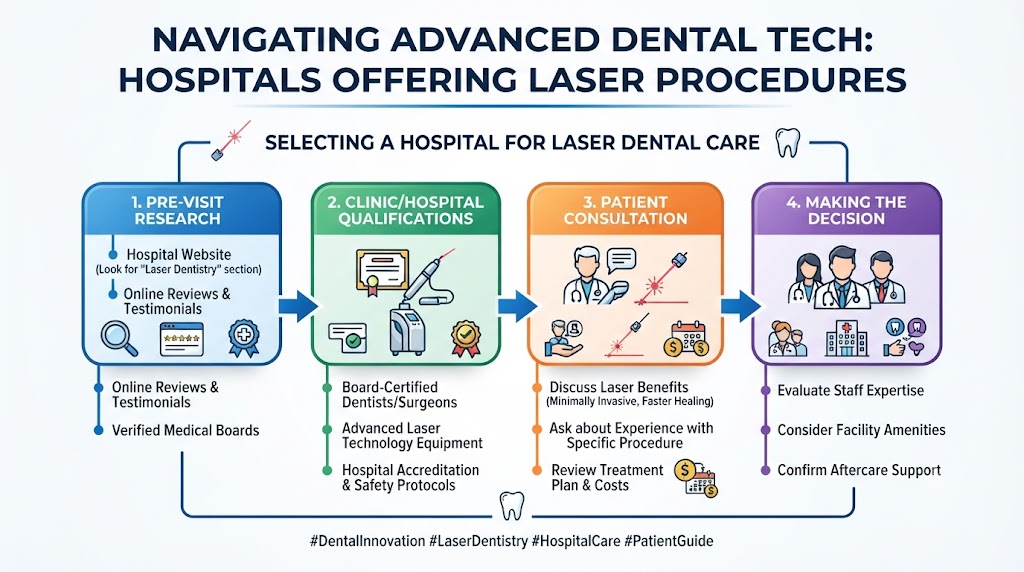
Most people; your dentist will decide. - How do I choose a hospital?
Look for advanced equipment and certified staff. - Does it bleed?
Significantly less than traditional surgery. - Is it noisy?
No, it removes the drill’s grinding sound. - Are results permanent?
Improvements in gum/bone are lasting. - Is insurance covered?
Depends on the specific procedure and provider. - Is it better than drills?
It is more precise, but drills are still needed for some tasks.
Final Thoughts
The integration of laser technology in dentistry has fundamentally changed the patient experience, offering precision and comfort that was once difficult to achieve. By seeking care at hospitals that prioritize this advanced technology, you ensure that your treatment plan is modern, safe, and effective.Remember that technology is a tool, and the skill of your dental provider remains the most important factor in your oral health outcome. We encourage you to visit BestDentalHospitals to find resources, compare advanced facilities, and continue your journey toward a healthier, more confident smile.