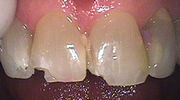
Overview
Teeth are remarkably strong, but they can still chip, crack or break. When a tooth is damaged it should be seen to promptly, because an untreated break can worsen, become infected, or in some cases lead to loss of the tooth. If the injury results from a significant trauma such as a fall or car accident, seek emergency care first and follow up with a dentist as soon as possible.
Causes
Damage can occur in several ways:
- Biting on hard food or objects
- Being hit in the face or mouth
- Falls and accidents
- Cavities that weaken the tooth from within
- Grinding or clenching
Symptoms
A chip or crack may be visible or felt as a rough edge with the tongue. Larger breaks can cause pain on biting, sensitivity to temperature, and sometimes swelling if the inner tooth is affected.
Treatment
Repair depends on the size and location of the damage. A very small chip can be smoothed by enamel shaping, while larger chips are often restored with bonding or a veneer. A chipped molar may be repaired with an onlay, and a crown is usually needed for a large fracture. If the nerve is involved, root canal treatment may be required, and a severely damaged tooth that cannot be saved may need extraction followed by a bridge or implant.