Introduction
A missing tooth can make eating, speaking, and smiling harder. A dental bridge can fill the empty space with an artificial tooth.A dental bridge uses nearby teeth or dental implants for support. It can help restore chewing and keep nearby teeth from moving into the gap.Choosing a qualified dentist and a suitable dental hospital also matters. Good care starts with a proper dental check and a clear treatment plan.BestDentalHospitals helps patients learn about dental bridge treatment and dental care options. Your dentist should always decide the right treatment after checking your mouth.
What Is a Dental Bridge?
A dental bridge replaces one or more missing teeth. It stays in place with support from nearby teeth or implants.The replacement tooth is called a false tooth. It fills the space left by the missing tooth.
The teeth beside the gap may support the bridge. In some cases, dental implants provide the support instead.A bridge can help you chew food more easily. It may also help with speech and the look of your smile.A dental bridge does not suit every person. Your dentist checks your teeth, gums, jaw, and the size of the gap first.Your oral health also affects treatment choices. Good planning helps the dentist choose a suitable restoration for your needs.
Who May Need a Dental Bridge?
A dentist may suggest a bridge when one or more teeth are missing. But not every missing tooth needs a bridge.A bridge may be considered when one tooth is missing. It may also help when several nearby teeth are missing.Some people have trouble chewing after losing teeth. Others notice changes in speech or feel less confident when smiling.Missing teeth can also leave open spaces between teeth. Nearby teeth may slowly move toward an empty space.Before treatment, the dentist checks the teeth around the gap. The dentist also checks the gums, jaw, bite, and overall mouth health.These checks help find safe treatment choices. For example, a person may need gum care before getting a dental restoration.
Types of Dental Bridges
There are several dental bridge types. Each type uses a different way to stay in place.
A traditional bridge uses nearby teeth for support. These teeth hold the bridge on both sides of the gap.
A cantilever bridge uses support from one side. It may suit some areas, but it does not fit every case.
A Maryland bridge uses a thin support attached behind nearby teeth. It can replace certain missing teeth with less tooth preparation.An implant-supported bridge uses dental implants for support. Implants are small supports placed in the jaw.The right choice depends on the missing teeth and nearby teeth. Gum health, bone support, bite, and overall oral health also matter.
| Bridge Type | Simple Explanation | Common Use |
|---|---|---|
| Traditional | Uses nearby teeth for support | Some gaps between healthy teeth |
| Cantilever | Uses support from one side | Selected cases |
| Maryland | Uses support attached behind nearby teeth | Some front teeth |
| Implant-supported | Uses dental implants for support | Some larger gaps |
How Dental Bridge Restoration Works
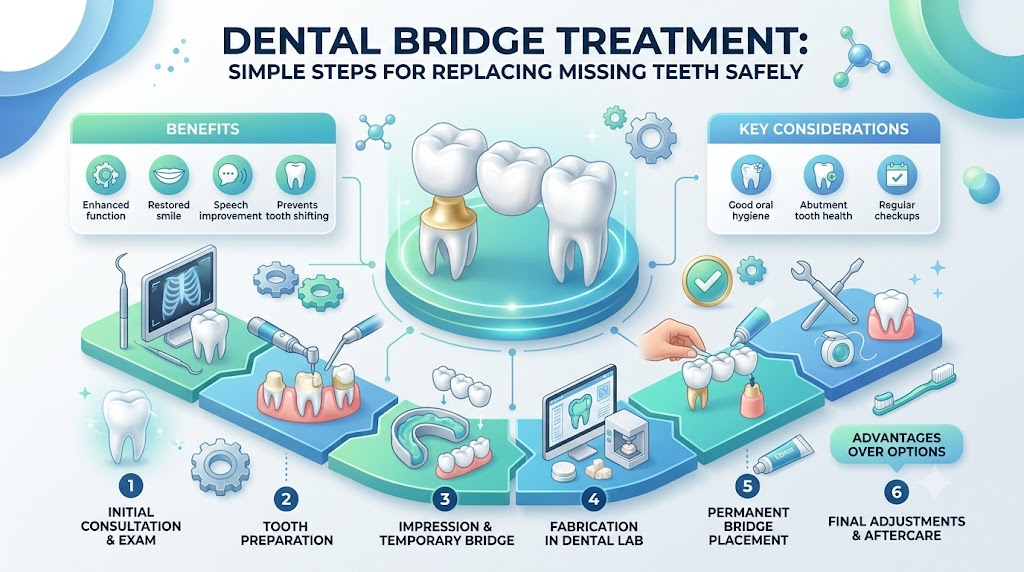
- Dental bridge restoration usually starts with a dental examination. The dentist checks your teeth, gums, bite, and missing tooth area.
- X-rays may be used when needed. They can help the dentist see areas below the gum line.
- Next, the dentist checks the teeth that may support the bridge. Some supporting teeth may need preparation.
- The dentist may take dental impressions or digital scans. These records show the shape of your mouth.
- They help the dental laboratory create a bridge that fits your mouth. The dentist may place a temporary bridge while the final one is made.
- At the next visit, the dentist checks the final bridge carefully. The dentist checks its fit, bite, shape, and comfort.
- If the bridge fits well, the dentist secures it in place. The exact steps can vary by bridge type and patient needs.
How to Choose a Dental Hospital
- Choosing a dental hospital or dental clinic needs careful thought. Start by checking the dentist’s qualifications and experience.
- Ask about experience with restorative dentistry. Restorative dentistry means dental care that repairs or replaces damaged or missing teeth.
- Clean treatment areas and good infection-control practices also matter. Ask how the facility keeps treatment areas clean and safe.
- Dental imaging can help with treatment planning. A suitable facility may also work with a dental laboratory.
- Modern dental tools may support careful planning. Still, technology should support good dental care rather than replace it.
- Also ask about follow-up care and clear costs. Good communication helps patients understand each step before treatment starts.
- Location and easy access can also matter. A nearby clinic may make follow-up visits easier.
Dentist and Specialist Experience
- Dentist experience can matter during dental bridge treatment. General dentists provide many types of restorative dental care.
- Some complex cases may need a prosthodontist. A prosthodontist is a dentist who focuses on replacing or repairing missing and damaged teeth.
- Your dentist can explain whether another dental specialist is needed. The decision depends on your mouth and treatment needs.
- Ask questions before starting treatment. You should understand the planned procedure, possible choices, and follow-up care.
- A clear discussion can also help you understand the expected costs. It gives you a chance to ask about concerns before treatment begins.
Dental Bridge Materials
Dental bridges can use different materials. Common choices include porcelain, ceramic, metal, porcelain-fused-to-metal, and zirconia.Porcelain and ceramic can have a natural tooth-like look. Metal can provide strong support in some situations.Porcelain-fused-to-metal combines a metal base with a tooth-colored outer layer. Zirconia is another material used for some dental restorations.The choice depends on several factors. These include tooth location, strength, appearance, bite, and oral health.Your dentist can explain the materials used for your bridge. The goal is to choose an option that fits your dental needs.
Dental Bridge Cost
Dental bridge cost can vary from person to person. The type of bridge is one factor that affects the total cost.The number of missing teeth can also affect the price. Material choice and dentist fees may change the total amount.Other costs may include X-rays, dental tests, and laboratory work. Extra dental treatment can also increase the total cost.Hospital or clinic charges may vary by location. Follow-up care may also be part of the overall treatment cost.Ask for a clear cost breakdown before treatment. This helps you understand what each charge covers.Do not choose treatment based on price alone. Also consider dentist experience, care quality, safety, and follow-up support.
Dental Bridge Recovery and Aftercare
- Most people need some time to get used to a new bridge. You may notice mild sensitivity or gum tenderness at first.
- These changes may improve as your mouth adjusts. Tell your dentist if discomfort is severe or does not improve.
- Daily cleaning is important after dental bridge treatment. Brush your teeth as directed and clean around the bridge.
- You also need to clean under the bridge. Your dentist can show you safe ways to clean this area.
- Regular dental visits help your dentist check the bridge and nearby teeth. Good oral care can help protect the restoration for longer.
- Avoid habits that may damage the bridge. For example, do not use your teeth to open packages or bite very hard objects.
Dental Bridge vs Other Options
- Dental bridges are one option for replacing missing teeth. Other choices include dental implants and partial dentures.
- A dental implant uses a small support placed in the jaw. It can support a replacement tooth or bridge.
- A partial denture is a removable appliance that replaces several missing teeth. You can take it out for cleaning.
- A bridge stays in place and uses nearby teeth or implants for support. Each choice has different care needs, costs, benefits, and limits.
- Your dentist can compare suitable options with you. The right choice depends on your oral health, missing teeth, and personal needs.
Frequently Asked Questions About Dental Bridge Restoration
1. What is a dental bridge?
A dental bridge replaces one or more missing teeth. It uses nearby teeth or implants for support.
2. Why might someone need a dental bridge?
A bridge can fill a tooth gap. It may also support chewing, speech, and the look of your smile.
3. What types of dental bridges are available?
Common types include traditional, cantilever, Maryland, and implant-supported bridges. Your dentist can explain which types may suit your case.
4. How does dental bridge treatment work?
The dentist checks your mouth first. Then, the bridge is planned, made, checked, and secured in place.
5. Is getting a dental bridge painful?
Some patients may have mild discomfort or sensitivity. Your dentist can explain what to expect during and after treatment.
6. How long does dental bridge treatment take?
Treatment time varies by bridge type and dental needs. Some cases need more than one dental visit.
7. How should a dental bridge be cleaned?
Brush your teeth regularly as advised by your dentist. Also clean around and under the bridge.
8. How long can a dental bridge last?
A bridge can last for many years with proper care. Its lifespan varies with oral health, use, and daily cleaning.
9. What affects dental bridge cost?
Cost can depend on the bridge type, material, dentist fees, and laboratory work. Extra dental treatment can also affect the total.
10. When should someone contact a dentist about a bridge?
Contact a dentist if you have a missing tooth or trouble chewing. Also seek care if an existing bridge feels loose or damaged.
Final Thoughts
Dental bridge treatment can replace missing teeth and support daily mouth function. The process starts with a dental check and clear treatment planning.Different bridge types and materials suit different dental needs. Cost also depends on the procedure, materials, and other care.Daily cleaning and regular dental visits help protect your dental restoration. Always speak with a qualified dentist before choosing treatment.Ask questions about the procedure, costs, care, and other options. A clear plan can help you feel more prepared and confident about your dental care.