
Introduction
Engineering teams often lose hours each day to repetitive server setup and delayed code releases. Manual checklists slow down updates, while IT staff look for clear career paths in automation. Understanding what is NoOps gives teams a practical way to handle routine operations work.
NoOpsSchool is a specialized IT education, certification, and consulting platform focused on cloud infrastructure automation. It serves an international English-speaking technical audience through online training and professional services.
Joining a structured NoOps training course helps technical staff learn modern automation habits. These skills reduce manual toil while keeping skilled people in charge of critical decisions.
What Is NoOps?
Learning what is NoOps starts with seeing how software tools automate routine IT work. NoOps stands for No Operations. It uses automated workflows to handle server setup, deployments, and basic system recovery.
For example, serverless computing runs code without manual server care. Self-healing systems can also restart common failed services automatically.
Still, knowing what is NoOps requires realistic expectations. NoOps does not remove operations teams or replace human judgment. Engineers still design systems, review security rules, and solve complex outages.
Why This Matters for IT Teams and Careers
Manual server chores delay releases and create easy mistakes. When teams automate common steps, updates move faster and stay more consistent.
For IT staff, understanding what is NoOps opens practical career paths. Companies value engineers who can turn repetitive manual tasks into reliable code. Developers, administrators, and platform engineers all gain useful skills here.
At the same time, automation brings new risks if teams rush. A flawed script can spread errors fast without review. Skilled people remain vital for governing systems and handling unusual problems.
NoOps vs DevOps: How Both Approaches Fit Together
Many engineers compare NoOps vs DevOps when planning their next career step. DevOps brings developers and operations staff together to share goals, feedback, and daily work.
When looking at NoOps vs DevOps, think of NoOps as deeper automation built on DevOps habits. DevOps improves team collaboration and shared ownership. NoOps automates routine infrastructure requests so developers wait less on manual tickets.
Even so, NoOps vs DevOps is not about replacing people or teamwork. DevOps practices like clear communication and shared security care still matter. Teams still work together closely when complex issues appear.
NoOps Automation Tools
Picking the right NoOps automation tools helps teams replace slow manual steps with code. These tools cover different parts of software delivery and system care.
- Infrastructure as code (IaC): IaC defines servers and networks in text files instead of manual clicks. Terraform is a common example that builds cloud resources from code.
- Containers and orchestration: Containers package software so it runs cleanly across environments. Docker builds containers, while Kubernetes manages and scales them across servers.
- CI/CD: Continuous Integration and Continuous Delivery (CI/CD) pipelines test and ship code automatically. Automated checks catch errors before changes reach users.
- GitOps: GitOps keeps infrastructure definitions in a code repository as the source of truth. Changes in the repository trigger automated updates to live systems.
- Observability: Observability collects logs, metrics, and traces to show internal system health. Engineers use this data to spot slowdowns and errors early.
- AIOps: Artificial Intelligence for IT Operations (AIOps) applies machine learning to system data. It helps teams group noisy alerts and spot common patterns faster.
Using NoOps automation tools safely requires clear rules and human review. Tools like Terraform, Docker, and Kubernetes still need careful setup. Training staff on NoOps automation tools prevents mistakes and keeps systems safe.
NoOps Certification: What to Look For
A NoOps certification shows that you understand core concepts in cloud automation and delivery. A strong credential checks how well you connect infrastructure, pipelines, and monitoring.
Before picking any NoOps certification, check the syllabus for real technical depth. Look for coverage of infrastructure as code, CI/CD, observability, and security automation. Hands-on practice matters most because theory alone cannot prepare you for real systems.
Make sure the NoOps certification matches your role and career goals. Details vary by program, so check the provider’s current details before enrolling. A NoOps certification supports your learning path, though real practice builds lasting skill.
NoOps Engineer Certification
Builders who write scripts and run pipelines often target a NoOps engineer certification. This role focuses on building and running automated cloud systems day to day.
A practical NoOps engineer certification covers infrastructure as code, CI/CD workflows, and observability setup. Learners also practice writing self-healing rules for common errors and adding security checks.
Earning a NoOps engineer certification helps administrators shift toward cloud automation roles. However, automation never removes personal accountability. Engineers still review changes and solve complex incidents when automated fixes fall short.
NoOps Architect Training
Senior engineers who design large systems benefit from NoOps architect training. Architects plan how cloud services, networks, and automated workflows fit together cleanly.
Good NoOps architect training covers cloud-native design, serverless patterns, and multi-cloud planning. Architects balance delivery speed, reliability, and cost while setting clear technical standards.
Completing NoOps architect training prepares experienced staff to guide big platform changes. Architects must build human oversight and security checks into every design. Automated systems still need regular human review to stay safe.
NoOps Manager Certification
Leaders who guide teams and budgets can pursue a NoOps manager certification. This role focuses on planning, people, process, risk, and measuring outcomes.
A useful NoOps manager certification helps leaders spot manual bottlenecks and plan staff training. Managers track delivery progress fairly while keeping clear accountability across the team.
Earning a NoOps manager certification helps leads guide NoOps vs DevOps shifts smoothly. Good managers set realistic goals and protect team time for careful reviews.
NoOps Training Course
Choosing a structured NoOps training course makes complex automation topics easier to learn. Look for clear lessons that build skills step by step without confusion.
A strong NoOps training course offers hands-on labs with real-world automation scenarios. Practicing in safe lab environments builds confidence before touching production systems. Good learner support also helps when you hit tricky errors.
On NoOpsSchool.com, the site advertises courses covering infrastructure as code, Kubernetes, Docker, and Terraform. Their catalog also includes GitOps, CI/CD automation, serverless architecture, observability, and AI-powered operations. Taking a NoOps training course gives you a guided path through these tools.
NoOps Consulting Services
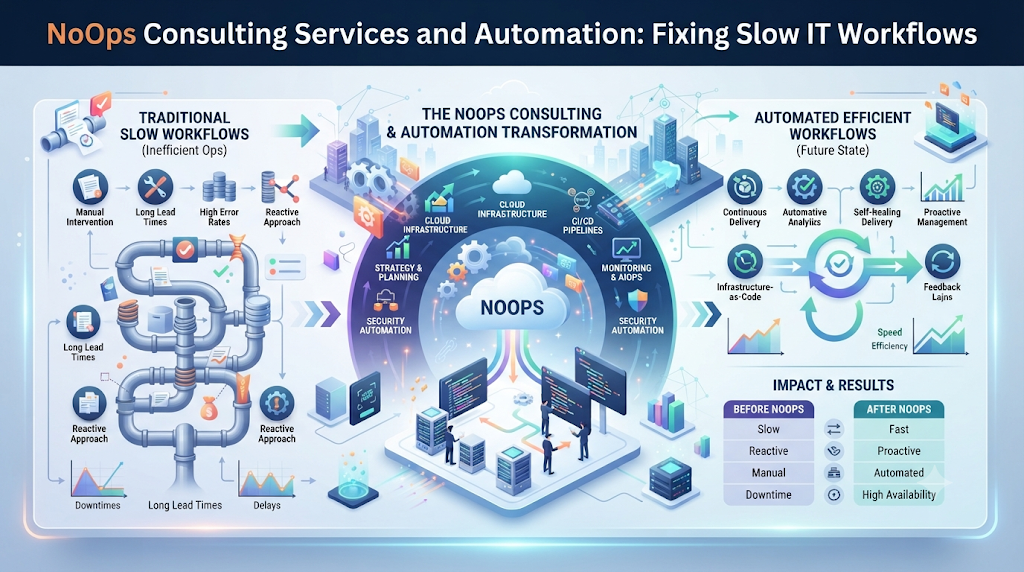
Some organizations need outside help to plan or start automation work. In those cases, NoOps consulting services offer structured guidance from experienced specialists.
Typically, NoOps consulting services cover operational assessments, automation strategy, and cloud-native modernization. They can also support infrastructure provisioning, CI/CD implementation, AIOps integration, and security automation.
NoOpsSchool.com advertises NoOps consulting services for organizations working to cut manual operations effort. Results depend on the organization and its current setup. Internal teams still run, monitor, and govern systems after outside work wraps up.
How to Hire NoOps Freelancers
Teams with short-term projects sometimes choose to hire NoOps freelancers for focused help. Independent specialists can build specific pipelines or set up monitoring on tight timelines.
Before you hire NoOps freelancers, check their relevant skills, past work, and communication style. Set a clear scope so everyone knows what tasks are included.
NoOpsSchool.com offers access to freelancers with skills in Terraform, Kubernetes, cloud platforms, automated monitoring, and self-healing systems. When you hire NoOps freelancers, make sure your team gets clear documentation for long-term care.
Table: NoOps Learning and Service Options at a Glance
| Option | What It Covers | Who It Helps |
| NoOps training course | Hands-on labs in IaC, CI/CD, GitOps, Kubernetes, and observability | Beginners and IT staff learning automation basics |
| NoOps engineer certification | Building and running automated pipelines and self-healing setups | System administrators, developers, and DevOps engineers |
| NoOps architect training | Designing automated, resilient cloud systems and platform standards | Senior engineers and cloud architects |
| NoOps manager certification | Planning, people, process, risk, and measuring outcomes | IT managers, team leads, and delivery leaders |
| NoOps consulting services | Assessments, strategy, modernization, CI/CD, AIOps, and security automation | Organizations needing outside guidance for automation projects |
| Hire NoOps freelancers | Focused project work in Terraform, Kubernetes, monitoring, and self-healing | Teams needing short-term specialist support |
Common Mistakes Learners and Teams Make
Avoiding simple mistakes saves time and keeps automation projects steady. Watch out for these common pitfalls:
- Treating NoOps as “no people”: Assuming automation removes human roles creates blind spots and weak oversight.
- Automating without observability: Shipping fast changes without logs, metrics, and traces hides real issues.
- Skipping security automation: Leaving security checks out lets risky changes reach production quickly.
- Learning tools without hands-on practice: Reading slides without building labs leaves you unprepared for real setups.
- Ignoring team skills: Buying NoOps automation tools without staff training leads to poor configuration.
- Chasing a NoOps certification without a plan: Picking credentials without role goals wastes study time.
- Automating broken processes: Turning messy manual habits into code simply repeats bad workflows faster.
- Expecting self-healing to fix everything: Automated recovery handles common, known problems, not every failure.
A Simple Example
Consider a fictional logistics app team called CargoBridge Systems. Their four system administrators spent hours each week setting up test servers by hand. Software releases took two weeks because every step required manual checks.
The engineering manager looked into what is NoOps to ease this manual load. First, the team enrolled in online training at NoOpsSchool.com to learn infrastructure as code. They practiced writing Terraform scripts and setting up basic CI/CD steps in hands-on labs.
Next, the team used GitOps workflows to provision test environments from code changes. They also set up observability dashboards to watch service health and spot common errors early.
Soon, test environments spun up with less manual ticket work. Administrators spent more time reviewing security and improving system design. Engineers still checked code changes and handled complex alerts personally.
How NoOpsSchool Can Help
NoOpsSchool.com is a specialized IT education, certification, and consulting platform focused on cloud infrastructure automation. The site advertises learning programs and certification tracks for NoOps Engineers, NoOps Architects, NoOps Managers, and NoOps Professionals.
Course topics include infrastructure as code, cloud-native computing, Kubernetes, Docker, and Terraform. Learners can also study GitOps, CI/CD automation, serverless architecture, observability, and AI-powered operations. Programs emphasize hands-on labs, real-world automation scenarios, self-healing infrastructure, and automated incident response.
In addition, NoOpsSchool.com advertises NoOps consulting services for operational assessments, automation strategy, and cloud-native modernization. The site also lists infrastructure provisioning, CI/CD implementation, AIOps integration, and security automation. Finally, the platform offers access to freelancers with skills in Terraform, Kubernetes, cloud platforms, automated monitoring, and self-healing systems.
Frequently Asked Questions About NoOps Consulting and Automation
1. How does understanding what is NoOps help teams plan gradual automation?
Learning what is NoOps helps teams spot repetitive tasks that software can automate safely. Engineers start with small steps like automated builds and basic recovery scripts. Skilled staff still design workflows, review security rules, and oversee live systems.
2. Why do teams compare NoOps vs DevOps before changing release habits?
Comparing NoOps vs DevOps helps teams see how collaboration and automation fit together. DevOps builds shared habits between developers and operations staff. NoOps adds deeper automation for routine steps while keeping team ownership and human oversight strong.
3. How do teams keep NoOps automation tools organized across projects?
Teams keep NoOps automation tools organized by using shared templates, version control, and clear naming rules. Tools like Terraform and Kubernetes work better when changes follow a standard review process. Human engineers still test updates and watch system alerts.
4. What should beginners expect in a NoOps training course?
A NoOps training course guides learners through core cloud tools using structured lessons and hands-on labs. Practicing real automation scenarios builds skill step by step. Details vary by program, so check the provider’s current details before enrolling.
5. How does a NoOps certification help show practical study progress?
A NoOps certification shows that you have studied automation workflows, infrastructure as code, and delivery pipelines. Pair your certification study with hands-on labs to show real skill. Always check the provider’s current details for program scope.
6. What technical areas are central to a NoOps engineer certification?
A NoOps engineer certification centers on building and running automated cloud systems. Engineers work with infrastructure as code, CI/CD pipelines, and observability tools. They also build self-healing scripts for common issues while keeping strong security care.
7. How does NoOps architect training support resilient system design?
NoOps architect training helps senior staff design automated, resilient cloud systems and plan how pieces fit together. Architects shape serverless setups, container platforms, and security rules. Human review remains essential so designs stay safe as needs change.
8. How does a NoOps manager certification help leaders manage risk and people?
A NoOps manager certification focuses on planning, people, process, risk, and measuring outcomes. Managers guide staff training, track delivery health, and keep clear accountability. This helps teams adopt automation without losing oversight.
9. When should a business use NoOps consulting services or hire NoOps freelancers?
Organizations use NoOps consulting services for operational assessments, automation strategy, or cloud modernization planning. Teams hire NoOps freelancers for short-term project work, such as Terraform modules, Kubernetes setups, or monitoring tasks.
10. What does NoOpsSchool.com offer for learners and organizations?
NoOpsSchool.com advertises online courses and certification tracks for NoOps Engineers, Architects, Managers, and Professionals. The site also advertises consulting services for cloud automation and offers access to skilled freelancers. Check the provider’s current details for exact offerings.
Final Thoughts
Understanding what is NoOps gives IT teams and professionals a clear way to cut manual work. Using NoOps automation tools, CI/CD pipelines, and observability helps teams ship software faster and more steadily.
Still, automation never removes human oversight, security duties, or skilled people. Engineers, architects, and managers must always design systems, review changes, and solve complex incidents. Whether you take a NoOps training course, pursue a certification, or explore consulting, steady practice builds real skill.