
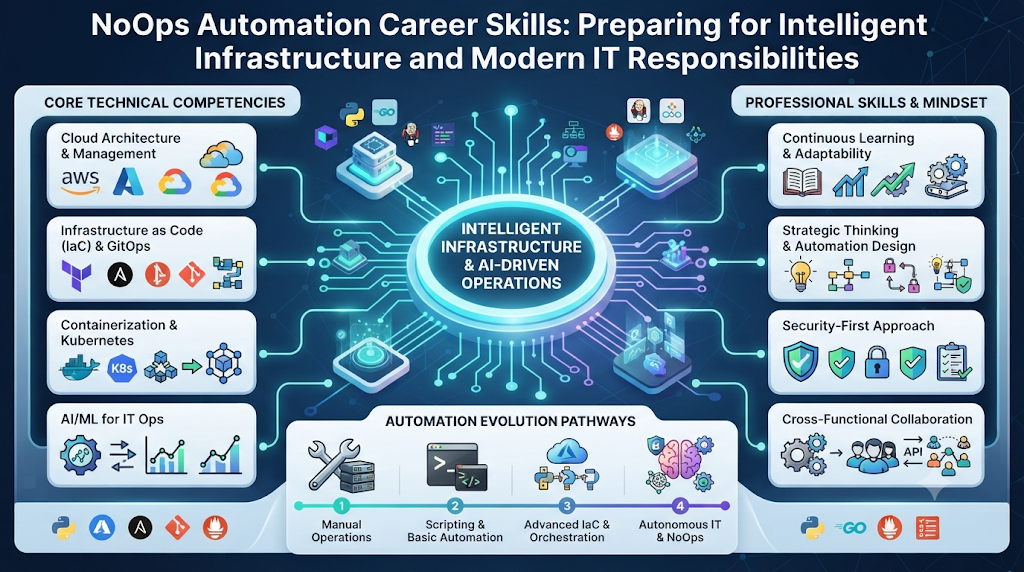
Introduction
Technology teams handle many connected responsibilities, including infrastructure setup, application releases, system checks, and service recovery. When every activity requires a person to complete each step, routine work can take valuable time away from more complex tasks. NoOps explores how suitable operational activities can be handled through automation and managed technology services. It encourages professionals to build systems that follow clear instructions, repeat approved processes, and report problems when attention is needed. This approach requires knowledge of cloud platforms, infrastructure design, software delivery, security, and monitoring. It also requires people who can judge when automation is appropriate. NoOpsSchool focuses on NoOps education, certification learning, and related professional services for individuals and organisations developing these capabilities.
Understanding the NoOps Approach
NoOps is an automation-focused approach to managing technology environments. It aims to reduce routine manual operational work by using automated workflows, cloud services, standard configurations, and monitoring systems.
An automated process may create a development environment, deploy an approved application update, or respond to a familiar service problem. These activities can become more consistent when their instructions are designed and tested properly.
However, NoOps does not mean that technical operations become unnecessary. People must still make architecture decisions, protect systems, review important changes, and investigate situations that automated processes cannot handle.
What is NoOps?
The phrase what is NoOps describes the basic idea of using automation to handle suitable IT operations activities with less repeated human intervention. It helps explain how infrastructure and applications can follow predefined workflows while remaining under professional supervision.
Learning what is NoOps also involves understanding the responsibilities that remain with people. Engineers and other specialists design workflows, check their results, manage security, and improve systems when requirements change.
Key ideas behind NoOps
- Automation: Use scripts and platforms to perform repeatable technical activities.
- Standardisation: Apply consistent configurations across development, testing, and production environments.
- Managed services: Use cloud capabilities that reduce the need to manage certain infrastructure components directly.
- Observability: Collect information that helps teams understand application and infrastructure behaviour.
- Human oversight: Review critical changes and handle unusual technical or business situations.
NoOpsSchool.com advertises learning tracks for NoOps Engineers, NoOps Architects, NoOps Managers, and NoOps Professionals. These tracks address different areas of responsibility within automation-focused environments.
Why NoOps Skills Matter in Professional Development
Automation knowledge can help IT professionals work with larger and more connected technology environments. It can also improve their ability to identify unnecessary manual steps and suggest safer, more repeatable processes.
For example, an engineer who understands infrastructure as code can help a team create consistent environments. A professional with monitoring knowledge can help identify service problems before they affect more users.
NoOps-related knowledge can support several career areas:
- Cloud engineering: Learn how to configure and manage cloud resources.
- Infrastructure automation: Develop reusable scripts and configuration files.
- Platform engineering: Understand how internal platforms can support development teams.
- Reliability engineering: Study monitoring, recovery, and service performance.
- Technical management: Learn how to plan automation work and coordinate different specialists.
Career development should include more than course completion. Professionals should practise technical tasks, document their work, and understand the consequences of incorrect automation.
NoOps vs DevOps: Comparing Two Related Approaches
NoOps vs DevOps is a useful comparison for understanding how automation fits into software development and IT operations.
DevOps promotes cooperation between development and operations teams. It encourages shared responsibility, continuous delivery, feedback, and automation across the software lifecycle.
NoOps gives more attention to reducing routine operational work through automated processes, managed services, and standardised infrastructure.
How their priorities differ
| Comparison Area | DevOps | NoOps |
|---|---|---|
| Main priority | Cooperation across development and operations | Less manual effort in suitable operational tasks |
| Working approach | Shared team responsibilities | Automated workflows with human supervision |
| Common activities | Testing, integration, deployment, feedback | Automated provisioning, monitoring, and recovery |
| Human contribution | Collaboration and shared ownership | Design, governance, review, and exception handling |
The NoOps vs DevOps comparison does not mean that organisations must abandon one approach to adopt the other. DevOps practices can continue while teams automate more routine infrastructure and operational activities.
Understanding NoOps vs DevOps helps professionals discuss the purpose of automation without confusing it with the removal of technical responsibilities. The best approach depends on the organisation’s systems, risk level, delivery needs, and available skills.
NoOps Automation Tools for Infrastructure and Service Management
NoOps automation tools are technologies that help teams manage infrastructure, application delivery, configuration, monitoring, and selected recovery tasks. They allow professionals to create repeatable workflows and reduce the need for manual intervention in routine activities.
A learner should understand what each category does and how different tools work together.
Infrastructure as code
Infrastructure as code describes technical resources through files that can be reviewed and reused. Terraform is commonly associated with this area.
Learners can practise defining resources, checking proposed changes, and updating environments through controlled workflows.
Container platforms
Docker packages an application and its dependencies into a container. Kubernetes helps manage containerised workloads across a cluster.
These technologies help professionals understand application deployment and orchestration in modern environments.
CI/CD platforms
CI/CD tools support automated software delivery. They can run builds, execute tests, and prepare releases according to defined rules.
A useful learning exercise is to create a pipeline that stops when a required test fails.
GitOps tools
GitOps uses version-controlled configuration to manage changes in an environment. Teams can review updates and use automation to apply approved configurations.
Observability platforms
Observability combines information such as logs, metrics, and traces. These signals help engineers investigate performance issues and understand what is happening inside an application.
Serverless and AI-supported services
Serverless computing allows developers to run code without directly managing every underlying server. AI-supported operations can help analyse operational information, but people must evaluate important recommendations.
Learning NoOps automation tools should include safe configuration, testing, documentation, and troubleshooting. NoOpsSchool.com advertises learning topics such as infrastructure as code, Kubernetes, Docker, Terraform, GitOps, CI/CD, serverless, observability, and AI-powered operations.
NoOps Certification: Evaluating Learning Quality
NoOps certification refers to a credential connected with learning about automation-focused IT operations. Its content may differ between programmes, so learners should examine the learning objectives and assessment details before choosing one.
A useful NoOps certification should explain the technical subjects covered and the skills a learner is expected to develop. Practical activities can help connect the course material with real technical responsibilities.
What to check before enrolling
- Technical coverage: Does the syllabus include cloud infrastructure, automation, and monitoring?
- Security knowledge: Does it explain access controls and safe configuration?
- Practical learning: Are there exercises for applying the concepts?
- Assessment information: Is it clear how learning is evaluated?
- Professional relevance: Does the content match your current experience and future goals?
A NoOps certification can provide a structured learning target and evidence of completing a programme. It should not be treated as proof of every technical ability or a guarantee of employment.
People comparing a NoOps certification should check the course details instead of judging only by the certificate title. NoOpsSchool.com focuses on NoOps education and certification learning, with advertised tracks for different professional roles.
NoOps Engineer Certification: Learning to Build Automated Systems
NoOps engineer certification is a learning route for professionals who want to develop technical knowledge of automated infrastructure and application operations. It can cover resource provisioning, deployment, monitoring, containers, and cloud platforms.
The purpose of NoOps engineer certification is to help learners understand how separate technologies support a complete automated environment.
Skills to develop
Cloud resource management
Learn how to create and configure resources while understanding network settings, permissions, and resource limits.
Configuration automation
Practise writing reusable files that describe the required infrastructure state. Learn how to review changes before applying them.
Software delivery
Build a basic pipeline that checks application code and prepares a release. Understand how failed tests affect the workflow.
Container deployment
Study how applications are packaged and how container workloads are managed.
Monitoring and troubleshooting
Learn to read logs, review metrics, and investigate alerts. Practise identifying whether a problem is suitable for automated recovery.
Security awareness
Understand how credentials, service permissions, and configuration settings affect system safety.
Learners working towards NoOps engineer certification can create a project that provisions a test environment, deploys a sample application, and collects monitoring information. Documenting each step can help show how the different skills connect.
The value of NoOps engineer certification depends on the quality of the learning and the ability to apply it. Practical experience and problem-solving remain important parts of professional development.
NoOps Architect Training: Designing Reliable Automated Infrastructure
NoOps architect training helps professionals understand how to design technology environments that use automation effectively. It focuses on relationships between infrastructure, applications, cloud services, security, and monitoring.
A strong NoOps architect training plan should teach learners to evaluate technical choices rather than simply follow tool instructions.
Architecture knowledge areas
- System structure: Understand how application components and infrastructure services connect.
- Capacity planning: Consider how resources should respond to changing workloads.
- Reliability design: Identify possible failures and prepare suitable recovery methods.
- Security planning: Apply identity controls, network protection, and secure configurations.
- Automation patterns: Design reusable methods for provisioning and deployment.
- Cost awareness: Understand how infrastructure choices affect ongoing expenses.
Practical NoOps architect training can include a design exercise where learners prepare an architecture for an application, explain their service choices, and identify possible risks.
Architects should also understand when automated actions need approval. A workflow that changes an important production system may require testing and human review.
Professionals considering NoOps architect training should look for topics that develop design judgement, documentation, and communication skills alongside technical knowledge.
NoOps Manager Certification: Understanding Leadership Responsibilities
NoOps manager certification is intended for professionals who oversee technical teams, automation programmes, or operational improvement work. It focuses on how to plan, coordinate, and evaluate automation initiatives.
A NoOps manager certification path should connect technical concepts with team responsibilities and organisational goals.
Management skills to understand
Process evaluation
Identify activities that are repeated frequently and may be suitable for automation. Consider whether the process is stable enough to automate.
Project planning
Set clear priorities, milestones, and responsibilities. Select work based on its value, complexity, and risk.
Team communication
Help developers, infrastructure engineers, security specialists, and business teams understand their roles.
Risk control
Make sure important workflows include suitable testing, permissions, and approval procedures.
Performance review
Use service information and project results to understand whether automation is improving the process.
Ongoing improvement
Review feedback, investigate recurring problems, and update workflows when systems or requirements change.
Professionals exploring NoOps manager certification should check whether the programme covers both leadership and technical foundations. A manager needs enough technical understanding to ask useful questions and evaluate project risks.
A NoOps manager certification may support professional learning, but it cannot promise a promotion, management role, or employer recognition.
NoOps Training Course: Creating a Practical Study Plan
A NoOps training course provides a planned way to study the concepts and technologies behind automated IT operations. It can help learners move from basic understanding to practical exercises.
An effective NoOps training course should include explanations, demonstrations, hands-on tasks, and opportunities to review mistakes.
A progressive learning route
Foundation stage
Study cloud computing, networking, operating systems, and basic scripting. These subjects help learners understand the environment where automation runs.
Infrastructure stage
Explore infrastructure as code and practise creating a small test environment.
Application stage
Learn about containers and automated application delivery.
Monitoring stage
Configure basic metrics, logs, and alerts. Understand how to identify service issues.
Security stage
Study permissions, credentials, and configuration checks.
Project stage
Combine the skills in a practical exercise and document how the environment is created, updated, and monitored.
Before selecting a NoOps training course, review the expected experience level and the subjects included. A beginner may need foundational lessons, while an experienced engineer may prefer more advanced infrastructure and architecture exercises.
NoOpsSchool.com advertises learning tracks for engineers, architects, managers, and other NoOps professionals. Its listed topics include Terraform, Kubernetes, Docker, GitOps, CI/CD, serverless, and observability.
NoOps Consulting Services: Finding the Right Automation Opportunities
NoOps consulting services can help an organisation review how it manages infrastructure and delivers technology services. The work may involve identifying repeated manual tasks, examining existing workflows, and planning improvements.
The purpose of NoOps consulting services should be to solve defined operational problems and help the organisation make informed technical decisions.
Areas of support
- Operational assessments: Review current activities and identify possible improvements.
- Automation strategy: Plan which processes should be automated and how they will be evaluated.
- Cloud-native modernisation: Examine opportunities to improve applications and infrastructure through cloud-native methods.
- Infrastructure provisioning: Improve the process of creating and configuring environments.
- CI/CD implementation: Establish workflows for building, testing, and releasing applications.
- AIOps integration: Explore AI-supported analysis of operational information.
- Security automation: Introduce suitable automated security checks and configuration controls.
NoOpsSchool.com advertises NoOps consulting services across these areas, including operational assessments, automation strategy, cloud-native modernisation, infrastructure provisioning, CI/CD implementation, AIOps integration, and security automation.
Before engaging NoOps consulting services, an organisation should describe its current environment, technical challenges, security requirements, and expected outcomes. It should also decide who will maintain the resulting workflows.
A consulting recommendation should be realistic about cost, complexity, and operational risk. Automation is useful when it improves a process without creating unnecessary maintenance work.
How to Hire NoOps Freelancers for Defined Technical Work
Organisations sometimes need specialist help for a particular automation task or a limited project. They may choose to hire NoOps freelancers when they need skills that are not currently available within their own team.
The decision to hire NoOps freelancers should begin with a clear project scope and a list of required technical abilities.
Steps for making a suitable choice
1. Explain the project
Describe the current system, the problem, and the expected outcome. Include any technical or security restrictions.
2. List the necessary skills
Identify whether the work requires Terraform, Kubernetes, cloud platforms, automated monitoring, or self-healing systems.
3. Review relevant experience
Ask candidates to explain projects they have worked on and the tasks they personally completed.
4. Discuss access and security
Agree on permissions, credential handling, data protection, and production access.
5. Define deliverables
Set clear expectations for configurations, scripts, testing, documentation, and handover.
6. Plan ongoing maintenance
Decide who will review and update the work after the assignment ends.
When businesses hire NoOps freelancers, they should check more than tool knowledge. Communication, documentation, testing habits, and understanding of system risks are also important.
NoOpsSchool advertises access to freelancers with skills in Terraform, Kubernetes, cloud platforms, automated monitoring, and self-healing systems. Businesses should review individual experience and confirm project arrangements before proceeding.
Table: NoOps Learning and Service Options at a Glance
| Option | What It Covers | Who It Helps |
|---|---|---|
| NoOps certification | Structured study of automation-focused operations | Learners building foundational knowledge |
| NoOps engineer certification | Cloud infrastructure, provisioning, and deployment | Technical engineers |
| NoOps architect training | Architecture, reliability, security, and system planning | Architects and senior professionals |
| NoOps manager certification | Automation planning, governance, and team coordination | Managers and technical leads |
| NoOps training course | Guided lessons and hands-on technical exercises | Beginners and experienced IT workers |
| NoOps consulting services | Assessments, strategy, and automation implementation areas | Organisations reviewing their processes |
| Hire NoOps freelancers | Specialist help with selected infrastructure tasks | Teams needing project-based support |
Common Mistakes in NoOps Learning and Implementation
Automation projects can become difficult when teams ignore the planning and maintenance needed to keep workflows reliable. These mistakes are worth avoiding:
- Assuming every task should be automated: Some activities need human judgement or are too unusual to justify automation.
- Starting without a clear objective: Teams should identify the problem before selecting a platform or writing scripts.
- Ignoring basic infrastructure knowledge: Automation cannot replace an understanding of networking, operating systems, and cloud services.
- Using untested configurations: A small error in a reusable workflow may affect several environments.
- Giving automation excessive permissions: Workflows should receive only the access they need.
- Treating alerts as complete incident management: Alerts provide information, but investigation and decisions may still be necessary.
- Learning only through demonstrations: Learners need to create, test, and troubleshoot their own workflows.
- Overlooking documentation: Technical processes should be understandable to the people who maintain them.
- Expecting a certificate to prove experience: Practical ability must be developed and demonstrated separately.
- Forgetting future changes: Automation needs regular reviews as applications, cloud services, and security requirements evolve.
A Simple Example
Consider a fictional organisation called TerraGauge Labs, which provides equipment tracking services for environmental field research teams. Its platform receives information from monitoring devices and makes the collected data available through a web application.
The technical team needs to maintain separate development and testing environments. It also has to deploy application updates and check whether the platform is responding correctly.
The team begins by defining its infrastructure in reusable configuration files. It creates a workflow that prepares test environments when needed. A deployment pipeline runs checks before an application update is released.
Monitoring tools collect application and infrastructure information. The team also configures an automated response for a known service issue, while unusual data or system failures are sent to engineers for investigation.
The manager reviews the process and confirms that access permissions, documentation, and change approvals are clear. The team records how to update and maintain each workflow.
This fictional example shows how automation can support a technical service without removing human responsibility. It also provides a practical learning scenario for studying infrastructure, deployment, monitoring, and security.
How NoOpsSchool Can Help
NoOpsSchool focuses on NoOps education, certification learning, and related professional services. Its advertised learning tracks include NoOps Engineers, NoOps Architects, NoOps Managers, and NoOps Professionals.
The site lists learning subjects such as infrastructure as code, cloud-native computing, Kubernetes, Docker, Terraform, GitOps, CI/CD, serverless, observability, and AI-powered operations. It also advertises hands-on labs and real-world automation scenarios involving self-healing infrastructure and automated incident response.
For organisations, the advertised service areas include operational assessments, automation strategy, cloud-native modernisation, infrastructure provisioning, CI/CD implementation, AIOps integration, and security automation. The platform also offers access to freelancers with selected automation and infrastructure skills.
People interested in these options should review the current programme and service information before deciding whether it meets their needs.
Frequently Asked Questions About NoOps Automation Skills and Professional Development
1. What basic subjects should someone study before learning NoOps?
Start with operating systems, networking, cloud computing, and basic scripting. These subjects make it easier to understand where automated workflows operate. Learning what is NoOps then helps connect those foundations with infrastructure provisioning, deployment, monitoring, and human oversight.
2. How can a learner judge whether NoOps certification content is practical?
Check whether the NoOps certification includes exercises that require learners to configure resources, test workflows, or investigate errors. Clear learning objectives and practical assessments are useful signs. Also review whether the topics match the technical responsibilities you want to develop.
3. What should an engineer include in a portfolio alongside NoOps engineer certification?
A portfolio can include an infrastructure configuration, a sample deployment pipeline, monitoring setup, and project documentation. NoOps engineer certification may support structured learning, while a portfolio gives people an opportunity to explain how they applied their knowledge.
4. Does NoOps architect training cover security and reliability decisions?
A suitable NoOps architect training path should consider security, access management, reliability, scalability, and recovery planning. These topics help architects understand the wider effects of infrastructure choices. Learners should check the actual syllabus to confirm the depth of coverage.
5. Can NoOps manager certification help a non-technical project manager?
It may help a project manager understand automation concepts, technical responsibilities, and operational risks. NoOps manager certification is most useful when its content matches the person’s role and provides enough technical context to support communication with engineering teams.
6. How much practical work should a NoOps training course include?
A NoOps training course should provide opportunities to apply its lessons through configuration, deployment, monitoring, and troubleshooting exercises. The exact amount depends on the course design, but learners should have a chance to practise rather than only read about technical concepts.
7. What should a team discuss before combining NoOps vs DevOps practices?
When reviewing NoOps vs DevOps, teams should discuss existing responsibilities, delivery processes, security requirements, and suitable automation opportunities. They should also decide which tasks require human approval. Clear ownership helps both approaches work together without creating gaps in accountability.
8. How can an organisation measure the value of NoOps consulting services?
An organisation can agree on clear measures before a project begins. These may include fewer repeated manual steps, more consistent deployments, improved monitoring coverage, or clearer infrastructure processes. NoOps consulting services should be evaluated against the organisation’s actual goals.
9. What contract details matter when companies hire NoOps freelancers?
Companies should agree on the project scope, deliverables, access permissions, confidentiality, testing requirements, documentation, and handover arrangements. When businesses hire NoOps freelancers, they should also clarify who will maintain the work and approve changes after the assignment.
10. What should someone expect to learn from NoOpsSchool programmes?
NoOpsSchool advertises learning tracks for engineers, architects, managers, and NoOps professionals. Its listed subjects include cloud-native computing, infrastructure as code, Kubernetes, Terraform, CI/CD, and observability. Learners should check the current programme details to understand its exact coverage.
Final Thoughts
NoOps encourages a thoughtful use of automation across infrastructure and technology services. Its value comes from choosing suitable tasks, creating dependable workflows, and keeping skilled people involved in decisions that require judgement. Learning cloud platforms, infrastructure as code, deployment methods, security, and monitoring can help professionals understand this approach. Organisations can also explore assessments, specialist services, and project-based technical support when they have clear requirements. NoOpsSchool advertises learning tracks and related professional services for people exploring this field. Begin with a manageable technical project, test every important change, and build knowledge through steady practice.