Introduction
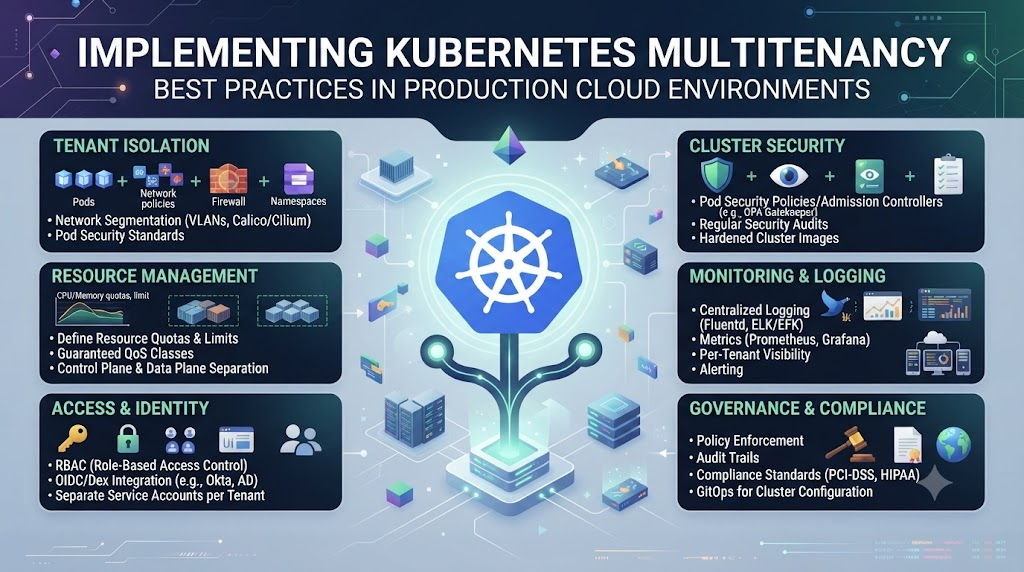
As cloud infrastructure management scales, running dedicated Kubernetes clusters for every engineering team or application becomes cost-prohibitive and operationally exhausting. Cluster sprawl increases management overhead, fragments observability, and inflates cloud bills. Multi-tenancy solves these issues by allowing multiple teams, applications, or customers to share a single physical Kubernetes cluster securely.For platforms focused on modern cloud operations, managing shared infrastructure efficiently is the foundation of scalable cloud engineering. This guide breaks down how to architect, secure, and operate enterprise-ready multi-tenant Kubernetes clusters.
What is Kubernetes Multitenancy?
Kubernetes multi-tenancy refers to an architectural design where multiple users, workloads, or business units—known as tenants—share the compute, memory, storage, and networking resources of a single Kubernetes control plane and underlying worker nodes.
Tenants can be internal (e.g., development teams, staging environments, microservices) or external (e.g., SaaS customers running isolated workloads).
There are two primary models of multi-tenancy in Kubernetes:
- Soft Multitenancy (Logical Isolation): Multiple tenants share control planes and worker nodes. Isolation relies on native Kubernetes primitives like Namespaces, Role-Based Access Control (RBAC), and Network Policies. This model fits trusted internal teams.
- Hard Multitenancy (Physical Isolation): Tenants share minimal infrastructure, using hypervisor-level isolation (e.g., KubeVirt, Kata Containers) or dedicated virtual control planes (e.g., vCluster). This model is required for untrusted workloads or external SaaS end-users.
How Does Kubernetes Multitenancy Work?
Kubernetes does not have a single native “Tenant” resource. Instead, multi-tenancy is achieved by layering API features and infrastructure controls.
+---------------------------------------------------------------------------------+
|                               Shared API Server                                 |
+---------------------------------------------------------------------------------+
|  Tenant A (Namespace A)             |  Tenant B (Namespace B)                   |
|  - RBAC (Role/RoleBinding)          |  - RBAC (Role/RoleBinding)                |
|  - ResourceQuota & LimitRange       |  - ResourceQuota & LimitRange             |
|  - NetworkPolicy (Ingress/Egress)   |  - NetworkPolicy (Ingress/Egress)         |
+-------------------------------------+-------------------------------------------+
|                          Shared Worker Nodes (OS Kernel)                        |
|                     (Optional Sandbox: gVisor / Kata Containers)                |
+---------------------------------------------------------------------------------+
- Authentication & Authorization: The API Server authenticates requests via OIDC or IAM, matching users to specific namespaces via RBAC bindings.
- Resource Boundaries: Admission controllers evaluate incoming pod creation requests against defined quotas and limits.
- Network Traffic Filtering: Container Network Interfaces (CNIs) enforce ingress and egress firewall rules per namespace.
- Execution Isolation: Pods run on shared node kernels or inside sandboxed runtimes to prevent host system exploitation.
Core Components of Multi-Tenant Kubernetes
Building a multi-tenant cluster requires configuring several core building blocks:
Namespaces
Namespaces form the logical boundary within a cluster. They scope resource names, permissions, and policies, acting as the primary anchor for tenant isolation.
Role-Based Access Control (RBAC)
RBAC governs API access. Using Roles and RoleBindings scoped to specific namespaces ensures tenant administrators cannot modify resources outside their assigned boundary.
Resource Quotas and LimitRanges
- ResourceQuotas: Limit aggregate CPU, memory, and storage consumption per namespace.
- LimitRanges: Enforce default min/max compute allocations for individual pods.
Network Policies
By default, Kubernetes allows open pod-to-pod communication across all namespaces. Network Policies define explicitly allowed traffic pathways, blocking unauthorized inter-tenant traffic.
Role of AWS, Azure, and GCP
Managed cloud engines simplify control plane operations, but multi-cloud management requires applying platform-specific integrations for full multi-tenancy:
| Feature | AWS (EKS) | Microsoft Azure (AKS) | Google Cloud (GCP / GKE) |
| IAM Integration | EKS Pod Identity / IRSA | Azure AD Workload Identity | GKE Workload Identity |
| CNI Plugin | VPC CNI (Security Groups for Pods) | Azure CNI (Subnet Isolation) | Dataplane V2 (eBPF Network Policies) |
| Sandboxing | AWS Fargate (MicroVM Isolation) | Azure Pod Sandboxing (Kata) | GKE Sandbox (gVisor Integration) |
AWS Azure GCP cloud management for multi-tenant setups hinges on linking native cloud IAM identities directly to Kubernetes Service Accounts, maintaining absolute least-privilege access across underlying cloud APIs.
Cloud Operations and Automation Considerations
Manual configuration of tenant environments leads to configuration drift and security vulnerabilities. Operational efficiency depends heavily on cloud infrastructure automation.
- GitOps & Infrastructure as Code: Use Terraform or OpenTofu to provision clusters, and ArgoCD or Flux to automatically bootstrap new tenant namespaces with standardized RBAC, Quotas, and NetworkPolicies.
- Virtual Clusters (vCluster): For complex multi-tenancy, deploy virtual control planes inside a host cluster namespace. Tenants get full administrative control over their virtual API server without risking host cluster stability.
- Policy Enforcement: Enforce organizational governance using Open Policy Agent (OPA) Gatekeeper or Kyverno to block non-compliant deployments automatically.
Monitoring, Observability, and Reliability
Observability in a multi-tenant environment requires strict telemetry scoping:
- Metrics Scoping: Configure Prometheus and Grafana using tenant-level label selectors. Prevent teams from querying global cluster metrics or observing neighboring namespace workloads.
- Log Aggregation: Route pod logs to dedicated log sinks (e.g., Elasticsearch, Loki) partitioned by namespace tags.
- Chargeback & Showback: Use tools like Kubecost to allocate compute, storage, and egress network costs back to individual tenant teams, encouraging efficient resource usage.
Security and Governance
Securing shared execution environments demands a defense-in-depth approach:
- Pod Security Standards (PSS): Enforce the
restrictedPSS profile to block pods from running as root, accessing host network namespaces, or mounting dangerous host volumes. - Kube-bench & CIS Benchmarks: Run automated audit checks to ensure node configurations meet established compliance baselines.
- Secret Management: Avoid storing sensitive values directly in Kubernetes Secrets. Inject secrets dynamically using external stores like HashiCorp Vault or AWS Secrets Manager.
Best Practices for Kubernetes Multitenancy
Applying robust Kubernetes multitenancy best practices keeps shared operational environments predictable and secure.
- Enforce Default Deny Network Policies: Drop all ingress and egress pod communication by default, explicitly whitelisting authorized pathways per namespace.
- Mandate Resource Quotas on Every Namespace: Define CPU and memory requests/limits to prevent runaway applications from crashing worker nodes.
- Implement Identity Federation: Link Kubernetes RBAC directly with your enterprise Identity Provider (IdP) via OIDC to manage tenant access dynamically.
- Isolate Sensitive Workloads with Node Taints and Tolerations: Combine Taints, Tolerations, and Node Affinity to ensure high-security workloads run on dedicated physical node pools.
- Enforce Policy as Code: Gate deployments via Kyverno or OPA Gatekeeper to reject containers running with privileged escalation.
- Use Lightweight Sandboxing for Untrusted Code: Run multi-tenant SaaS workloads in sandboxed runtimes like gVisor or Kata Containers to mitigate container breakout risks.
- Automate Tenant Onboarding: Use GitOps patterns to instantly spin up standard tenant environments with pre-configured monitoring, network rules, and storage classes.
Common Mistakes to Avoid
- Over-relying on Logical Isolation: Using simple namespaces to segregate hostile or completely untrusted external code leads to security vulnerabilities.
- Omitting Resource Limits: Failing to define LimitRanges leads to node resource exhaustion and widespread outage cascades.
- Granting Cluster-Admin Permissions: Assigning broad RBAC access instead of scoped namespace roles breaks isolation boundaries.
- Neglecting API Server Rate Limiting: Allowing a single tenant script to overwhelm the shared Kubernetes API server impairs access for all cluster users.
- Ignoring Egress Traffic: Blocking incoming connections while leaving egress traffic unmonitored opens vectors for data exfiltration and external command-and-control communication.
Real-World Use Cases
- Internal Developer Platforms (IDP): Providing isolated dev/test namespaces for hundreds of microservice developers on a single shared EKS or GKE cluster.
- SaaS Application Infrastructure: Running isolated tenant pods with strict pod sandboxing and automated tenant-level cost allocation.
- CI/CD Build Pipelines: Executing dynamic build agents within restricted namespaces, tearing down compute resources cleanly after job completion.
Challenges and Limitations
Multi-tenancy reduces cloud compute spend, but introduces explicit trade-offs:
- Control Plane Bottlenecks: A single shared API server can hit request throttling if one tenant runs abusive automated calls.
- Blast Radius Risk: Kernel-level exploits bypass namespace boundaries unless hardware or hypervisor isolation is configured.
- Operational Complexity: Managing intricate RBAC rules, network policies, and policy engine code requires continuous oversight from dedicated platform engineers.
Step-by-Step Implementation Guide
Follow this phased roadmap to implement a secure, scalable multi-tenant environment:
- Establish Namespace Architecture: Structure namespaces using consistent naming conventions based on team or environment boundaries.
- Implement Pod Security Standards: Set admission controllers to enforce baseline or restricted Pod Security Standards cluster-wide.
- Apply Default Isolation Policies: Deploy global
deny-allNetworkPolicies and enforce explicit allow-rules for core services. - Define Quotas and Limits: Assign default
ResourceQuotaandLimitRangemanifests to every namespace template. - Configure Enterprise RBAC: Bind IdP groups (e.g., Azure AD or Okta) to namespace-scoped Kubernetes Roles.
- Automate Provisioning Pipeline: Store tenant templates in version control and automate deployment using GitOps tooling.
- Verify Isolation Controls: Perform automated penetration testing and policy validation before opening the cluster to production workloads.
Future Trends in Kubernetes Multitenancy
As cloud operations management matures, multitenancy shifts away from complex namespace management toward virtualized architectures:
- Virtual Control Planes: Tooling like
vClusteris fast becoming the standard for enterprise tenancy, providing full API isolation without cluster sprawl. - AIOps and Predictive Autoscaling: Machine learning tools dynamically adjust
ResourceQuotasbased on actual tenant traffic spikes. - Wasm (WebAssembly) RunTimes: WebAssembly micro-engines offer lightweight execution sandboxing, providing near-instant startup times with hard isolation boundaries.
Frequently Asked Questions
- What are the key Kubernetes multitenancy best practices for enterprise security?
Key practices include using namespaces as logical boundaries, applying default-deny network policies, enforcing Pod Security Standards, setting ResourceQuotas on every namespace, and implementing least-privilege RBAC integrated with an enterprise identity provider.
- What is the difference between soft and hard multitenancy in Kubernetes?
Soft multitenancy relies on logical software boundaries like Namespaces and NetworkPolicies to separate trusted internal teams. Hard multitenancy uses physical node separation or hypervisor-level sandboxes to isolate untrusted or external workloads.
- Can namespaces fully isolate tenants in a shared cluster?
No, namespaces provide logical isolation for resource naming and RBAC scoping, but they do not isolate network traffic or block shared kernel access by default. Additional controls like NetworkPolicies and Pod Security Standards are required.
- How do virtual clusters improve multi-tenant architecture?
Virtual clusters provide isolated, dedicated API control planes running inside a namespace on the host cluster. This allows tenants to manage custom CRDs and cluster-scoped resources without risking host stability.
- How do you manage network security between tenants?
Network security is managed using Container Network Interfaces (CNIs) that enforce NetworkPolicies. Teams deploy default-deny rules to block all inter-namespace communication and explicitly whitelist required connection paths.
- What tools help enforce compliance in multi-tenant clusters?
Tools like Kyverno and Open Policy Agent (OPA) Gatekeeper automate policy enforcement by checking incoming API requests against custom security rules before resources are provisioned.
- How does multi-tenancy reduce cloud operations costs?
Sharing control planes and worker nodes across multiple teams increases host resource utilization, eliminating the unused CPU and memory headroom wasted by maintaining dozens of independent, idle clusters.
- Is it better to use multi-tenancy or multiple dedicated clusters?
Multi-tenancy works best for scaling internal dev environments and microservices efficiently. Dedicated clusters are preferred when strict regulatory compliance or complete fault domain isolation is mandated by business policies.
- How do you calculate per-tenant compute costs in shared clusters?
Open-source tools like Kubecost track pod CPU, memory, and storage allocations per namespace, integrating directly with cloud provider billing APIs to calculate accurate chargeback metrics.
- How do managed services like EKS, AKS, and GKE handle multi-tenancy?
Managed services offer built-in IAM identity federation, managed network policy drivers, and options for sandboxed execution like AWS Fargate, Azure Pod Sandboxing, or GKE Sandbox.
Conclusion
Implementing Kubernetes multitenancy best practices allows modern engineering organizations to scale cloud operations efficiently without compromising reliability or security. By layering namespace scope, RBAC, strict network policies, resource quotas, and policy engine controls, platform teams can eliminate cluster sprawl while maintaining safe tenant boundaries.As cloud-native environments mature, adopting automated GitOps workflows and virtual cluster patterns ensures that shared infrastructure remains scalable, compliant, and cost-effective.