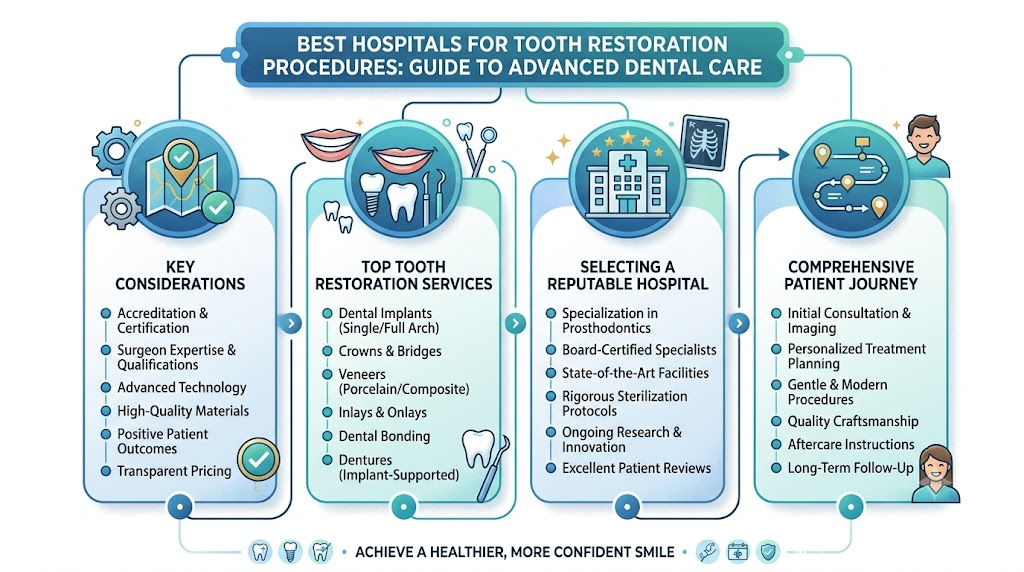
Introduction
Healthy teeth play an essential role in daily life. From chewing foods to speaking clearly and expressing a confident smile, oral health impacts overall physical well-being. However, teeth are constantly subjected to stress, friction, bacteria, and potential trauma. Over time, dental issues such as decay, fractures, cracks, or tooth loss can compromise both the structure and function of the mouth.Navigating the various options for restorative care can feel overwhelming for patients facing complex dental needs. Platforms like BESTDENTALHOSPITALS support patients by helping them discover dental facilities, compare care options, understand treatment techniques, and connect with qualified dental teams.In this guide, you will learn about the fundamentals of tooth restoration, common procedures like fillings, crowns, bridges, and implants, advanced digital dentistry tools, hospital selection guidelines, and daily habits for maintaining long-term oral health.
What Are Tooth Restoration Procedures?
Understanding the primary objectives of restorative dentistry helps clarify why timely treatment is crucial for long-term health.
+-----------------------------------------------------------------------+
|                 GOALS OF RESTORATIVE DENTISTRY                        |
+-----------------------------------------------------------------------+
|  1. Functional Restoration : Re-establishes efficient chewing & speech|
|  2. Structural Protection  : Reinforces remaining natural tooth enamel |
|  3. Arch Alignment         : Prevents neighboring teeth from shifting  |
|  4. Esthetic Integration   : Blends seamlessly with natural dentition  |
+-----------------------------------------------------------------------+
Definition and Primary Objectives
Tooth restoration encompasses a wide range of clinical procedures in restorative dentistry designed to repair damaged natural teeth or replace missing ones. The primary goal is to restore normal oral function—such as biting, chewing, and clear speech—while preserving as much natural tooth structure as possible.
Restorative dentistry also protects the underlying jawbone and surrounding soft tissues. While many restorative materials (like tooth-colored composite resins and advanced zirconia ceramics) deliver outstanding cosmetic results, the fundamental focus remains on structural health, bite stability, and disease prevention.
Restorative vs. Cosmetic Dentistry
While restorative and cosmetic dentistry frequently overlap, their primary clinical objectives differ:
- Restorative Dentistry: Focuses on treating disease, repairing structural defects, restoring chewing capability, and relieving pain or discomfort. It is medically necessary to preserve oral health.
- Cosmetic Dentistry: Focuses primarily on enhancing smile aesthetics (such as teeth whitening, cosmetic porcelain veneers, or gum re-contouring) when underlying tooth structure is healthy.
Who May Need Tooth Restoration?
Patients across all age groups may require restorative dental interventions depending on their oral health status and medical history.
                  +-----------------------------------+
                  |  CANDIDATES FOR TOOTH RESTORATION |
                  +-----------------+-----------------+
                                    |
        +---------------------------+---------------------------+
        |                                                       |
+-------v-------+                                       +-------v-------+
| STRUCTURAL DAMAGE |                                   | TOOTH LOSS    |
+-------+-------+                                       +-------+-------+
| • Dental Caries (Decay)                               | • Single Tooth Loss
| • Fractured / Cracked Teeth                           | • Multi-Tooth Gaps
| • Failed Existing Fillings                            | • Full Arch Edentulism|
+---------------+                                       +---------------+
- Dental Caries (Cavities): Bacterial decay that breaks down enamel and dentin, leaving hollow spaces that require thorough cleaning and filling.
- Chipped, Cracked, or Fractured Teeth: Trauma, biting hard objects, or nighttime teeth grinding (bruxism) can fracture enamel, exposing inner nerve tissues.
- Missing Teeth: Gaps left by tooth extraction or developmental absence disrupt bite balance and allow adjacent teeth to drift out of alignment.
- Worn Enamel: Severe acid erosion or chronic attrition wears down chewing surfaces, shortening teeth and altering vertical bite alignment.
- Root Canal-Treated Teeth: Teeth that have undergone endodontic therapy lose internal blood supply, making them brittle and requiring protective structural coverage.
- Failing Prior Restorations: Older silver amalgam fillings or aged crowns can break, leak, or develop secondary decay beneath their margins over time.
Common Tooth Restoration Procedures
Restorative treatments range from minimal direct repairs to comprehensive full-mouth reconstructions, chosen based on the extent of healthy tooth structure remaining.
+------------------------------------------------------------------------+
|                     COMMON RESTORATIVE OPTIONS                         |
+------------------------------------------------------------------------+
|  DIRECT RESTORATIONS   : Dental Fillings, Composite Bonding             |
|  INDIRECT RESTORATIONS : Inlays, Onlays, Dental Crowns, Bridges        |
|  REPLACEMENT SURGERY   : Dental Implants, Implant-Supported Prostheses  |
|  REMOVABLE PROSTHETICS : Complete & Partial Removable Dentures          |
+------------------------------------------------------------------------+
Dental Fillings & Composite Bonding
When dental decay causes small to moderate cavities, dentists remove the decayed material and fill the space with tooth-colored composite resin. Composite bonding is also applied directly to fix minor chips or close small gaps between natural teeth.
Dental Crowns (Caps)
When a tooth is severely cracked, decayed, or weakened following a root canal, a dental crown is placed over the entire visible portion above the gumline. Crowns act like protective helmets, restoring original shape, strength, and chewing function.
Dental Bridges
A dental bridge replaces one or more missing teeth in a row. It consists of artificial replacement teeth (pontics) held securely in place by crowns anchored to adjacent natural teeth or implants (abutments) on either side of the gap.
Dental Implants
Dental implants represent an advanced, long-term solution for missing teeth. A biocompatible titanium or zirconia post is surgically anchored directly into the jawbone, serving as an artificial tooth root. After integrating with the bone, it supports an individual custom crown, bridge, or full-arch prosthesis.
Inlays and Onlays (Partial Crowns)
When damage is too extensive for a standard filling but not severe enough to require a full crown, inlays or onlays are used. Fabricated in a laboratory or via CAD/CAM milling, inlays fit within the grooves of a tooth, while onlays extend over one or more biting cusps.
Dentures & Endodontic Restorations
For patients missing multiple teeth or entire arches, removable partial or complete dentures provide functional coverage. When deep decay reaches the inner nerve pulp, root canal therapy removes infected tissue before placing a reinforcing crown.
Tooth Restoration Procedures Comparison Table
| Procedure | Best Used For | Primary Clinical Benefit | Expected Longevity |
| Dental Fillings | Small to moderate decay cavities | Restores simple structural loss quickly | 5 to 10+ years |
| Dental Crowns | Severely damaged, broken, or endodontically treated teeth | Encases and reinforces weakened enamel | 10 to 15+ years |
| Dental Bridges | Replacing 1 to 3 consecutive missing teeth | Restores chewing continuity without surgery | 7 to 15 years |
| Dental Implants | Single or multiple missing teeth replacement | Preserves jawbone density and avoids altering adjacent teeth | 20+ years / Lifetime |
| Inlays & Onlays | Moderate decay or cusp damage | Conserves more natural healthy tooth enamel than crowns | 10 to 15+ years |
| Dentures | Extensive or complete tooth loss across an arch | Cost-effective restoration of speech and chewing ability | 5 to 8 years |
Services Offered by Leading Dental Hospitals
Top-tier dental hospitals bring together specialized departments to deliver seamless, comprehensive care for complex cases.
                   +--------------------------------+
                   |  COMPREHENSIVE DENTAL SERVICES  |
                   +---------------+----------------+
                                   |
        +--------------------------+--------------------------+
        |                                                     |
+-------v-------+                                     +-------v-------+
| DIAGNOSTICS & |                                     | SURGICAL &    |
| PROSTHODONTICS|                                     | PERIODONTAL   |
+-------+-------+                                     +-------+-------+
| • Digital Scans|                                    | • Implant Ops |
| • Crowns/Bridges|                                   | • Bone Grafting|
| • Inlays/Onlays|                                    | • Gum Therapy |
+---------------+                                     +---------------+
Diagnostics & Prosthodontic Expertise
Leading facilities begin care with detailed digital diagnostics, including high-resolution 3D imaging and intraoral scans. Specialist prosthodontists design custom crowns, bridges, and complex full-mouth reconstructions tailored to individual bite mechanics.
Implant Surgery & Periodontal Care
Hospitals feature dedicated oral surgery suites for guided dental implant placement, bone grafting, and sinus lift procedures. On-site periodontists ensure supporting gum tissues and bone structures are healthy before placing permanent restorations.
Endodontic Services & Preventive Maintenance
Specialized endodontists perform root canal treatments using precision operating microscopes, preserving natural tooth roots. Integrated preventive departments provide long-term maintenance, cleanings, and bite evaluations to protect completed restorations.
Advanced Technologies Used
Modern dental hospitals utilize digital technology to improve treatment precision, reduce procedure times, and enhance patient comfort.
+----------------------------------------------------------------------+
|                     ADVANCED DENTAL TECHNOLOGIES                     |
+----------------------------------------------------------------------+
|  [3D CBCT Imaging]            --> Accurate bone & nerve mapping      |
|  [Intraoral Digital Scanners] --> Replaces uncomfortable impression putty|
|  [CAD/CAM In-Office Milling]  --> Same-day ceramic crowns & restorations|
|  [Computer-Guided Surgery]    --> Precise implant placement templates|
|  [Digital Smile Design (DSD)] --> Pre-visualize aesthetic outcomes   |
+----------------------------------------------------------------------+
- Cone-Beam Computed Tomography (CBCT): 3D imaging technology that provides detailed anatomical views of jawbone density, nerve pathways, and sinus cavities for safe surgical planning.
- Intraoral Optical Scanners: Digital wands that capture thousands of 3D images per second, eliminating the need for uncomfortable impression putty while producing precise digital models.
- CAD/CAM Same-Day Restorations: Computer-Aided Design and Manufacturing tools allow clinicians to design and mill custom ceramic crowns or onlays right in the hospital during a single visit.
- Computer-Guided Surgery: Surgical templates created from 3D scans guide the precise angle, depth, and placement of dental implants, minimizing surgical discomfort and healing time.
How to Choose the Right Dental Hospital
Selecting an appropriate hospital for restorative dental procedures involves evaluating clinical qualifications, technological capabilities, and patient safety protocols. The ideal choice depends on your specific dental needs, overall health history, and financial considerations.
                       +------------------------+
                       | EVALUATING A HOSPITAL  |
                       +-----------+------------+
                                   |
         +-------------------------+-------------------------+
         |                                                   |
+--------v-------+                                  +--------v-------+
| CLINICAL EXPERTISE |                              | FACILITIES & SUPPORT|
+--------+-------+                                  +--------+-------+
| • Prosthodontists |                               | • Digital Diagnostic Suite
| • Oral Surgeons   |                               | • On-Site Milling Lab
| • Endodontists    |                               | • Sterilization Assurance|
+----------------+                                  +----------------+
Specialist Qualifications & Team Collaboration
Confirm that the facility employs board-certified prosthodontists, oral surgeons, and endodontists. Complex restorative cases benefit from a team approach where multiple specialists collaborate on your treatment plan.
On-Site Technology & Laboratory Integration
Look for hospitals equipped with 3D CBCT imaging, intraoral digital scanners, and integrated dental laboratories. On-site technicians ensure tighter quality control over ceramic shade matching and restoration fit.
Sterilization Protocols & Patient Comfort Options
Ensure the hospital strictly adheres to international sterilization and infection control protocols. For anxious patients or lengthy procedures, check for sedations options, such as nitrous oxide, oral conscious sedation, or IV sedation managed by qualified professionals.
Hospital Selection Checklist
| Feature | Why It Matters |
| Prosthodontic Specialists | Advanced expertise in designing and fitting complex restorations |
| 3D Digital Diagnostics (CBCT) | Essential for safe, precise implant placement and nerve mapping |
| Intraoral Digital Scanning | Ensures higher precision and eliminates uncomfortable impression trays |
| Integrated Dental Laboratory | Speeds up turnaround times and improves custom color matching |
| Sedation Options Available | Supports comfortable care during multi-hour or complex procedures |
| Structured Maintenance Programs | Helps protect your investment through regular checkups and cleanings |
Diagnostic Evaluation Before Treatment
A thorough diagnostic process establishes a solid foundation for successful restorative outcomes.
  [Medical & Dental History]
             │
             ▼
  [Clinical Examination & Gum Screening] ──► Evaluates decay, tooth wear, & gum health
             │
             ▼
  [3D CBCT & Intraoral Digital Scans]     ──► Maps bone density, nerves, & teeth layout
             │
             ▼
  [Digital Bite & Occlusal Analysis]      ──► Checks how upper & lower teeth meet
             │
             ▼
  [Comprehensive Treatment Plan Review]   ──► Personalized options, timelines, & costs
Initial Screening & Digital Scans
Care begins with a detailed medical history and clinical exam. Dentists review active medications, systemic conditions (like diabetes or osteopenia), and gum tissue health. High-resolution digital X-rays and 3D CBCT scans are taken to evaluate internal tooth structures, root health, and jawbone density.
Occlusal (Bite) Analysis & Treatment Consultation
Using digital bite sensors or articulated models, clinicians evaluate how your upper and lower teeth meet when chewing. Addressing bite misalignments before placing crowns or implants prevents excessive wear or chipping of new restorations. Finally, your dentist presents a personalized treatment plan outlining procedure choices, phased timelines, and expected costs.
What to Expect During Tooth Restoration
Knowing what to expect during a restorative procedure helps minimize anxiety and ensures a comfortable experience.
  [1. Anesthesia & Prep] ──► [2. Digital Impression] ──► [3. Temporary Placement]
                                                                  │
                                                                  ▼
  [6. Final Adjustments] ◄── [5. Permanent Bonding] ◄── [4. Lab Fabrication]
1. Preparation & Local Anesthesia
To keep you comfortable, local anesthesia is administered to numb the tooth and surrounding gum tissue. The dentist carefully removes decayed or damaged enamel, shaping the remaining tooth structure to receive a crown, inlay, or filling.
2. Scanning & Fabrication
Instead of messy traditional impression trays, a compact wand digitally scans the prepared tooth. These digital files are sent to an in-office milling unit or specialized laboratory where your custom restoration is crafted from durable porcelain or zirconia.
3. Placement & Bite Calibration
When the final restoration is ready, the dentist checks its fit, margin seals, and color match against adjacent natural teeth. Once bonded into place with permanent dental cement, the bite is fine-tuned so biting pressure is evenly distributed.
Recovery and Long-Term Care
Proper care after treatment ensures your dental restorations remain functional, comfortable, and aesthetically pleasing for years to come.
+--------------------------------------------------------------------+
|                  RECOVERY & DAILY MAINTENANCE                      |
+--------------------------------------------------------------------+
|  [Daily Oral Hygiene]   --> Brush twice daily & floss under bridges|
|  [Bite Protection]      --> Wear a custom nightguard if grinding   |
|  [Dietary Habits]       --> Avoid biting ice, hard candies, or shells|
|  [Routine Checkups]     --> Schedule professional cleanings every 6 mos|
+--------------------------------------------------------------------+
- Diligent Daily Oral Hygiene: Restored teeth still require daily care. Decay can form along the edges where a crown or filling meets natural tooth enamel. Brush twice daily with fluoride toothpaste and floss daily, using specialized floss threaders around bridges or implants.
- Protecting Against Excessive Forces: Avoid using your teeth as tools to open packages, cut threads, or crack nuts. If you grind your teeth at night (bruxism), wear a custom-fitted nightguard to protect porcelain surfaces from chipping.
- Routine Professional Evaluations: Visit your dental hospital every six months for professional cleanings and examinations. Dentists use localized digital X-rays to verify that underlying bone levels and restoration margins remain sound over time.
Possible Risks and Complications
While modern restorative procedures are highly effective and safe, potential complications can arise and should be managed proactively:
- Post-Procedure Sensitivity: Mild sensitivity to hot or cold temperatures is common for a few days after placing fillings or crowns, usually resolving as tissues heal.
- Bite Discomfort or High Spots: If a restoration sits even slightly too high, biting can cause localized soreness. A brief follow-up visit allows your dentist to smooth down the high spot quickly.
- Restoration Fractures or Debonding: Heavy chewing trauma or grinding can occasionally chip porcelain or loosen dental cement, requiring repair or re-bonding.
- Recurrent Secondary Decay: Poor oral hygiene allows plaque to accumulate along restoration margins, leading to new decay beneath crowns or fillings.
- Gum Tissue Inflammation: Irritation can occur around new crown margins or under bridge pontics if plaque is not cleaned away regularly.
Regular dental checkups help detect these minor issues early before they escalate.
How BESTDENTALHOSPITALS Helps Patients
Finding a trusted hospital for complex restorative dental work requires clear, reliable guidance. BESTDENTALHOSPITALS provides accessible educational resources to help patients navigate their dental choices with confidence.
+------------------------------------------------------------------------+
|                     BESTDENTALHOSPITALS RESOURCES                      |
+------------------------------------------------------------------------+
|  [Hospital Discovery]  --> Search accredited dental care facilities    |
|  [Procedure Guides]    --> Simple breakdowns of crowns, implants, & more|
|  [Technology Insights] --> Learn about 3D scanning & same-day dentistry|
|  [Patient Empowerment] --> Prepare key questions for your consultation |
+------------------------------------------------------------------------+
Through BESTDENTALHOSPITALS, readers can research accredited facilities, learn about restorative procedures, explore modern digital technologies, and access practical oral health guides. By bringing essential information together in one convenient location, the platform helps patients make informed decisions alongside their dental providers.
Common Mistakes Patients Make
Avoiding common oversights helps protect your oral health and ensures long-term treatment success.
1. Postponing Treatment for Early Decay
- The Mistake: Waiting until a cavity causes severe pain before visiting a dentist.
- The Solution: Treat decay early with simple fillings. Postponing treatment allows decay to reach the inner nerve, requiring root canals or crowns.
2. Ignoring a Missing Back Tooth
- The Mistake: Choosing not to replace a missing molar because it isn’t visible when smiling.
- The Solution: Replace missing back teeth promptly with implants or bridges. Unreplaced teeth cause adjacent teeth to shift, destabilizing your overall bite.
3. Using Teeth as Tools
- The Mistake: Biting open plastic packaging, chewing ice, or biting fingernails with restored teeth.
- The Solution: Use scissors or appropriate tools instead. Excessive pressure can crack natural enamel as well as custom ceramic crowns.
4. Skipping Maintenance Checks
- The Mistake: Assuming that teeth with crowns or implants no longer require professional cleanings or checkups.
- The Solution: Maintain regular six-month dental visits. Gum disease and margin decay can still compromise the underlying natural roots and bone supporting your restorations.
Common Myths vs. Facts
| Myth | Fact |
| Dental fillings and crowns last forever. | Most restorations experience normal wear and may eventually require repair or replacement after many years. |
| Missing a single back tooth causes no harm. | Gaps allow neighboring teeth to drift, alter bite mechanics, and lead to accelerated jawbone loss over time. |
| Dental crowns are strictly cosmetic enhancements. | While crowns improve appearance, their primary function is to protect and structurally reinforce severely weakened teeth. |
| Restorative dentistry and cosmetic dentistry are identical. | Restorative care focuses primarily on repairing disease and restoring health and chewing function, though it often enhances aesthetics as well. |
Real-Life Educational Scenarios
Scenario A: Early Treatment of Cavities with Composite Fillings
A 28-year-old patient noticed mild sensitivity to sweet foods while eating. During a routine dental exam, digital bitewing X-rays revealed two small cavities between their back molars. The dentist removed the decay and placed tooth-colored composite fillings in a single 45-minute visit, restoring full structural integrity and preventing the need for more extensive treatment.
Scenario B: Reinforcing a Tooth After Endodontic Therapy
A patient developed severe toothache from deep decay reaching the nerve of a lower molar. After an endodontist performed root canal therapy to clear the infection, the tooth was structurally brittle. The patient’s dentist fitted a durable zirconia crown over the tooth, allowing them to chew comfortably without risking a fracture.
Scenario C: Replacing a Missing Tooth with a Dental Implant
Following an sports injury, a 35-year-old lost a single upper premolar. Preferring not to grind down adjacent healthy teeth for a traditional bridge, they opted for a dental implant. An oral surgeon placed a titanium post using 3D computer guidance, and after bone integration, a prosthodontist attached a custom porcelain crown. The result functioned and looked just like a natural tooth.
Scenario D: Re-establishing Bite Function with a Dental Bridge
An older adult missing two lower molars struggled to chew foods comfortably on one side of their mouth. A prosthodontist placed a three-unit bridge supported by strong natural teeth on either side of the gap. The bridge restored balanced chewing function, prevented adjacent teeth from tilting, and relieved strain on the jaw joints.
Frequently Asked Questions (FAQs)
1.What is restorative dentistry?
Restorative dentistry focuses on diagnosing, managing, and surgically or prosthetically repairing damaged, decayed, fractured, or missing teeth to restore normal function, strength, and health.
2.What is the main difference between restorative and cosmetic dentistry?
Restorative dentistry is medically necessary to fix functional issues, decay, or missing teeth. Cosmetic dentistry focuses primarily on improving the aesthetic appearance of healthy teeth and gums.
3.When is a simple dental filling sufficient?
A filling is recommended when a tooth has small to moderate decay cavities or minor surface wear, provided there is ample healthy natural enamel left to support the filling material.
4.When does a tooth require a full dental crown?
A crown is recommended when a tooth is severely decayed, cracked, fractured, heavily filled, or weakened following root canal therapy, requiring 360-degree structural protection.
5.How does a dental bridge work?
A dental bridge replaces one or more missing teeth by anchoring custom artificial teeth (pontics) to adjacent natural teeth or implants (abutments) fitted with protective crowns.
6.Are dental implants considered a permanent solution?
Dental implants integrate directly into the jawbone and can last a lifetime with proper care, though the custom crown attached to the implant post may experience normal wear over 15 to 20+ years.
7.What are inlays and onlays?
Inlays and onlays are custom laboratory-milled ceramic or composite restorations. Inlays fit within the cusps of a tooth, while onlays cover one or more cusps, conserving more natural tooth structure than a full crown.
8.How long do typical tooth restorations last?
With good oral hygiene and regular dental checkups, fillings typically last 5 to 10 years, crowns and bridges last 10 to 15+ years, and implants can last a lifetime.
9.How should I care for a restored tooth daily?
Brush twice daily with fluoride toothpaste, floss daily (using threaders around bridges or implants), avoid biting hard objects, and wear a nightguard if you grind your teeth.
10.Can severely damaged teeth always be saved?
Not always. If decay extends deep beneath the gumline, if the root is vertically fractured, or if supporting bone loss is severe, extraction followed by replacement (like an implant or bridge) may be necessary.
11.How do I choose the right dental hospital?
Look for facilities with board-certified prosthodontists and oral surgeons, modern digital diagnostics (CBCT and intraoral scanners), transparent safety protocols, and comprehensive follow-up care programs.
12.Are tooth restoration procedures painful?
No. Clinicians use local anesthetics to ensure you are comfortable during treatment. Mild soreness or sensitivity after procedures usually resolves quickly with over-the-counter pain relievers.
13.What modern technologies improve restorative care?
Key advances include 3D CBCT imaging, intraoral optical scanners, CAD/CAM same-day ceramic milling, and computer-guided implant placement software.
14.How often should my restorations be evaluated by a dentist?
Restorations should be checked during routine dental exams every six months so your dentist can confirm margin seals, check bite balance, and identify any issues early.
15.How does BESTDENTALHOSPITALS assist patients in finding care?
BESTDENTALHOSPITALS provides an educational directory and guides that help patients explore accredited dental centers, understand procedure options, and make informed oral healthcare decisions.
Final Thoughts
Addressing damaged, decayed, or missing teeth through timely restorative procedures is one of the most effective investments you can make in your health. Restoring proper function, protecting natural enamel, and replacing lost teeth preserves your bite, supports comfortable chewing, and prevents secondary complications.Achieving durable, natural-looking results relies on proper care and planning. Choosing an accredited dental hospital with experienced specialists, modern digital technology, and comprehensive maintenance programs ensures high-quality care at every step.