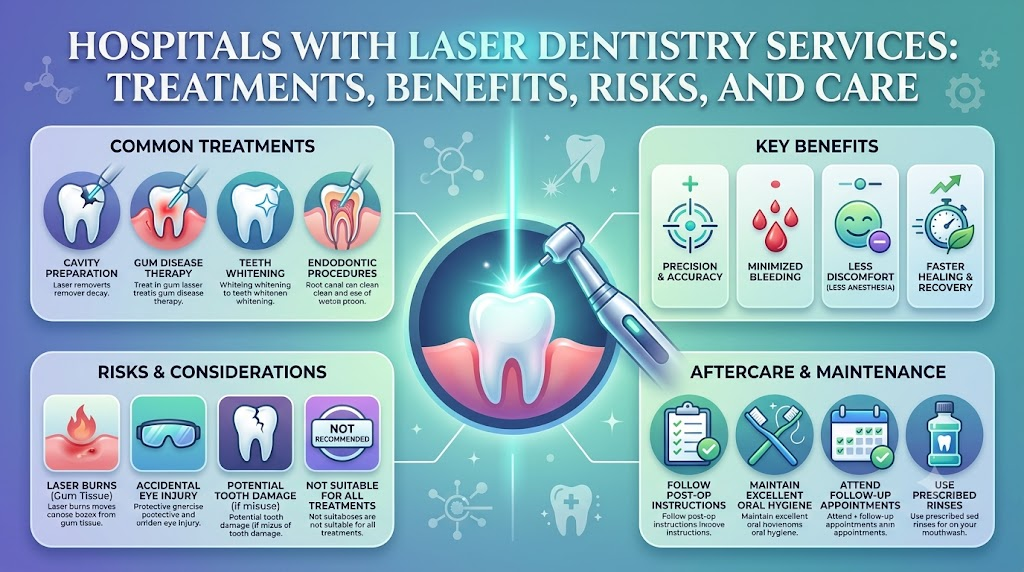
Laser technology has changed how dentists treat some teeth and gum problems. Hospitals with laser dentistry services may offer treatments that use focused light energy. These treatments can help with selected gum procedures, certain cavities, and other dental needs.
Laser dentistry may suit patients who want to learn about newer treatment options. However, lasers do not replace every traditional dental tool. The right choice depends on the dental problem, the dentist’s skills, and the patient’s needs.
Patients can explore dental care options through bestdentalhospitals and prepare questions before booking a consultation. A qualified dentist can explain which treatments may work and whether laser technology offers a real benefit.
What Is Laser Dentistry?
Laser dentistry uses focused light energy to treat certain areas of the teeth, gums, and other tissues in the mouth. A dentist selects the laser based on the treatment needed.
There are two main types of dental lasers.
- Soft-tissue lasers: These treat selected areas of the gums and other soft tissues. Dentists may use them to reshape gums or remove certain affected tissue.
- Hard-tissue lasers: These can treat certain hard tissues, such as tooth enamel and dentin. Some are used for selected cavity-related procedures.
Each laser has its own uses and limits. A dentist may use a laser alone for a suitable procedure or combine it with traditional dental tools.
Laser dentistry does not mean every treatment is easier or better. Patients should understand the expected benefits before choosing it.
How Does Laser Dental Treatment Work?
Laser dental treatment uses a device that sends focused light toward a specific area. The light interacts with the tissue in a way that supports the planned treatment.
A typical process includes these steps:
- The dentist examines the teeth, gums, and mouth.
- The dentist explains the problem and the available treatments.
- The dental team prepares the laser and suitable safety equipment.
- The patient wears protective eyewear when required.
- The dentist treats the planned area with a laser, traditional tools, or both.
- The dental team explains aftercare and follow-up needs.
Some procedures need local anesthesia to reduce pain. Others may need little or no anesthesia. This depends on the treatment, the device, and the patient’s comfort.
Laser treatment is not always painless. Patients should tell the dentist if they feel pain or discomfort during the procedure.
Which Dental Treatments May Use Lasers?
Lasers can support several types of dental treatment. However, their use depends on the condition, the available equipment, and the dentist’s training. Not every patient is a suitable candidate.
Gum Treatment
Dentists may use soft-tissue lasers for selected gum procedures. These may include reshaping gum tissue or removing certain affected tissue.
Laser gum treatment may also support care for some gum conditions. However, it does not replace professional cleaning, proper oral hygiene, or other proven gum treatments in every case.
The dentist must assess the gums before recommending a laser procedure. Some patients need deeper cleaning or other forms of periodontal care.
Treatment for Tooth Decay
Some hard-tissue lasers can help treat certain cavities. They may remove some decayed tooth tissue in suitable cases.
However, traditional dental tools may still be needed. The choice depends on the cavity’s size, location, and depth.
Lasers cannot treat every cavity. They also do not remove the need for fillings or other repairs when the tooth needs them.
Root Canal Treatment
A root canal treats infected or damaged tissue inside a tooth. In some cases, a dentist may use a laser as an extra tool during this process.
The laser may help clean or disinfect parts of the treatment area. However, it does not replace the full root canal procedure.
The dentist must still assess the tooth, clean the root canal system, and seal it as needed. Laser use cannot guarantee that an infection will never return.
Treatment for Mouth Lesions
Dentists or oral specialists may use lasers to remove or treat certain soft-tissue lesions. A lesion is an unusual area of tissue in the mouth.
Some lesions need a biopsy. This means taking a tissue sample for laboratory testing. Before laser removal, patients should ask how the dentist will collect and test tissue if needed.
A suspicious, bleeding, persistent, or unexplained mouth lesion needs professional assessment. Laser removal alone cannot confirm that a lesion is harmless.
Tongue-Tie and Other Soft-Tissue Procedures
A tongue-tie limits the movement of the tongue because of a tight band of tissue beneath it. In selected cases, a dentist or specialist may use a laser to release this tissue.
The need for treatment depends on symptoms and how the tongue works. Age and other personal factors also matter.
Not every tongue-tie needs surgery. A qualified professional should assess the problem before recommending treatment.
Tooth Sensitivity
Some laser techniques may help reduce tooth sensitivity in selected cases. However, sensitivity can have several causes.
These include tooth decay, worn enamel, exposed roots, and gum recession. The dentist should find the cause before choosing a treatment.
A laser may not help if another problem needs attention. Treating the cause is often the most important step.
Laser-Assisted Teeth Whitening
Some professional whitening systems use light or lasers with a whitening product. Other whitening treatments do not need a laser.
Patients should ask what the system does and what results they can reasonably expect. Claims about faster or better whitening should have reliable evidence.
Whitening may cause temporary tooth sensitivity or gum irritation. A dentist can check oral health and discuss whether whitening is suitable.
Common Laser Dentistry Procedures and Their Uses
| Procedure or treatment area | How lasers may be used | Important limitation |
|---|---|---|
| Gum treatment | Reshape gums or remove selected affected tissue | Does not replace all gum treatments |
| Cavity treatment | Help remove decay in selected cases | Fillings or traditional tools may still be needed |
| Root canal support | Help clean or disinfect parts of the treatment area | Does not replace the full root canal process |
| Mouth lesions | Treat or remove certain soft-tissue lesions | Some lesions need a biopsy and lab testing |
| Tooth sensitivity | Help reduce sensitivity in selected cases | The cause must be checked first |
| Professional whitening | Work with certain whitening systems | Lasers are not needed for every whitening treatment |
Laser use depends on the patient’s condition and the equipment available. Dentists may combine laser treatment with conventional methods.
Potential Benefits of Laser Dentistry
Laser dentistry may offer useful benefits for certain procedures. However, results vary from person to person.
Possible benefits include:
- Precise treatment: A suitable laser can target a selected area of tissue.
- Less bleeding: Some soft-tissue procedures may cause less bleeding.
- Fewer stitches: Certain procedures may not need stitches.
- Possible comfort benefits: Some patients may feel less discomfort during selected treatments.
- Care for nearby tissue: Proper laser use may reduce injury to nearby areas in some procedures.
- Less tool-related anxiety: Patients who dislike the sound or feel of dental drills may feel more at ease with some laser treatments.
These benefits depend on the procedure, the laser system, and the dentist’s skill. They are not guaranteed.
A laser may help one patient but offer little advantage to another. The dentist should explain the expected result for the specific treatment.
Limitations and Risks of Laser Dentistry
Laser dentistry has limits. It cannot replace traditional tools for every dental problem. Some procedures still need drills, hand tools, fillings, or local anesthesia.
Laser equipment may not be available at every dental hospital. In some settings, laser treatment may also cost more than conventional care.
The evidence for laser treatment varies by procedure. Patients should ask whether research supports its use for their particular problem.
Possible risks include:
- Heat damage to nearby tissues if the laser is used incorrectly.
- Injury to the gums or teeth.
- Pain or discomfort during or after treatment.
- Eye injury if suitable protective measures are not followed.
- Delayed care if a laser is chosen when another treatment is more suitable.
Proper training and safety measures help reduce these risks. Patients should choose a qualified dental professional who explains the procedure clearly.
Do not choose laser treatment only because it sounds modern. The main goal is to treat the dental problem safely and effectively.
Laser Dentistry Compared With Traditional Dental Treatment
Laser and conventional dental treatments can both play important roles in oral care. Neither method is always the best choice.
| Feature | Laser-based treatment | Traditional treatment |
|---|---|---|
| Main method | Uses focused light energy | Uses tools such as drills and hand instruments |
| Common uses | Selected gum and other dental procedures | A wide range of dental procedures |
| Bleeding | May reduce bleeding in some soft-tissue procedures | Bleeding depends on the procedure |
| Anesthesia | May still be needed | May also be needed |
| Equipment | Requires a suitable laser system | Uses conventional dental equipment |
| Availability | Depends on the dental hospital | Often available for many routine procedures |
| Cost | May be higher in some settings | Varies by procedure and location |
The best option depends on the diagnosis, the evidence for the treatment, and the dentist’s experience. Personal comfort and cost also matter.
Ask why the dentist recommends a laser. Also ask whether conventional treatment could offer similar results. A good treatment plan should explain both the benefits and the limits of each option.
What Happens During a Laser Dental Appointment?
A laser dental appointment often follows a simple process. The exact steps depend on the procedure.
- Examination: The dentist checks the teeth, gums, and other areas of concern.
- Diagnosis: The dentist explains the problem and possible treatments.
- Discussion: You can ask about costs, risks, benefits, and alternatives.
- Preparation: The dental team prepares the equipment and provides protective eyewear when required.
- Treatment: The dentist uses a suitable laser, traditional tools, or both.
- Aftercare: The team explains how to care for your mouth and when to return.
Tell the dentist about your concerns before treatment begins. Ask for an explanation if you do not understand any part of the plan.
You should have enough information to make an informed choice before you agree to treatment.
Recovery and Aftercare
Recovery depends on the type of procedure and the area treated. Some patients need little downtime. Others need more time for the treated tissue to heal.
Your dentist may give advice about:
- Brushing and cleaning your teeth.
- Choosing foods while the treated area heals.
- Eating and drinking after the procedure.
- Using any prescribed medicines as directed.
- Attending follow-up visits.
Follow the instructions given by your dental team. Do not assume that laser treatment needs no aftercare.
Contact your dental team if you develop worsening pain, ongoing or heavy bleeding, increasing swelling, fever, or other worrying symptoms. Seek emergency care if severe swelling affects breathing or swallowing.
Who May Be Suitable for Laser Dentistry?
Laser dentistry may suit some patients, but it is not right for everyone. The decision depends on the dental problem, oral health, medical history, and proposed procedure.
Before treatment, tell your dentist about:
- Existing dental problems, including gum disease or tooth decay.
- Medicines you take and any known allergies.
- Pregnancy or other relevant health circumstances.
- Previous reactions to dental treatment.
- Your main concerns and treatment goals.
This information helps the dentist assess possible risks and choose a suitable approach. Some conditions respond better to conventional treatment or a combination of methods.
Do not assume that a laser is suitable simply because a dental hospital offers the service. Ask for a personal assessment and a clear explanation of your choices.
How to Choose a Hospital With Laser Dentistry Services
Choosing the right dental hospital takes more than finding one with laser equipment. Look for a team that understands your condition and explains your treatment choices.
Use this checklist when comparing dental hospitals:
- Qualified dentist: Check whether the dentist has suitable training for your procedure.
- Relevant experience: Ask how often the dentist performs the treatment you need.
- Suitable equipment: Ask whether the hospital has the right laser for your condition.
- Safety measures: Check that the team follows safety rules and uses suitable eye protection.
- Clear explanations: The dentist should explain benefits, risks, and other treatment options.
- Transparent costs: Ask for a clear estimate that includes likely extra fees.
- Infection control: The hospital should follow proper cleaning and sterilization practices.
- Follow-up care: Ask whom to contact if you have problems after treatment.
- No pressure: You should have time to consider your choices without feeling rushed.
A hospital that answers questions openly can help you make a more informed decision. Do not rely only on advertising or claims about advanced technology.
Questions to Ask Before Choosing Laser Treatment
Before you agree to treatment, make sure you understand what the dentist plans to do. These questions can help you compare hospitals with laser dentistry services.
Questions to Ask Before Choosing a Laser Dental Hospital
| Topic | Question to ask | Why it matters |
|---|---|---|
| Dentist qualifications | What training do you have for this procedure? | Helps you assess relevant skills |
| Experience | How often do you perform this treatment? | Helps you understand the dentist’s experience |
| Alternatives | Could conventional treatment work for me? | Helps you compare suitable options |
| Risks | What side effects or problems could occur? | Helps you make an informed choice |
| Costs | What is the total expected cost? | Helps you plan your budget |
| Equipment safety | What safety measures will you use? | Helps you understand how risks are managed |
| Follow-up care | Who should I contact if I have a problem? | Helps you plan for recovery and support |
You can also ask whether you will need anesthesia and how many visits the treatment may require. Ask what happens if laser treatment is unsuitable or does not work as expected.
A qualified dentist should explain the diagnosis and available choices before asking for your consent. You can take time to consider the information and seek another opinion if needed.
How BESTDENTALHOSPITALS Can Help Readers
Finding the right dental service can take time. A dental hospital information platform can help readers explore available services and learn about different care options.
BESTDENTALHOSPITALS can be a starting point for learning about dental hospitals and the services they may offer. Readers can use this information to prepare questions before contacting a provider.
Always confirm laser availability, dentist qualifications, treatment costs, and safety practices directly with the hospital. Do not assume that a listing alone confirms the quality of care or guarantees a treatment result.
Frequently Asked Questions
1. What is laser dentistry?
Laser dentistry uses focused light energy to treat certain areas of the teeth, gums, and other mouth tissues. Dentists may use soft-tissue or hard-tissue lasers for selected procedures.
2. Which dental problems can lasers help treat?
Lasers may help with selected gum procedures, certain cavities, root canal support, mouth lesions, tooth sensitivity, and some soft-tissue concerns. Their use depends on the diagnosis and available equipment.
3. Is laser dentistry better than traditional dentistry?
Not always. Lasers may offer benefits for certain procedures, while traditional tools may work better for others. The best option depends on the patient’s needs and the evidence for the treatment.
4. Is laser dental treatment painful?
Some procedures may cause less discomfort, but laser treatment is not always painless. Local anesthesia may still be needed, depending on the procedure.
5. Can lasers be used for gum disease?
Yes, dentists may use lasers in selected gum treatments. However, lasers do not replace all established gum care, professional cleaning, or other treatments.
6. Can lasers treat cavities or replace root canal treatment?
Some hard-tissue lasers can treat certain cavities. Lasers may also support cleaning during some root canal procedures. They do not treat every cavity or replace the full root canal process.
7. Is laser teeth whitening safe?
Professional whitening may be suitable for many people when a qualified dentist checks their oral health. Some systems use lasers or other light sources, but not all need them. Temporary sensitivity and gum irritation can occur.
8. What are the possible risks of laser dentistry?
Possible risks include discomfort, heat injury, damage to nearby tissue, and eye injury without proper protection. Qualified care and suitable safety measures help reduce these risks.
9. How can I find a hospital that offers laser dentistry?
Search for dental hospitals that list laser services, then contact them to confirm availability. Ask about the dentist’s training, experience, safety measures, costs, and other treatment choices.
10. How much does laser dental treatment cost?
The cost depends on the procedure, hospital, location, equipment, and your individual needs. Ask for a detailed estimate and check whether follow-up visits or other treatments cost extra.
Conclusion
Laser dentistry can help with selected dental procedures, including some gum treatments, cavity-related care, and soft-tissue procedures. It may offer benefits such as precise treatment and less bleeding in certain cases. However, it also has limits and possible risks.
Hospitals with laser dentistry services may offer useful options, but laser treatment is not right for every dental problem. Traditional tools remain important in modern dental care.
Before choosing a dental hospital, compare the dentist’s qualifications, experience, safety practices, treatment costs, and follow-up care. Ask why a laser is recommended and whether another method could work just as well.
The best dental treatment is one that suits your condition and needs. Speak with a qualified dental professional, understand the benefits and risks, and make your choice after reviewing the available options.