Introduction
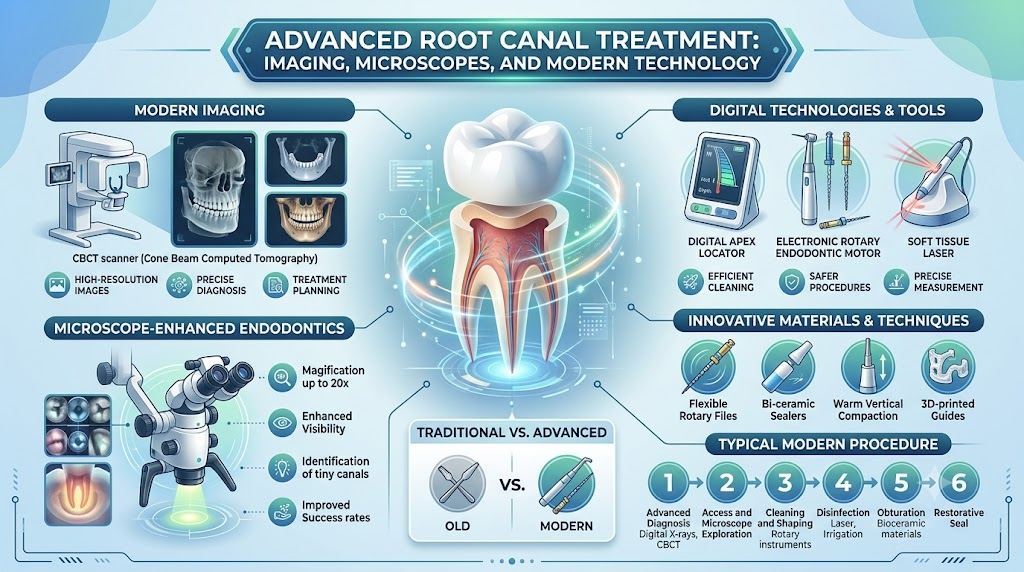
Root canal treatment has changed significantly with advances in dental technology. Modern dental hospitals and endodontic facilities may use digital imaging, 3D scans, microscopes, electronic measuring devices, advanced instruments, and improved cleaning systems to support careful treatment planning. These tools can be especially helpful when the tooth has unusual anatomy or has been treated before. BestDentalHospitals can help patients learn more about dental hospitals and treatment options. However, having advanced equipment does not automatically mean that every patient needs every available technology. The right approach depends on the tooth, the diagnosis, the complexity of the case, and the dentist’s clinical judgment.
What Is Root Canal Treatment?
Root canal treatment is a dental procedure used to treat a tooth when the soft tissue, called the dental pulp, inside the tooth becomes inflamed or infected.
The treatment involves accessing the inside of the tooth, cleaning and treating the affected root canal system, and then sealing the space. The main goal is to control infection or inflammation and preserve the natural tooth when possible.
Not every painful tooth needs a root canal. Tooth pain can have many causes, so a dentist usually considers symptoms, clinical examination, dental tests, and appropriate imaging before recommending treatment.
Why Does Technology Matter in Modern Root Canal Treatment?
Root canals can be very small and may have curves, branches, or other anatomical differences. Some canals can also be difficult to locate, especially when a tooth has been heavily restored or previously treated.
Advanced root canal technology can support different stages of care, including diagnosis, treatment planning, canal measurement, cleaning, shaping, and visualization.
Modern endodontics has developed through technologies such as digital radiography, CBCT, electronic testing, nickel-titanium instruments, improved irrigation methods, and other treatment systems. Technology supports the dentist’s work; it does not replace professional knowledge or clinical decision-making.
Advanced Imaging for Root Canal Treatment
Digital Dental X-Rays
Digital X-rays provide useful images of teeth and surrounding structures. They can help the dentist assess problems and understand important features of a tooth before and during treatment.
Digital imaging can also make it easier to store and review dental images as part of the patient’s treatment record.
Cone-Beam Computed Tomography (CBCT)
CBCT is a type of 3D dental imaging that can provide views of a tooth and surrounding structures from different directions. This can provide additional information when ordinary two-dimensional X-rays do not answer an important clinical question.
CBCT for root canal treatment may be useful in selected complex cases, including unusual anatomy, suspected treatment complications, some retreatment cases, and certain surgical procedures.
CBCT is not required for every root canal. Because it involves radiation exposure, it should be recommended based on the individual patient and the diagnostic question being addressed.
Dental Operating Microscopes and Magnification
A dental operating microscope provides magnification and focused lighting. This may help a dentist or endodontist see small structures that are difficult to identify with the naked eye.
A microscope can be particularly useful when locating difficult canals, examining complex anatomy, or working carefully inside a small tooth.
However, a microscope does not guarantee successful treatment. Its value depends on how appropriately it is used and the experience of the professional performing the procedure.
Electronic Apex Locators and Working-Length Technology
An electronic apex locator is a device that can assist the dentist in estimating the working length of a root canal.
Knowing the approximate length of the canal helps the clinician plan cleaning and shaping. Apex locators are generally used together with dental X-rays, clinical findings, and professional judgment rather than as a replacement for other diagnostic information.
Rotary and Reciprocating Root Canal Instruments
Modern root canal treatment may use nickel-titanium rotary or reciprocating instruments. These flexible instruments are designed to help shape the root canal system efficiently.
They may adapt to curved or complicated canal shapes better than some traditional instruments. This can support controlled preparation of the canal before cleaning and filling.
These systems do not remove every treatment risk. Instrument separation and other complications can still occur, particularly in difficult anatomy, so appropriate instrument selection and professional experience remain important.
Advanced Cleaning and Disinfection Technology
Cleaning and disinfection are major parts of root canal treatment. Shaping the canal alone is not enough; the treatment also needs appropriate irrigation and cleaning.
Modern irrigation systems and ultrasonic activation techniques may help move cleaning solutions through areas of the canal system that are difficult to reach with instruments alone.
These methods are designed to help address microorganisms and biofilms within the root canal system. No single technology can completely eliminate every possible source of infection.
Laser and Other Emerging Technologies
Some dental facilities may offer laser-assisted irrigation or other advanced systems for endodontic treatment.
These technologies continue to have specific clinical uses, and availability, evidence, equipment, and practitioner experience can differ between facilities. Patients should not assume that a newer or more expensive technology is automatically necessary or superior for their particular case.
Computer-Assisted and Dynamic Navigation
Computer-assisted and dynamic navigation systems represent newer developments in endodontics. These systems can combine 3D imaging, digital treatment planning, and real-time instrument tracking.
In selected complex cases, navigation may help guide instruments more precisely. It may be considered when anatomy is difficult, canals are heavily calcified, previous treatment has failed, or a minimally invasive approach is being planned.
Dynamic navigation is not necessary for every root canal procedure.
How Technology May Help in Complex Root Canal Cases
Advanced technology may provide additional information in cases involving:
- Unusual or complicated canal anatomy
- Calcified or difficult-to-locate canals
- Previously treated teeth
- Suspected missed canals
- Root canal retreatment
- Certain types of root resorption
- Selected endodontic surgical procedures
Technology can support diagnosis and treatment planning, but the final approach should be decided after a qualified dental professional evaluates the tooth.
Common Technologies and Their Uses
| Technology | How It May Help | Where It May Be Useful |
|---|---|---|
| Digital X-rays | Provides 2D images for diagnosis and treatment planning | Routine root canal assessment |
| CBCT | Provides 3D views of teeth and surrounding structures | Selected complex or unclear cases |
| Dental microscope | Provides magnification and focused lighting | Difficult canals and detailed treatment |
| Apex locator | Helps estimate canal working length | Canal cleaning and shaping |
| Rotary instruments | Helps shape canals efficiently | Routine and complex canal anatomy |
| Ultrasonic activation | Supports irrigation and cleaning | Selected canals and difficult areas |
| Dynamic navigation | Provides real-time guidance using digital planning | Selected complex cases |
What Should Patients Look for in a Dental Hospital?
A hospital offering advanced root canal technology should also have qualified dental professionals with appropriate experience. Ask who will perform the procedure and whether the dentist or endodontist regularly manages complex root canal cases.
Consider whether suitable imaging is available, whether infection-control procedures are followed, and whether the facility provides clear treatment planning and follow-up care.
Technology should have a clinical purpose. Patients do not need every available device simply because a facility offers it.
Limitations of Advanced Root Canal Technology
Advanced technology can improve visualization, diagnosis, planning, and procedural support, but it cannot replace clinical expertise.
For example, CBCT should not automatically be used for every patient. If conventional imaging and clinical examination provide enough information, an additional scan may not be necessary.
The quality of equipment, correct operation, image interpretation, clinician training, and appropriate patient selection all affect how useful a technology can be.
Technology Versus Dentist or Endodontist Expertise
Patients should not choose a dental facility only because it advertises advanced equipment.
Good root canal care also depends on accurate diagnosis, experience, careful treatment planning, infection control, communication, and appropriate follow-up. Advanced equipment is most useful when it is operated by trained professionals and used for a genuine clinical reason.
Preparing for a Technology-Assisted Root Canal Consultation
Bring information about previous dental treatment, including earlier root canals, X-rays, or scans if they are available.
Tell the dental professional about your current symptoms, medical and dental history, medicines, and known allergies. It can also help to prepare questions about the proposed procedure, possible alternatives, expected follow-up, and why a particular technology is being recommended.
Patients should not request unnecessary scans or procedures simply because advanced technology is available.
FAQs
1. What does advanced root canal technology mean?
It refers to modern tools used to support diagnosis, planning, cleaning, shaping, visualization, and other parts of root canal treatment.
2. Is CBCT needed for every root canal?
No. CBCT is generally used when it is clinically appropriate and when 3D information may answer an important diagnostic or treatment-planning question.
3. How do digital X-rays help with root canal treatment?
Digital X-rays provide images that can help the dentist examine the tooth, assess possible problems, and support treatment planning.
4. What does a dental microscope do?
A dental microscope provides magnification and focused lighting, which may help the dentist see small structures and difficult canals more clearly.
5. What are rotary root canal instruments?
They are modern instruments, often made from nickel-titanium, that help shape root canals during treatment.
6. How does an apex locator work?
An apex locator uses electronic measurements to help the dentist estimate the working length of a root canal. It is normally used with other clinical information.
7. Does advanced technology make root canal treatment painless?
Technology may support accurate and controlled treatment, but it does not guarantee a painless procedure. Comfort depends on several factors, including the tooth, inflammation, anesthesia, and the individual patient.
8. Is laser technology necessary for root canal treatment?
No. Laser systems are not necessary for every case. Their use depends on clinical indications, available equipment, evidence, and the professional’s experience.
9. Does advanced technology guarantee successful root canal treatment?
No. Treatment outcomes depend on many factors, including diagnosis, tooth anatomy, treatment planning, clinical skill, cleaning, sealing, restoration, and follow-up.
10. What should I consider when choosing a dental hospital?
Look at the qualifications and experience of the dental professional, appropriate imaging and equipment, infection-control practices, treatment planning, communication, and follow-up care rather than equipment alone.
Conclusion
Advanced root canal technology can support better visualization, diagnosis, treatment planning, cleaning, and precision in selected cases. Tools such as digital imaging, CBCT, microscopes, apex locators, modern instruments, and navigation systems can be valuable when used for the right clinical reasons. However, technology works best when combined with qualified dental expertise, careful diagnosis, appropriate case selection, and good follow-up. Patients should focus on the complete quality of care rather than choosing a dental hospital based only on the number of advanced technologies it advertises.