Introduction
Healthy gums form the structural foundation of a lifelong smile. While daily brushing and flossing protect the outer enamel of your teeth, the underlying periodontium—composed of the gingiva (gums), periodontal ligament, cementum, and alveolar bone—anchors teeth securely within the jaw. When bacterial plaque accumulates along the gumline and hardens into calculus, it can trigger chronic inflammation that degrades these supporting structures.For educational tools, dental hospital comparison guides, and specialized oral health resources, BESTDENTALHOSPITALS provides reliable information to help you locate qualified surgical facilities and understand modern periodontal procedures.
What Is Gum Surgery?
Gum surgery, clinically known as periodontal surgery, encompasses a variety of specialized surgical procedures designed to treat advanced gum disease (periodontitis), restore lost tissue around teeth, repair structural recession, and rebuild underlying support bone.
Stages of Periodontal Disease
 ├── Stage 1: Gingivitis (Reversible inflammation of surface gum tissue)
 ├── Stage 2: Early Periodontitis (Minor bone loss, early pocket formation)
 ├── Stage 3: Moderate Periodontitis (Moderate bone loss, deep pockets: 5–6mm)
 └── Stage 4: Advanced Periodontitis (Severe bone loss, deep pockets: >6mm, tooth mobility)
In healthy mouths, gum tissue fits tightly around each tooth, creating a protective seal that prevents food debris and bacteria from reaching deep roots. Normal pocket depth—the space between the tooth and the surrounding gum tissue—measures between 1 and 3 millimeters.
When chronic infection develops, toxins released by bacteria destroy tissue attachments, causing the gums to pull away from the tooth. This creates enlarged spaces known as deep periodontal pockets (often measuring 5 millimeters or more) that cannot be thoroughly cleaned with standard toothbrushing or routine deep cleanings.
Purpose of Periodontal Surgery
Periodontal surgery serves several primary clinical goals:
- Infection Clearance: Allowing direct visual access to deep root surfaces to remove subgingival calculus, bacterial colonies, and infected tissue.
- Pocket Depth Reduction: Folded or reshaped gum tissue is secured flush against the tooth to eliminate deep spaces where bacteria thrive.
- Tissue and Bone Regeneration: Utilizing specialized bone grafts, growth factors, or barrier membranes to encourage the regrowth of lost supporting bone and ligament fibers.
- Esthetic and Functional Restoration: Covering exposed root surfaces caused by severe gum recession to reduce sensitivity, prevent root decay, and improve smile symmetry.
Early evaluation by a trained specialist allows for timely surgical intervention before irreversible bone loss leads to tooth mobility or loss.
Who May Need Gum Surgery?
Gum surgery is not required for mild gingivitis or early-stage gum inflammation. Instead, surgical treatment is typically recommended for individuals presenting with specific clinical conditions that cannot be managed through non-surgical methods alone.
Advanced Periodontitis
When chronic inflammation damages the connective fibers and bone holding teeth in place, simple cleanings are insufficient. Advanced periodontitis involves deep tissue destruction that requires surgical access to clean infected roots thoroughly.
Deep Gum Pockets
Gums that have separated from the teeth to form persistent pockets measuring 5 millimeters or deeper harbor anaerobic bacteria. These deep spaces create an oxygen-deprived environment where harmful bacteria multiply rapidly, accelerating tissue destruction.
Severe Gum Recession
Recession occurs when the margin of the gum tissue pulls back, exposing the underlying root surface. Exposed roots lack protective enamel, leaving them vulnerable to severe temperature sensitivity, root decay, and mechanical wear.
Common Triggers for Periodontal Surgery
 ├── Chronic Bacterial Infection (Deep Pocketing >5mm)
 ├── Anatomical Defects (Severe Tissue Recession & Exposed Roots)
 ├── Structural Damage (Alveolar Bone Loss & Tooth Instability)
 └── Restorative Requirements (Inadequate Clinical Crown Height for Implants/Crowns)
Bone Loss Around Teeth
As the immune system fights persistent bacterial plaque, inflammatory chemicals break down the surrounding jawbone. Surgical interventions are often necessary to clear infected bone pockets and place regenerative materials to rebuild structural support.
Persistent Gum Infection and Abscesses
Recurring localized infections, bleeding, or purulent discharge (pus) beneath the gumline indicate deep-seated bacterial pockets that require surgical opening, debridement, and disinfection.
Preparation for Dental Implants or Restorations
Before placing dental implants or restorative crowns, periodontists must ensure that the supporting jawbone is sufficiently dense and that healthy gum margins are present to support the new restoration long-term.
Types of Gum Surgery
Specialized dental hospitals offer several surgical techniques, selecting the approach that best addresses the patient’s diagnostic needs and treatment goals.
Surgical Spectrum in Periodontics
 ├── Access & Pocket Reduction (Flap Surgery / Gingivectomy)
 ├── Soft Tissue Reconstruction (Free Gingival & Connective Tissue Grafts)
 ├── Hard Tissue Reconstruction (Bone Grafting & Guided Tissue Regeneration)
 └── Restorative Preparation (Crown Lengthening)
Flap Surgery (Pocket Reduction Surgery)
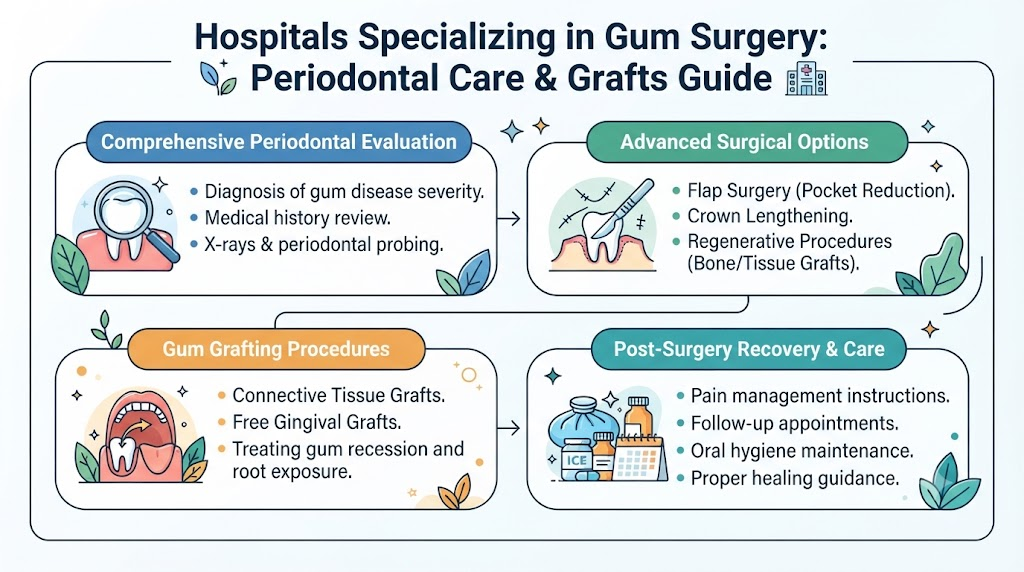
Flap surgery is a foundational treatment for deep periodontal pockets. The periodontist makes tiny, precise incisions in the gum tissue to gently fold it back from the tooth, creating a temporary “flap.” This provides direct visual access to root surfaces, enabling the specialist to remove deep calculus and smooth rough root areas. Once clean, the gum tissue is repositioned against the bone to minimize pocket depth and sutured into place.
Gum Graft Surgery
Gum grafting repairs severe gum recession and reinforces thin, fragile tissue. The specialist takes a small piece of donor tissue—typically from the palate or an approved acellular tissue matrix—and attaches it to the area of recession. As it heals, the graft integrates with existing tissue, covering exposed roots, reducing sensitivity, and protecting against further recession.
Bone Grafting
When periodontitis destroys the supporting jawbone, bone grafting helps rebuild structural volume. The periodontist cleans the infected bone defect and places synthetic, human, or bovine bone graft material into the area. This material acts as a scaffold, encouraging your body to generate new, healthy bone tissue over time.
Guided Tissue Regeneration (GTR)
GTR is a regenerative technique often combined with bone grafting. The periodontist inserts a small, biocompatible membrane between the bone graft and the surrounding soft gum tissue. This barrier prevents fast-growing skin and gum cells from invading the healing site, giving slower-growing bone and ligament cells the time they need to rebuild proper attachment.
Crown Lengthening
Crown lengthening adjusts the levels of gum and bone tissue to expose more of a natural tooth’s structure. This procedure may be performed for cosmetic reasons (to correct a “gummy smile”) or to prepare a damaged, broken, or severely decayed tooth for a supportive dental crown.
Gingivectomy
A gingivectomy involves the precise surgical removal of excess or overgrown gum tissue. It is frequently used to treat gingival hyperplasia—a condition where gums overgrow due to certain prescription medications, genetic factors, or chronic inflammation.
Gum Surgery Services Comparison Table
The following table summarizes common surgical procedures provided by hospital periodontal departments:
| Procedure | Primary Purpose | Best Suited For | Expected Clinical Outcome |
| Flap Surgery | Cleans deep roots and reduces pocket depth. | Persistent pockets measuring 5mm or deeper. | Cleaner root surfaces and reduced pocketing. |
| Gum Grafting | Covers exposed roots and thickens thin tissue. | Moderate to severe gum recession and root exposure. | Covered roots, less sensitivity, and thicker tissue. |
| Bone Grafting | Rebuilds lost jawbone support around teeth. | Vertical or localized bone defects from infection. | Increased bone density and enhanced tooth stability. |
| Guided Tissue Regeneration | Directs selective cell growth using a barrier membrane. | Complex bone and periodontal ligament loss. | Rebuilt periodontal attachment and bone. |
| Crown Lengthening | Recontours gum and bone to expose clear tooth structure. | Teeth broken near the gumline or gummy smiles. | Increased usable tooth height for crowns or esthetics. |
| Gingivectomy | Removes diseased, overgrown, or excess gum tissue. | Drug-induced gum overgrowth or deep false pockets. | Streamlined, easy-to-clean gum contours. |
Services Offered by Leading Hospitals
Choosing a hospital-based periodontics department ensures access to comprehensive clinical care throughout your diagnostic, surgical, and recovery journey.
Hospital Periodontal Care Journey
 ├── Phase 1: Comprehensive Diagnostics (3D CBCT, Digital Charting, Risk Profiles)
 ├── Phase 2: Non-Surgical Pre-Treatment (Scaling, Root Planing, Hygiene Instruction)
 ├── Phase 3: Surgical Intervention (Flap Surgery, Grafts, Laser Therapy in Sterile Suites)
 └── Phase 4: Long-Term Maintenance (Regular Recare Visits & Periodontal Surveillance)
- Specialized Periodontal Consultation: Thorough evaluations conducted by board-certified periodontists who focus exclusively on the health of gums and supporting bone.
- Digital Periodontal Charting: Precise electronic measurement and documentation of pocket depths, tissue recession, bleeding sites, and tooth mobility across all teeth.
- 3D Bone and Tissue Imaging: High-resolution Cone Beam Computed Tomography (CBCT) scans that generate three-dimensional models of the jawbone, revealing subtle bone defects and anatomical structures.
- Deep Non-Surgical Therapy: Thorough scaling and root planing performed prior to surgery to reduce surface bacterial load and calm acute inflammation.
- Advanced Surgical Suite Access: Procedures performed under strict hospital sterile protocols using specialized surgical lighting, magnification, and gentle instrumentation.
- Sedation Options: Choice of local anesthesia, oral sedation, nitrous oxide, or intravenous (IV) conscious sedation to ensure comfort throughout treatment.
- Laser-Assisted Periodontal Therapy: Utilization of targeted dental lasers to disinfect deep pockets, remove diseased epithelial lining, and support tissue healing.
- Long-Term Periodontal Maintenance: Customized cleaning schedules (typically every 3 to 4 months) designed to maintain surgical results and prevent disease recurrence.
Advanced Technologies Used
Modern hospital periodontic centers rely on advanced technologies to enhance procedural precision, reduce surgical discomfort, and accelerate healing.
- Digital Dental Radiography: Low-radiation digital X-rays that provide instant, high-contrast images of interdental bone levels and root anatomy.
- Cone Beam CT (CBCT) Scans: 3D imaging systems that capture clear cross-sectional views of the jawbone, allowing specialists to plan bone grafts and implant placements with high accuracy.
- Laser Periodontal Systems: Advanced dental lasers (such as Nd:YAG or Erbium lasers) that target diseased tissue and bacteria while preserving healthy collagen fibers and speeding up post-operative recovery.
- Ultrasonic and Piezoelectric Surgical Units: Instruments using ultrasonic vibrations to gently remove hardened calculus or trim bone tissue without damaging surrounding soft blood vessels or nerves.
- Surgical Loupes and Operating Microscopes: High-power magnification systems that allow periodontists to view delicate tissues clearly, perform tiny incisions, and place micro-sutures accurately.
- Digital Impression Scanners: Optical scanners that capture precise 3D digital models of the teeth and gums, eliminating the need for uncomfortable traditional impression pastes.
How to Choose the Right Hospital for Gum Surgery
Selecting an appropriate hospital for periodontal surgery involves evaluating clinical qualifications, technological capabilities, and patient safety standards.
                      ┌─────────────────────────────────────────┐
                      │   Hospital Evaluation Criteria          │
                      └────────────────────┬────────────────────┘
                                           │
         ┌─────────────────────────────────┼─────────────────────────────────┐
         ▼                                 ▼                                 ▼
┌──────────────────┐              ┌──────────────────┐              ┌──────────────────┐
│ Clinical Credentials│            │ Advanced Tech    │              │ Care & Safety    │
├──────────────────┤              ├──────────────────┤              ├──────────────────┤
│• Board-certified │              │• 3D CBCT imaging │              │• Strict sterile  │
│  periodontists   │              │• Surgical lasers │              │  protocols       │
│• Experienced     │              │• Piezoelectric   │              │• Structured 3-4  │
│  surgical team   │              │  bone tools      │              │  month recare    │
└──────────────────┘              └──────────────────┘              └──────────────────┘
Consider the following clinical priorities when selecting a medical center:
- Board-Certified Periodontists: Confirm that your treating specialist has completed three or more years of accredited postgraduate training dedicated exclusively to periodontics and implant surgery.
- Dedicated Surgical Facilities: Ensure the facility maintains dedicated, sterile surgical suites designed for oral procedures rather than multi-use examination rooms.
- Comprehensive Diagnostic Capabilities: Look for centers equipped with on-site CBCT 3D imaging and digital periodontal charting tools to eliminate the need for third-party diagnostic referrals.
- Variety of Sedation Options: Verify that the hospital offers monitored sedation services managed by qualified personnel if you experience dental anxiety.
- Multidisciplinary Team Integration: Choose facilities where periodontists work closely with prosthodontists, endodontists, and restorative dentists to address all aspects of your treatment seamlessly.
- Structured Post-Surgical Follow-Up: Select centers that emphasize long-term maintenance programs, offering scheduled follow-up visits to monitor healing and protect your investment.
Hospital Selection Checklist
Use this practical checklist when researching dental hospitals and evaluating treatment options:
| Feature | What to Look For | Why It Matters |
| Specialist Credentials | Board certification in periodontics and dental implantology. | Ensures advanced expertise in soft and hard tissue surgery. |
| 3D CBCT Imaging | On-site high-resolution 3D volumetric scanning capabilities. | Enables accurate mapping of bone defects and anatomical structures. |
| Sterile Surgical Suites | Hospital-grade sterilization protocols and dedicated surgical suites. | Minimizes infection risks during open-tissue procedures. |
| Sedation Services | Availability of oral, nitrous oxide, or IV conscious sedation options. | Guarantees patient comfort during extensive or multi-site surgeries. |
| Laser Capability | Availability of specialized dental lasers for tissue disinfection. | Provides less invasive treatment options for selected conditions. |
| Structured Maintenance | Customized 3 to 4 month periodontal recare and hygiene programs. | Prevents disease recurrence and supports long-term healing. |
What to Expect During Gum Surgery
Understanding what happens before, during, and after your procedure helps reduce anxiety and allows you to prepare effectively for your hospital visit.
Initial Consultation and Clinical Diagnosis
Your journey begins with an in-depth consultation. Your periodontist will review your medical history, record full-mouth pocket measurements, assess tooth mobility, and take necessary 3D digital images.
Comprehensive Treatment Planning
The specialist presents a clear treatment plan detailing the chosen surgical procedures, expected outcomes, sedation options, financial estimates, and pre-operative preparation steps.
       Step 1: Clinical Diagnosis & Full Periodontal Charting
                            │
                            ▼
       Step 2: 3D CBCT Scan & Custom Treatment Planning
                            │
                            ▼
       Step 3: Administration of Local Anesthesia or Sedation
                            │
                            ▼
       Step 4: Surgical Procedure (Flap / Graft / Bone Regeneration)
                            │
                            ▼
       Step 5: Suturing, Periodontal Dressing, & Post-Op Review
Anesthesia and Surgical Execution
On the day of surgery, local anesthesia is administered to numb the treatment site completely. If elected, intravenous or oral sedation is initiated. The periodontist carefully accesses the underlying tissue, clears deep bacterial deposits, shapes bone contours or places grafts as needed, and secures the tissue with tiny sutures. A protective surgical bandage (periodontal dressing) may be placed over the site.
Immediate Post-Operative Review
Before you return home, your care team provides detailed written discharge instructions, prescribes necessary medications (such as antibiotics or antiseptic rinses), and schedules your initial follow-up appointment.
Recovery After Gum Surgery
Proper post-operative care is essential to support tissue healing, reduce discomfort, and protect surgical grafts or bone materials.
- Expect Mild Swelling and Discomfort: Temporary swelling, minor bleeding, and mild discomfort are normal for the first 24 to 72 hours. Applying an ice pack to the outside of your cheek in 20-minute intervals helps minimize swelling.
- Follow a Soft-Food Diet: Stick to cool, soft foods—such as yogurt, smoothies, scrambled eggs, mashed potatoes, and lukewarm soups—for the first week. Avoid hot, spicy, acidic, crunchy, or hard foods that could irritate healing tissue.
- Maintain Gentle Oral Hygiene: Do not brush or floss directly over the surgical site until your periodontist explicitly gives permission. Instead, keep the rest of your mouth clean using standard brushing while using a prescribed chlorhexidine antiseptic mouthwash to gently disinfect the surgical area.
- Take Prescribed Medications as Directed: Complete the full course of any prescribed antibiotics to prevent infection, and use recommended pain relievers as directed to manage discomfort.
- Avoid Tobacco Products Entirely: Do not smoke, vape, or use tobacco during recovery. Nicotine constricts blood vessels, severely reducing oxygen flow to healing tissues and significantly increasing the risk of graft failure or infection.
- Attend Scheduled Follow-Up Visits: Return to the hospital as scheduled (typically 7 to 14 days after surgery) so your periodontist can evaluate healing progress, remove non-resorbable sutures, and guide your return to normal hygiene routines.
Possible Risks and Complications
While periodontal surgery performed in accredited dental hospitals is safe, all surgical procedures carry inherent risks. Understanding these potential complications helps you identify issues early and seek prompt care.
- Post-Operative Bleeding: Minor oozing for the first 24 hours is expected. However, continuous, active bleeding that does not stop after biting gently on a damp gauze pad requires immediate clinical attention.
- Surgical Site Infection: Bacterial contamination can occur during healing. Symptoms include worsening pain, increased swelling, fever, or unpleasant taste/discharge from the incision line.
- Temporary Tooth Sensitivity: As gums heal and settle into healthier, firmer positions, exposed root surfaces may feel temporarily sensitive to hot or cold temperatures. Using desensitizing toothpastes helps manage this symptom over time.
- Mild Gum Recession: As inflamed, swollen gums heal and tighten around the teeth, the final gumline may sit slightly lower than before surgery, making teeth appear slightly longer.
- Delayed Healing or Graft Dislodgement: Excessive mechanical pressure, smoking, or premature brushing can dislodge placed bone or soft tissue grafts, leading to delayed healing.
Promptly contacting your care team if you experience unexpected symptoms ensures that minor issues are addressed before they affect your overall results.
How BESTDENTALHOSPITALS Helps Patients
Navigating specialized dental options and selecting an appropriate facility for complex procedures can feel overwhelming. Platform resources simplify your search and support informed decision-making.
- Dental Hospital Discovery: Access organized information about accredited dental hospitals, periodontic clinics, and oral surgery centers.
- Specialist Qualifications: Learn how different medical centers structure their periodontal departments, surgical technology, and clinical teams.
- Patient-Centered Education: Read clear, medically accurate explanations of periodontitis, flap surgery, tissue grafting, and recovery protocols.
- Periodontal Procedure Guides: Explore resources covering non-surgical deep cleanings, bone regeneration, dental implants, and long-term maintenance.
- Empowered Decision-Making: Use practical checklists, diagnostic summaries, and expert insights to prepare for consultations and choose facilities that meet your specific needs.
Common Mistakes People Make
Achieving long-term periodontal health involves avoiding common habits and oversights that can compromise surgical results:
Common Mistakes to Avoid
 ├── Ignoring Early Signs (Bleeding Gums & Persistent Bad Breath)
 ├── Delaying Surgery Until Severe Tooth Mobility Occurs
 ├── Aggressive Brushing Directly Over Healing Surgical Sites
 ├── Skipping 3–4 Month Periodontal Maintenance Recare Visits
 └── Continuing Smoking or Tobacco Use During Healing
Ignoring Bleeding Gums and Early Symptoms
Assuming that bleeding during brushing is “normal” allows mild gingivitis to progress silently into destructive periodontitis. Seeking early evaluation prevents the need for extensive surgical interventions later.
Delaying Recommended Surgery
Postponing recommended periodontal surgery allows deep bacterial infection to continue destroying jawbone. Delaying care can lead to severe bone loss, making future tooth retention or dental implant placement much more difficult.
Disrupting the Healing Site Early
Brushing vigorously directly over fresh incision lines, picking at surgical sutures, or eating hard, sharp foods too soon can dislodge delicate tissue grafts and delay healing.
Skipping Long-Term Periodontal Maintenance
Assuming that surgery permanently “cures” periodontitis is a mistake. Without regular 3 to 4 month professional cleanings and diligent home care, harmful bacteria can return and cause recurrent infection.
Continuing Tobacco Use
Smoking or vaping significantly impairs blood circulation in gum tissue, weakening the immune response and markedly increasing the risk of surgical complications or graft failure.
Common Myths vs. Facts
Clearing up common misunderstandings helps patients approach periodontal surgery with clear expectations:
| Myth | Fact |
| Gum surgery is purely cosmetic. | While procedures like crown lengthening improve smile appearance, most gum surgeries treat severe infection and protect supporting bone. |
| Bleeding gums during brushing are normal. | Healthy gums never bleed during routine brushing or flossing. Bleeding is an early sign of inflammation or infection that warrants evaluation. |
| Gum disease is always accompanied by pain. | Periodontitis is often called a “silent” condition because severe bone loss can occur with little to no pain until teeth become loose. |
| Gum surgery permanently cures periodontitis. | Surgery controls infection and reduces pocket depths, but long-term success requires lifelong oral hygiene and regular professional maintenance. |
| Teeth will look unnaturally long after surgery. | Modern periodontic techniques focus on preserving natural tissue contours and, when appropriate, rebuilding lost tissue using grafts. |
Real-Life Educational Scenarios
Scenario 1: Controlling Advanced Periodontitis Through Flap Surgery
A patient in their mid-forties experiences persistent bleeding, deep 6-millimeter pockets, and mild bone loss around their molar teeth. Non-surgical deep cleanings provide partial improvement, but deep infection remains. Their periodontist performs flap surgery under local anesthesia to clear deeply buried calculus and smooth root surfaces. Six months later, pocket depths measure a healthy 3 millimeters, making the area easy to keep clean at home.
Scenario 2: Repairing Severe Gum Recession with a Soft Tissue Graft
An individual notices marked gum recession and sharp temperature sensitivity on a lower canine tooth caused by past aggressive brushing. A periodontist places a connective tissue graft over the exposed root surface. As the site heals, new tissue covers the root, eliminating temperature sensitivity and protecting the tooth from further recession.
Scenario 3: Rebuilding Bone Structure Prior to Dental Implant Placement
A patient seeking to replace a missing tooth learns that chronic periodontitis destroyed significant jawbone volume at the extraction site. Their periodontist performs a bone graft combined with guided tissue regeneration to rebuild structural volume. After six months of healing, a 3D CBCT scan confirms adequate bone density, allowing for successful dental implant placement.
Scenario 4: Maintaining Health Through Regular Recare Visits
Following successful multi-site flap surgery, a patient commits to a strict 3-month periodontal maintenance schedule at their dental hospital. During each visit, the hygienist and periodontist review pocket depths, clear early plaque buildup, and evaluate tissue health. By adhering to this routine, the patient maintains healthy gums and stable bone support over time.
FAQs (15 Questions)
1. What is gum surgery?
Gum surgery (periodontal surgery) refers to specialized dental procedures performed to treat advanced gum disease, reduce deep bacterial pockets, cover exposed roots, rebuild lost jawbone, and restore tissue support around teeth.
2. Who needs periodontal surgery?
Surgery is recommended for individuals with advanced periodontitis, persistent deep pockets (5mm or deeper), severe gum recession, significant bone loss, or areas of infection that do not respond to non-surgical deep cleanings.
3. Is gum surgery painful?
Surgeries are performed under local anesthesia—often combined with oral or IV sedation—ensuring you feel no pain during the procedure. Post-operative discomfort is generally mild to moderate and manageable with recommended pain relievers.
4. How long does recovery usually take?
Initial soft tissue healing takes about 7 to 14 days, during which sutures are removed or dissolve naturally. Complete internal bone and tissue regeneration takes several months, though most individuals return to normal work routines within 1 to 3 days.
5. What is flap surgery?
Flap surgery involves making precise incisions to gently fold back gum tissue, exposing deep root surfaces for thorough cleaning, calculus removal, and pocket depth reduction before the tissue is sutured back into place.
6. What is a gum graft?
A gum graft is a surgical procedure where donor tissue is attached to an area of severe recession to cover exposed tooth roots, reduce sensitivity, and reinforce thin tissue.
7. Can gum disease return after surgery?
Yes. Periodontitis can return if diligent daily oral hygiene is neglected or if scheduled 3 to 4 month professional maintenance visits are missed. Consistent long-term care is essential to maintain results.
8. How should I care for my mouth after surgery?
Eat soft, cool foods, avoid brushing directly over the surgical site until cleared, use prescribed antiseptic mouth rinses, take all medications as directed, and avoid smoking completely during recovery.
9. Are dental implants possible after gum disease treatment?
Yes. Once active periodontal infection is fully controlled and any necessary bone grafting is complete, dental implants can be safely placed to replace missing teeth.
10. What technologies improve gum surgery outcomes?
Key technologies include 3D CBCT imaging, digital periodontal charting, specialized dental lasers, piezoelectric bone cutting tools, and high-power surgical magnification.
11. How do I choose the right hospital for gum surgery?
Look for facilities with board-certified periodontists, dedicated sterile surgical suites, 3D CBCT diagnostic imaging, comprehensive sedation options, and structured long-term maintenance programs.
12. What are the risks associated with periodontal surgery?
Potential risks include temporary post-operative bleeding, minor infection, temporary tooth sensitivity to hot and cold, slight gum recession as tissues heal, and delayed healing if post-op instructions are not followed.
13. How can gum disease be prevented?
Prevent gum disease by brushing twice daily with fluoride toothpaste, flossing daily, eating a balanced diet, avoiding tobacco products, and visiting your dentist regularly for professional cleanings and checkups.
14. How often should I see a periodontist after surgery?
After successful surgery, most patients enter a periodontal maintenance program, visiting their periodontist or specialized hygienist every 3 to 4 months for targeted monitoring and deep cleaning.
15. How does BESTDENTALHOSPITALS help patients find facilities for gum surgery?
BESTDENTALHOSPITALS provides educational information, guidance on periodontic specialties, and tools to help patients locate qualified dental hospitals, compare treatment options, and make informed choices about their oral care.
Final Thoughts
Addressing advanced gum disease through timely periodontal surgery is a vital investment in your long-term oral and systemic health. Leaving deep bacterial infection untreated can lead to progressive bone loss, tooth mobility, and eventual tooth loss, while treatment restores stability and protects your smile.Partnering with a qualified periodontist in a well-equipped dental hospital ensures that your treatment plan is grounded in accurate 3D diagnostics, safe surgical practices, and gentle patient care.