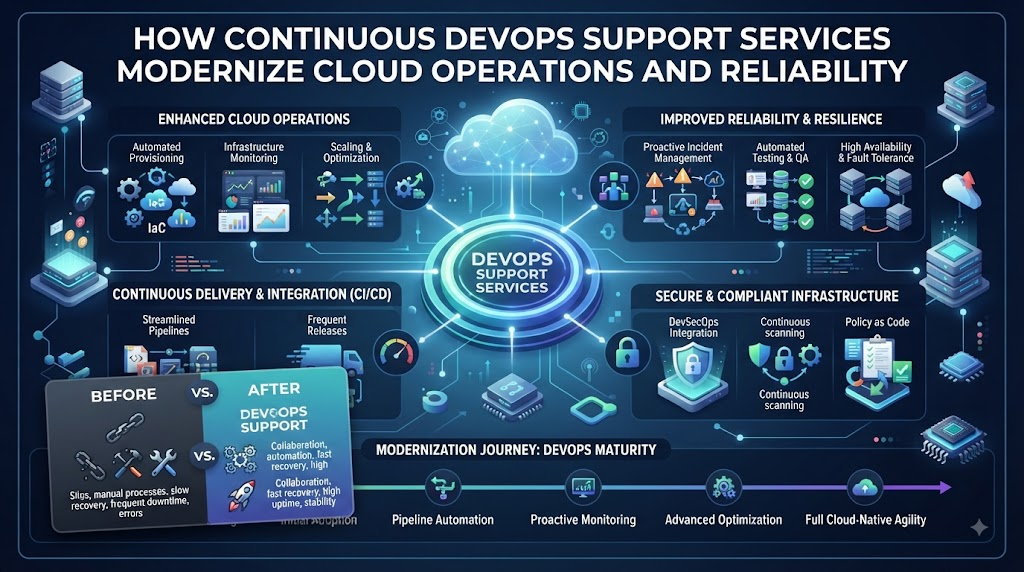
Software delivery ecosystems have evolved from straightforward, single-server setups into multi-cloud networks, microservices architectures, and complex automated pipelines. While these modern technologies allow engineering teams to build resilient, feature-rich applications, they also introduce significant operational overhead. Today’s software teams frequently encounter severe operational hurdles, including unexpected production incidents, subtle configuration drift across environments, brittle CI/CD delivery pipelines, and significant visibility gaps within containerized platforms like Kubernetes.Establishing a sustainable operational foundation requires a clear, strategic bridge between application development and infrastructure maintenance. Ongoing DevOps support services provide engineering teams with the technical skills, continuous monitoring, and infrastructure automation needed to run stable, secure, and scalable cloud applications in production.
What Are DevOps Support Services?
DevOps support services provide continuous operational assistance, infrastructure maintenance, and automation management for modern software environments. Unlike traditional software development, which focuses on building new application features, DevOps support focuses on keeping delivery systems operational, scalable, reproducible, and secure.
At its core, DevOps support encompasses several key technical domains:
- Infrastructure Operations: Managing cloud platforms, virtual networks, compute instances, storage, and database configurations using Infrastructure as Code (IaC) tooling like Terraform and OpenTofu.
- Continuous Integration and Continuous Delivery (CI/CD): Maintaining, optimizing, and troubleshooting automated build and deployment workflows to ensure code moves reliably from developer workstations to production environments.
- Monitoring and Observability: Configuring telemetry collection—metrics, logs, and distributed traces—to maintain visibility into application health and resource usage.
- Incident Management: Investigating system anomalies, resolving production outages, conducting root-cause analysis, and implementing preventive operational fixes.
It is critical to distinguish one-time DevOps consulting from continuous DevOps support. A one-time consulting project usually involves designing an initial architecture, building a standard CI/CD pipeline, or migrating an application to a cloud provider. However, operational needs do not end when a migration project finishes. Systems drift, software dependencies require updates, cloud providers roll out new APIs, traffic spikes occur, and security vulnerabilities emerge. Continuous DevOps support provides ongoing operational care, ensuring that infrastructure remains stable, updated, and aligned with evolving industry standards long after initial deployment.
Why Organizations Need Ongoing DevOps Support
Modern cloud environments are dynamic. Continuous code releases, microservice updates, auto-scaling events, and routine security patches mean that cloud infrastructure is constantly changing. Without continuous monitoring and proactive maintenance, even the most elegantly designed cloud architectures can gradually decay into unstable, fragile environments.
Engineering teams face significant pressure to balance feature velocity with operational stability. When an organization relies solely on feature developers to handle infrastructure operations, several operational challenges arise:
- Context Switching: Software developers forced to drop feature work to handle deployment failures or cloud configuration errors lose focus, slowing down application delivery schedules.
- Specialized Skill Gaps: Modern cloud operations require deep expertise across multiple specialized domains, including container orchestration, service meshes, cloud security, network design, and observability platforms. Finding and retaining internal expertise in every area can be difficult for growing companies.
- Operational Fatigue: Unstructured on-call rotations and regular middle-of-the-night alerts strain internal engineering teams, leading to reduced productivity and high staff turnover.
- Configuration Drift: Without ongoing oversight, environments branch into custom, undocumented states, making future updates unpredictable and risky.
Ongoing DevOps support complements internal development teams by providing dedicated operational expertise. While internal developers remain focused on application logic, user experience, and business value, specialized DevOps support engineers handle the underlying delivery mechanisms, cloud environments, and operational tooling. This division of responsibility improves overall operational efficiency while allowing core product teams to innovate faster.
24/7 DevOps Support Services
In a global digital market, software applications are expected to remain reachable and responsive at all times. A critical system failure, database deadlock, or security breach occurring outside normal business hours can cause service disruptions and lost revenue. 24/7 DevOps Support Services provide round-the-clock operational oversight to ensure continuous system availability and fast incident response.
Continuous 24/7 operational support typically involves several active workstreams:
- Real-Time Telemetry and Alerting: Setting up automated monitoring platforms that actively scan infrastructure metrics, error budgets, and application response times to flag anomalies before end users are impacted.
- Rapid Incident Triage: Establishing clear escalation paths and automated paging workflows so that active outages receive immediate technical triage, day or night.
- Deployment Assistance: Providing operational assistance for off-hours production releases, minimizing risks during high-traffic windows or complex system updates.
- Infrastructure Continuity: Executing routine maintenance, automated backup validations, and system maintenance tasks during low-traffic operational windows.
Rather than relying on vague performance guarantees, modern 24/7 operations focus on establishing defined operational response workflows, thorough documentation, and reliable escalation policies. Operating globally or supporting mission-critical software demands a systematic operational approach that mitigates risks and keeps services running smoothly around the clock.
Managed DevOps Services
As software environments become more complex, many organizations move away from ad-hoc task handling toward Managed DevOps Services. Under a managed services model, an external team takes functional ownership of day-to-day infrastructure maintenance, delivery workflows, security scanning, and system updates based on structured SLAs and operational guidelines.
| Traditional Internal Operations | Managed DevOps Services |
| Handled by internal developers as side-tasks | Managed by dedicated cloud operations specialists |
| Ad-hoc, unstructured maintenance schedules | Standardized, repeatable, documented operations |
| Knowledge isolated within individual team members | Shared operational workflows and team coverage |
| High vulnerability to context-switching and fatigue | Clear operational focus with proactive system tuning |
Managed DevOps covers recurring operational responsibilities, including automated environment provisioning, identity and access management (IAM) audits, cloud cost optimization, container platform upgrades, and release management.
This model works well for growing businesses, SaaS companies, and enterprises that want to focus internal engineering resources on product development while ensuring their underlying cloud platforms are maintained by experienced engineers. Conversely, organizations with highly proprietary internal tools or strict regulatory limitations may prefer to retain all infrastructure management within in-house teams. Evaluating team capacity, technical requirements, and business priorities helps determine the right operating model.
Kubernetes Support Services
Containerization has fundamentally altered how applications are built and shipped. Kubernetes has emerged as the industry standard for container orchestration, providing powerful features for self-healing, automated scaling, traffic routing, and resource management. However, running Kubernetes in production introduces significant operational complexity.
Managing production Kubernetes clusters requires active management across several areas:
- Cluster Upgrades and Lifecycle: Executing control plane and worker node upgrades without introducing service downtime or breaking API compatibilities.
- Resource Optimization: Configuring pod resource requests, limits, and cluster auto-scalers to ensure compute capacity matches demand without overspending on cloud resources.
- Networking and Ingress Management: Operating ingress controllers, service meshes, network policies, and internal DNS setups to guarantee secure, performant pod-to-pod and external communication.
- Security and Policy Enforcement: Implementing role-based access control (RBAC), pod security standards, network segmentation, and runtime vulnerability scanning.
       +-------------------------------------------------------+
       |             Kubernetes Management Plane               |
       +-------------------------------------------------------+
                                   |
         +-------------------------+-------------------------+
         |                                                   |
         v                                                   v
+------------------+                               +-------------------+
|  AWS EKS / EC2   |                               |  Azure AKS / VMs  |
+------------------+                               +-------------------+
| Pod Autoscaling  |                               | Cluster Upgrades  |
| Ingress Control  |                               | RBAC / Security   |
| Node Lifecycle   |                               | Volume Provision  |
+------------------+                               +-------------------+
Whether using managed Kubernetes engines like AWS EKS, Azure AKS, or Google GKE, maintaining production-grade container clusters demands specialized operational attention. Dedicated Kubernetes support ensures workloads remain stable, isolated, resource-efficient, and updated against emerging security vulnerabilities.
AWS DevOps Support Services
Amazon Web Services (AWS) provides a vast ecosystem of cloud infrastructure primitives and managed solutions. However, architecting, securing, and maintaining an AWS environment requires a deep understanding of cloud-native best practices and infrastructure management tools.
AWS DevOps support helps engineering teams run secure, resilient, and cost-effective cloud workloads using core AWS services and methodologies:
- Container Operations: Configuring, scaling, and maintaining containerized environments running on Elastic Kubernetes Service (EKS) or Elastic Container Service (ECS).
- Serverless and Compute Management: Managing compute capacity, auto-scaling groups, Elastic Compute Cloud (EC2) instances, and serverless architectures like AWS Lambda.
- Infrastructure as Code (IaC): Writing, modularizing, and executing IaC configurations using Terraform or AWS CloudFormation to ensure all cloud resources are reproducible and version-controlled.
- Deployment Pipelines: Building secure build and release workflows using native tools like AWS CodePipeline or integrating third-party CI/CD orchestrators into AWS IAM and VPC environments.
- Cloud Observability: Implementing Amazon CloudWatch, AWS X-Ray, and third-party monitoring platforms to maintain real-time visibility into infrastructure health, API performance, and resource costs.
Because every enterprise workload has unique latency, regulatory, and traffic requirements, AWS support focuses on tailoring cloud architectures to real-world usage patterns rather than enforcing a rigid, one-size-fits-all setup.
Azure DevOps Support Services
For organizations operating within Microsoft Azure, maintaining cloud efficiency requires tailored expertise across Azure infrastructure tools, deployment pipelines, and enterprise identity management systems.
Azure DevOps support services guide engineering teams through the operational nuances of the Azure platform:
- Azure Pipelines and CI/CD: Designing, securing, and maintaining automated build, test, and release workflows that connect seamlessly with Azure app services, virtual machine scale sets, and container targets.
- Azure Kubernetes Service (AKS): Administering AKS clusters, managing node pools, setting up Azure CNI networking, and enforcing container security standards.
- Infrastructure Automation: Deploying and maintaining Azure environments through declarative Bicep, ARM templates, or Terraform workflows.
- Enterprise Identity and Access Management: Integrating Azure Active Directory (Microsoft Entra ID) into cloud workloads, setting up fine-grained RBAC, and enforcing managed identities across services to reduce hardcoded credentials.
- Observability and Monitoring: Utilizing Azure Monitor, Log Analytics, and Application Insights to track infrastructure metrics, set up alerts, and diagnose performance bottlenecks across distributed applications.
Targeted Azure operational support helps organizations establish repeatable infrastructure management workflows, maintain security compliance, and prevent unexpected cloud costs.
DevSecOps Support Services
Historically, security testing was often treated as an after-the-fact checkpoint late in the software development lifecycle. This delayed approach frequently led to urgent, expensive code refactoring right before scheduled release dates. DevSecOps shifts security responsibilities to the early stages of software engineering, integrating security practices directly into daily automated delivery workflows.
       +-------------------------------------------------------+
       |                 Continuous Security                   |
       +-------------------------------------------------------+
                                   |
    +------------------------------+------------------------------+
    |                              |                              |
    v                              v                              v
+-----------------------+ +------------------+  +-----------------------+
|    Code & Pipeline    | |   Containers     |  |     Runtime & IAM     |
+-----------------------+ +------------------+  +-----------------------+
| SAST / DAST Scans     | | Image Scans      |  | Secrets Management    |
| Dependency Checks     | | Base Image Audit |  | Compliance Audits     |
+-----------------------+ +------------------+  +-----------------------+
DevSecOps support services integrate continuous security controls across the entire software delivery pipeline:
- Static and Dynamic Analysis (SAST/DAST): Embedding automated code and security scanning tools directly into CI/CD pipelines to catch code vulnerabilities and security flaws during development.
- Dependency and Container Scanning: Automatically auditing software libraries, third-party packages, and container base images for known vulnerabilities (CVEs) before code reaches production.
- Secrets Management: Replacing hardcoded passwords, API tokens, and access keys with dynamic secrets engines like HashiCorp Vault or cloud-native secrets managers.
- Policy as Code: Enforcing infrastructure security standards automatically, blocking misconfigured cloud resources or open storage buckets before deployment.
Treating security as a continuous, automated component of software delivery reduces system vulnerabilities, simplifies regulatory compliance, and protects applications without slowing down deployment speeds.
SRE Support Services
Site Reliability Engineering (SRE) applies software engineering principles to solve operational and infrastructure problems. SRE creates a balanced framework between software delivery speed and system reliability, ensuring applications remain stable under high traffic demands.
Key SRE concepts and operational practices include:
- Service Level Indicators (SLIs): Defining precise, measurable metrics—such as request latency, error rate, or throughput—that reflect the real-time quality of a service.
- Service Level Objectives (SLOs): Setting target values for SLIs that establish acceptable performance thresholds (e.g., maintaining an API latency below 200ms for 99.9% of incoming requests).
- Error Budgets: Calculating the acceptable amount of system downtime or error tolerance. If an application operates well within its error budget, product teams can release features faster; if the error budget is exhausted, releases pause while developers focus on stability fixes.
- Observability Frameworks: Moving beyond standard infrastructure uptime checks to implement distributed tracing, structured logging, and application performance monitoring (APM).
- Blameless Post-Mortems: Conducting objective, data-driven post-incident reviews focused on improving system resilience, documentation, and automation rather than pointing fingers at individuals.
SRE support services help organizations design reliable operational frameworks, establish meaningful observability systems, reduce operational toil through automation, and maintain system stability as application workloads scale.
MLOps Support Services
As artificial intelligence and machine learning (ML) models transition from experimental prototypes to mission-critical production systems, the need for specialized operational support has grown rapidly. Machine learning systems face unique operational challenges compared to standard software, including data drift, complex hardware dependency management, and resource-intensive training pipelines.
MLOps (Machine Learning Operations) support applies proven DevOps principles—such as version control, automated testing, continuous deployment, and monitoring—to machine learning workflows:
  +--------------------+      +--------------------+      +--------------------+
  |   Data & Model     | ---> |   Automated ML     | ---> |   Production       |
  |   Versioning       |      |   Pipelines        |      |   Deployment       |
  +--------------------+      +--------------------+      +--------------------+
            ^                                                       |
            |                 Continuous Feedback                   |
            +-------------------------------------------------------+
                                Model Monitoring
- Pipeline Automation: Building repeatable data-ingestion, feature-engineering, model-training, and evaluation pipelines using frameworks like Kubeflow, MLflow, or cloud-native ML tools.
- Model Deployment: Deploying trained models as scalable microservices using containerized serving infrastructures.
- Data and Model Drift Monitoring: Tracking production inference requests to detect changes in input data distributions or model accuracy over time, triggering automated model retraining when needed.
- Resource Optimization: Managing specialized compute hardware, such as GPUs and high-memory instances, to handle training and inference costs efficiently.
MLOps support bridges the operational gap between data science teams and cloud infrastructure engineers, ensuring machine learning models move smoothly from research environments into reliable, scalable production systems.
DevOps Support Technology Areas
Modern cloud operations rely on a wide range of specialized tools and practices across different operational domains:
| Operational Area | Common Tools and Frameworks | Primary Function |
| CI/CD | Jenkins, GitHub Actions, GitLab CI, Azure Pipelines | Automates code integration, testing, and deployment. |
| Cloud Platforms | AWS, Microsoft Azure, Google Cloud Platform (GCP) | Provides scalable, managed cloud infrastructure primitives. |
| Containers & Orchestration | Docker, Kubernetes, Helm, ArgoCD | Ensures application container packaging and runtime management. |
| Infrastructure as Code | Terraform, OpenTofu, AWS CloudFormation, Bicep | Enables repeatable, code-driven cloud provisioning. |
| Observability | Prometheus, Grafana, Datadog, OpenTelemetry | Delivers real-time monitoring, metrics, and distributed tracing. |
| DevSecOps | SonarQube, Trivy, HashiCorp Vault, Snyk | Automates security scanning, secrets management, and compliance checks. |
| SRE | OpenTelemetry, PagerDuty, Chaos Mesh | Standardizes reliability tracking, SLO management, and chaos testing. |
| MLOps | MLflow, Kubeflow, Feast, Triton Inference Server | Coordinates machine learning pipeline training and deployment. |
Benefits of Continuous DevOps Support
Investing in ongoing DevOps support provides strategic operational advantages for growing engineering organizations:
- Faster Incident Resolution: Proactive monitoring, structured triage workflows, and experienced on-call support significantly reduce Mean Time to Detect (MTTD) and Mean Time to Recovery (MTTR).
- Reduced Manual Work (Toil): Automating repetitive tasks like environment provisioning, deployment scripts, and backups frees up engineering capacity.
- Enhanced System Observability: Unified dashboards, centralized log aggregators, and distributed tracing provide clear visibility into system health and performance bottlenecks.
- Consistent Releases: Standardized, automated CI/CD pipelines eliminate manual deployment errors and ensure software updates roll out smoothly.
- Stronger Security Posture: Automated vulnerability scanning, policy enforcement, and proactive patching reduce application security risks.
- Improved Cloud Efficiency: Active infrastructure right-sizing, clean-up of unused resources, and modern cloud design principles prevent cost overruns.
Common DevOps Support Challenges
While continuous operational support delivers significant value, organizations can run into challenges if support workflows are poorly planned or implemented:
- Inadequate Documentation: Incomplete infrastructure guides, missing architecture diagrams, and tribal knowledge slow down troubleshooting and onboarding.
- Unclear Operational Ownership: Lack of clear boundaries between application development duties and infrastructure support tasks leads to missed alerts and delayed deployments.
- Weak Observability Systems: Basic uptime checks that lack deep metrics or tracing fail to highlight performance bottlenecks before failures occur.
- Configuration Drift: Manual infrastructure edits made directly in cloud consoles break IaC synchronization, leading to deployment failures later on.
- Alert Fatigue: Overly sensitive, untuned monitoring alerts flood engineers with non-critical notifications, causing real incidents to be missed.
- Inconsistent Environments: Misaligned configurations between staging, test, and production environments cause unexpected deployment errors.
- Siloed Communication: Poor communication channels between developers, operational support teams, and security engineers create project delays.
- Incomplete Knowledge Transfer: Failure to share technical insights between external support partners and internal developers creates dependencies on specific individuals.
- Overreliance on Third Parties: Outsourcing infrastructure tasks without maintaining internal visibility into system designs weakens an organization’s long-term technical control.
- Delayed Security Integration: Treating security audits as an afterthought rather than integrating security automated checks into daily operations causes delivery delays.
How to Choose a DevOps Support Company
Selecting an external DevOps support partner requires a careful, methodical evaluation of their technical capabilities, communication protocols, and operational alignment.
       +-------------------------------------------------------+
       |             Provider Evaluation Framework             |
       +-------------------------------------------------------+
                                   |
         +-------------------------+-------------------------+
         |                                                   |
         v                                                   v
+------------------+                               +-------------------+
| Technical Depth  |                               | Operational Fit   |
+------------------+                               +-------------------+
| Multi-Cloud      |                               | Clear SLAs        |
| Kubernetes/IaC   |                               | Escalation Paths  |
| DevSecOps/SRE    |                               | Documentation     |
+------------------+                               +-------------------+
When evaluating potential DevOps support providers, technical leaders should consider several core factors:
- Technical Expertise: Verify deep hands-on experience across major cloud providers (AWS, Azure, GCP), container platforms (Kubernetes), and Infrastructure as Code tooling (Terraform).
- Security Practices: Confirm strict adherence to industry security standards, secure credential handling, RBAC enforcement, and compliance practices.
- Incident Management Protocols: Review the provider’s escalation policies, response workflows, and communication channels during critical outages.
- SLA Structures: Evaluate Service Level Agreements (SLAs) for initial response times and triage standards based on issue severity levels.
- Documentation Standards: Ensure the provider documents all infrastructure configurations, automation pipelines, and runbooks clearly.
- Team Alignment: Look for providers that operate as a collaborative extension of your internal team, emphasizing transparent communication and knowledge sharing.
Support Area and Business Need
Different operational support structures align with specific technical priorities and business stages:
| Support Model | Primary Business Goal |
| DevOps Support | Delivers ongoing operational maintenance for cloud infrastructure and delivery pipelines. |
| 24/7 DevOps Support | Provides continuous monitoring, rapid alert triage, and off-hours incident response. |
| Managed DevOps | Offloads recurring cloud administration, maintenance, and environment management. |
| Kubernetes Support | Ensures container cluster stability, autoscaling, updates, and performance tuning. |
| AWS DevOps Support | Tailors cloud architecture, IaC management, and container delivery within AWS. |
| Azure DevOps Support | Manages enterprise Microsoft Azure platforms, pipelines, and identity integrations. |
| DevSecOps Support | Integrates automated security scanning, policy checks, and compliance into CI/CD workflows. |
| SRE Support | Establishes SLOs, observability standards, and reliability engineering practices. |
| MLOps Support | Maintains automated machine learning pipelines, model monitoring, and inference infrastructure. |
Frequently Asked Questions (FAQ)
1. What are DevOps Support Services?
DevOps support services provide ongoing management, optimization, troubleshooting, and automation for cloud infrastructure, CI/CD pipelines, container environments, and monitoring systems. They ensure software delivery platforms remain reliable, scalable, and secure.
2. Why do companies need ongoing DevOps support?
Modern cloud environments undergo continuous changes, updates, and scaling events. Ongoing support ensures infrastructure updates, security patches, deployment pipelines, and monitoring systems are proactively maintained, allowing developers to focus on building products.
3. What do 24/7 DevOps Support Services include?
24/7 support services provide round-the-clock infrastructure monitoring, rapid incident response, deployment assistance during off-peak hours, and active system troubleshooting to maintain continuous application availability.
4. What is the difference between managed DevOps and DevOps support?
DevOps support typically provides specialized, task-level assistance, incident response, and pipeline troubleshooting. Managed DevOps involves broader operational responsibility, where an external team continuously manages cloud administration, infrastructure updates, security posture, and release management.
5. When is Kubernetes support useful?
Kubernetes support is valuable when teams face operational challenges managing complex container clusters, executing zero-downtime upgrades, tuning auto-scaling rules, configuring ingress/mesh networking, or securing containerized production workloads.
6. What does AWS DevOps support involve?
AWS support covers managing infrastructure using Terraform or CloudFormation, maintaining container environments on EKS or ECS, configuring serverless architectures, managing compute instances, and optimizing AWS monitoring and deployment workflows.
7. How does DevSecOps support improve system security?
DevSecOps support embeds automated security tools directly into daily CI/CD workflows. This enables static code analysis, third-party dependency scanning, container vulnerability audits, and policy enforcement to catch vulnerabilities early in development.
8. What is the role of SRE and MLOps support?
SRE support focuses on reliability engineering, observability, blameless post-mortems, and error budget management. MLOps support provides specialized infrastructure assistance for machine learning workflows, including automated model training pipelines, inference deployment, and data drift monitoring.
Conclusion
Modern software delivery requires a thoughtful balance between fast feature development and robust operational stability. As cloud infrastructure becomes more complex—incorporating container orchestration, multi-cloud platforms, continuous security checks, and machine learning pipelines—relying on unorganized, ad-hoc maintenance creates severe operational risks and developer burnout.A structured operational strategy connects every layer of the delivery ecosystem. Integrating continuous monitoring, Infrastructure as Code, automated delivery pipelines, and proactive incident management helps engineering teams maintain resilient, highly available systems. The ideal support model depends on an organization’s internal skills, regulatory demands, system complexity, and long-term product roadmaps.