Introduction
Wisdom teeth, often called third molars, are the final set of teeth to emerge. For many individuals, these teeth can develop without incident. However, for a significant number of people, wisdom teeth do not have enough space to grow properly, leading to complications such as impaction, pain, and infection. When these issues arise, professional intervention is necessary to protect your overall oral health.
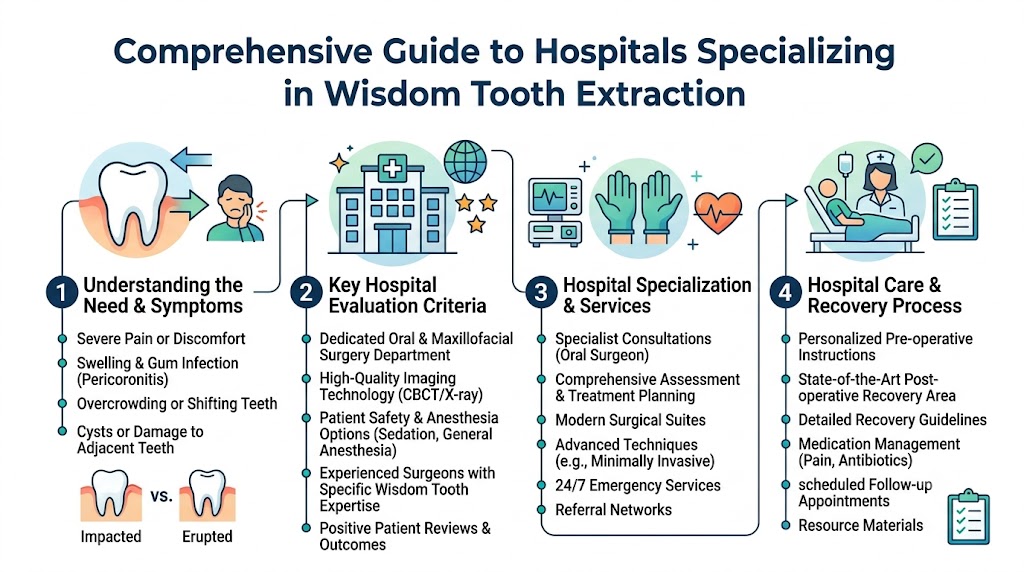
Recognizing the signs that your wisdom teeth need attention is the first step toward relief. Whether you are dealing with mild discomfort or an acute infection, choosing the right facility for your procedure is essential for a safe and successful outcome. Oral surgery is a specialized field that demands precision, modern technology, and a dedicated team of professionals. To help you navigate your options and find the expert care you deserve, BESTDENTALHOSPITALS provides a detailed resource to guide you through selecting a hospital for your procedure.
Understanding Wisdom Tooth Problems
Wisdom teeth usually appear in the late teens or early twenties. Because they are the last teeth to erupt, the jaw often lacks sufficient room to accommodate them comfortably.
What Is an Impacted Wisdom Tooth?
An impacted tooth occurs when the wisdom tooth is trapped beneath the gum line or against another tooth. This can happen because the tooth is growing at an angle, leading to several complications:
- Symptoms: You may experience persistent jaw pain, swelling in the gums, or an unpleasant taste in the mouth.
- Infection: Bacteria can easily get trapped around partially erupted teeth, leading to pericoronitis (gum infection).
- Crowding: As the wisdom teeth push against neighboring teeth, they can disrupt your alignment, often undoing years of orthodontic work.
Why Wisdom Tooth Removal Is Important
Removing problematic wisdom teeth is not just about stopping current pain; it is a proactive measure for long-term health.
- Preventing Infection: Removing the site of potential bacterial growth protects your gums from recurring infections.
- Reducing Chronic Pain: Eliminating the pressure exerted by impacted teeth relieves jaw and ear pain.
- Avoiding Cyst Formation: In rare cases, fluid-filled sacs can develop around an impacted tooth, potentially damaging the jawbone.
- Protecting Nearby Teeth: By removing a wisdom tooth that is pushing against a healthy molar, you prevent potential damage and decay to that adjacent tooth.
QUICK COMPARISON TABLE
| Hospital Name | Location | Oral Surgery Expertise | Technology Used | Anesthesia Type | Patient Support |
| Metro Dental Center | City Center | Advanced Extraction | CBCT & Laser | Local/Sedation | Excellent |
| Apex Oral Surgery Unit | North District | Impacted Tooth Expert | Digital X-ray | General/IV | High |
| Global Dental Hospital | West Zone | Complex Cases | 3D Imaging | Local/IV | Good |
| Prime Dental Institute | South Hub | Minor/Major Surgery | Minimally Invasive | Sedation | High |
Top Hospitals for Wisdom Tooth Removal
1. Metro Dental Center
- Overview: Known for its patient-centric approach to routine and complex extractions.
- Surgery Expertise: Highly trained oral surgeons specializing in comfort-focused dentistry.
- Technology: Uses CBCT scans to map nerve pathways before every surgery.
- Pain Management: Offers various sedation levels to ensure a calm experience.
2. Apex Oral Surgery Unit
- Overview: A dedicated unit focused exclusively on surgical dental procedures.
- Surgery Expertise: Specialized teams that handle severe impactions with high success rates.
- Technology: Advanced 3D digital treatment planning.
- Pain Management: Expert anesthesiologists on-site for deep sedation.
3. Global Dental Hospital
- Overview: A large facility capable of handling complex maxillofacial needs.
- Surgery Expertise: Surgeons experienced in both standard extractions and complex bony impactions.
- Technology: Latest laser dental equipment for precise soft tissue management.
- Pain Management: Comprehensive monitoring for all surgical patients.
Modern Dental Technologies Used
- Digital X-rays: Provide immediate, clear images with significantly less radiation than traditional film.
- CBCT Scans: Cone Beam Computed Tomography provides a 3D view of the tooth and surrounding nerves, essential for safe surgical planning.
- Laser Dentistry: Allows for precise incisions and faster healing with minimal bleeding.
- Sedation Dentistry: A variety of options, including IV sedation, help patients remain relaxed and pain-free during the procedure.
When Wisdom Tooth Removal Is Needed
Your dentist may recommend removal if they observe:
- Impaction: The tooth is stuck in the jawbone.
- Infection: Repeated bouts of swelling around the gum line.
- Damage: The wisdom tooth is pushing against and damaging the second molar.
- Cysts: Signs of fluid-filled sacs forming around the tooth.
- Difficulty Cleaning: The tooth is in a position that makes it impossible to floss or brush, inviting decay.
How to Choose the Right Dental Hospital
- Surgeon Experience: Ensure the oral surgeon has specific experience with impacted teeth.
- Technology: Look for hospitals that utilize 3D imaging for surgical planning.
- Hygiene Standards: Hospitals must follow strict sterilization protocols for all instruments.
- Emergency Support: Verify that the facility provides after-care support and guidance for post-surgical issues.
- Cost Transparency: A good hospital provides a clear breakdown of surgical and anesthetic costs.
Benefits of Professional Wisdom Tooth Removal
- Infection Prevention: Eliminates the hidden pockets where bacteria thrive.
- Improved Long-term Comfort: Prevents the pain and pressure associated with shifting or impacted teeth.
- Faster Recovery: When handled by experts using minimally invasive techniques, you can return to your routine sooner.
- Protection of Your Smile: Saves your existing teeth from decay, crowding, and damage.
Real-Life Patient Scenarios
“James,” a college student, ignored mild jaw pain for months, assuming it would go away. Eventually, he developed a severe infection that caused significant facial swelling. By visiting a specialized hospital, James received an accurate CBCT scan that identified the exact angle of his impacted tooth. The oral surgery team performed a smooth extraction, and with proper post-operative care, James recovered fully within days. His experience highlights the importance of not delaying treatment when symptoms first appear.
Common Mistakes Patients Make
- Delaying Treatment: Waiting until a condition becomes an emergency makes the procedure more complex.
- Avoiding Consultations: Skipping X-rays because “it doesn’t hurt yet.”
- Ignoring Post-Surgery Care: Failure to follow simple instructions, such as resting and avoiding certain foods, can significantly delay healing.
Future of Dental Surgery
The field is evolving with AI-driven diagnostics, which can help predict how teeth will develop, and robot-assisted surgery, which allows for unparalleled precision. Furthermore, regenerative medicine is being explored to accelerate bone healing after complex extractions.
FAQs
- What is wisdom tooth removal?
A surgical procedure to remove one or more third molars. - Is extraction painful?
The procedure itself is performed under local anesthesia or sedation, so you will not feel pain. - How long is recovery?
Most patients recover in three to seven days. - Who performs the surgery?
An oral and maxillofacial surgeon. - What is an impacted tooth?
A tooth that is unable to erupt properly due to lack of space. - Is surgery safe?
When performed by a qualified surgeon in a sterile hospital, it is a very safe, routine procedure. - Cost?
Varies based on the number of teeth and complexity of impaction. - What anesthesia is used?
Options range from local numbing to IV sedation. - What to eat after?
Soft, cool foods like yogurt, smoothies, and mashed potatoes. - Can I drive home?
Not if you have had sedation; you will need a driver. - How to manage swelling?
Apply ice packs according to doctor instructions. - Will my face be swollen?
Some swelling is normal and usually peaks within two days. - Are there risks?
As with any surgery, there are minor risks, but professionals minimize them. - How soon can I work?
Most people take a few days off to rest. - Why remove them early?
Younger patients generally heal faster and have less bone density around the roots.
Final Thoughts
Wisdom tooth removal is a common procedure that, when performed in a high-quality hospital, ensures your long-term oral health and comfort. By prioritizing expert care and modern diagnostics, you can navigate your treatment journey with confidence and ease.If you are concerned about your wisdom teeth, don’t wait for the pain to become unbearable. Explore the options and insights provided at BESTDENTALHOSPITALS to find the specialized care you need for a healthy smile.