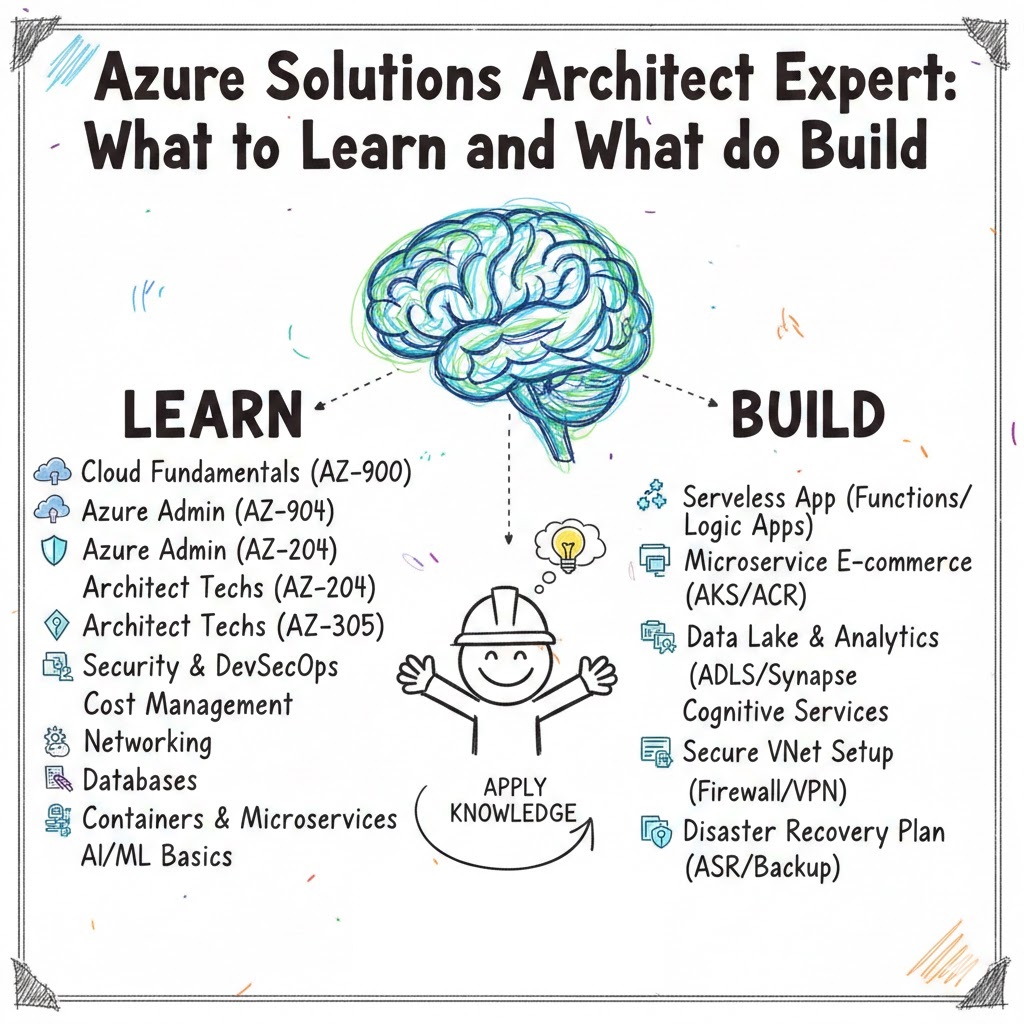
Cloud projects fail for simple reasons: unclear ownership, weak identity controls, flat networks, no recovery plan, poor monitoring, and surprise bills. A strong solutions architect prevents these problems before they happen. That is what the Azure Solutions Architect Expert journey is really about. It helps you think like someone who designs systems that teams can build confidently, operate safely, and scale without chaos.This master guide is written for working engineers and managers (India + global). It uses simple English, short paragraphs, and practical structure. You will learn what the certification is, who should take it, what skills it builds, what projects you should be able to deliver after it, how to prepare in realistic time windows, what mistakes to avoid, what to do next, and how to pick a learning path based on your career direction.
What Azure Solutions Architect Expert means in real work
Azure Solutions Architect Expert validates your ability to design Azure and hybrid solutions across:
- Identity and access
- Networking and connectivity
- Compute and application hosting
- Storage and data
- Security and governance
- Reliability, business continuity, and disaster recovery
- Monitoring, operations, and cost control
It is not about knowing 200 services. It is about making good decisions with limited time and imperfect information, then documenting those decisions so delivery teams can implement them safely.
Who this guide is for
Engineers
- Cloud engineers moving into architecture ownership
- Platform engineers building shared foundations (landing zones, policies, networks)
- Senior developers shifting from coding to designing systems
- DevOps/SRE engineers who want stronger architecture and governance skills
- Security engineers influencing identity, segmentation, and compliance controls
Managers and leads
- Engineering managers who review designs and budgets
- Program leaders running migrations or cloud modernization initiatives
- Tech leads who must align multiple teams under consistent standards
Why this certification is worth it
Better technical credibility
Teams trust architects who can explain “why” clearly. This certification trains that discipline.
Better risk control
Most cloud incidents are predictable. Strong architecture reduces “unknown unknowns.”
Better cost outcomes
Architecture decisions become billing decisions. Good architects prevent waste by design.
Better career mobility
Solution architecture skills travel well across countries, companies, and domains.
Certification mini-sections
What it is
Azure Solutions Architect Expert focuses on designing end-to-end solutions on Azure. It validates your ability to choose services, connect them securely, plan reliability and recovery, and design governance and operations so the solution stays healthy in production.
Who should take it
- Engineers already working with Azure who want to lead design decisions
- Platform teams building reusable cloud foundations
- DevOps/SRE leads who need stronger system design and governance skills
- Security engineers working on cloud identity and guardrails
- Managers who must evaluate proposals and reduce risk
Skills you’ll gain
- Architecture thinking: trade-offs, constraints, reference designs
- Identity: least privilege, role boundaries, access strategy
- Network design: segmentation, hub-and-spoke patterns, private access
- Compute selection: VMs vs containers vs PaaS options
- Data design: storage tiers, encryption, backup and restore planning
- Governance: standards, policy, naming, tagging, guardrails
- Reliability: availability patterns, failover planning, DR reasoning
- Operations: monitoring strategy, alert quality, runbooks, readiness checks
- Cost control: budgeting mindset, cost drivers, optimization loops
- Documentation: architecture packs, decision logs, risk registers
Real-world projects you should be able to do after it
- Design a secure Azure landing zone with clear subscription boundaries
- Build a hub-and-spoke network plan with segmentation and shared services
- Produce a high availability architecture for a business-critical app
- Write a DR plan with realistic RPO/RTO targets and test steps
- Create an operations pack: monitoring, alerts, dashboards, runbooks
- Present a cost-aware architecture proposal with assumptions and trade-offs
Preparation plan (7–14 days / 30 days / 60 days)
7–14 days
Best for people already designing or reviewing Azure solutions.
- Days 1–2: Collect weak areas, map them to daily job scenarios
- Days 3–5: Identity + governance deep focus (access model, guardrails)
- Days 6–8: Network patterns + private connectivity + segmentation design
- Days 9–11: Reliability + DR planning (RPO/RTO, failover, backups)
- Days 12–14: Case-based practice: read scenario → propose architecture → list risks
30 days
Best for working engineers who need steady progress.
- Week 1: Cloud foundations for architecture: identity, network, governance
- Week 2: Compute + application design: scale, deployment safety, patterns
- Week 3: Data + security: encryption, access patterns, backup strategy
- Week 4: Full scenario practice with review checklists and documentation
60 days
Best for those moving into architecture for the first time.
- Weeks 1–2: Azure fundamentals plus hands-on “small builds”
- Weeks 3–4: Landing zone + network + governance design practice
- Weeks 5–6: Security baseline + DR + monitoring readiness
- Weeks 7–8: End-to-end case studies with written architecture packs
Common mistakes
- Starting with services instead of starting with requirements and constraints
- Treating security as a “later task” instead of a first design decision
- Designing a perfect system but ignoring operations (monitoring/runbooks)
- No DR testing plan, only DR theory
- Using complex services without strong justification
- Flat networks and weak segmentation that become security risks later
- No cost model: surprises happen after production launch
- Weak documentation: teams cannot implement consistently
Best next certification after this
Your next move should match your role goals:
- Same track: deepen enterprise cloud architecture and governance
- Cross-track: strengthen delivery and reliability execution (DevOps/SRE)
- Leadership: improve architecture governance, review practice, and stakeholder alignment
Certification table
| Certification | Track | Level | Who it’s for | Prerequisites | Skills covered | Recommended order |
|---|---|---|---|---|---|---|
| Azure Solutions Architect Expert | Azure Architecture | Expert | Senior engineers, architects, platform leads, managers reviewing designs | Strong Azure basics + real project exposure | Architecture design across identity, network, compute, data, security, governance, DR | 1 |
| Master in DevOps Engineering | DevOps / DevSecOps / SRE | Advanced program | DevOps/SRE/platform engineers aiming for strong end-to-end delivery capability | Project exposure recommended | DevOps lifecycle skills, automation mindset, reliability and security alignment | After architecture (cross-track) |
What you should know before starting
Technical foundations that matter
- Networking basics: DNS, CIDR, routing, load balancing, TLS
- Identity concepts: least privilege, role separation, access review thinking
- Basics of Linux/Windows and scripting comfort
- Application fundamentals: stateless vs stateful, scaling, caching ideas
- Data basics: backup vs restore, encryption concepts, performance trade-offs
Experience that makes preparation easier
- At least one workload deployed on Azure (even internal)
- Exposure to monitoring and incident handling
- Familiarity with change control, releases, and production risks
If you do not have all of these, do not worry. You can still succeed, but you should use the 60-day plan and do more hands-on practice.
How architects think (a simple mental model)
A good cloud architect answers six questions clearly:
- What are we building and why?
- What can go wrong? (security, failure, cost, compliance, performance)
- What design choices control those risks?
- How do we operate it daily?
- How do we recover?
- How do we keep cost predictable?
If you train yourself to answer these six questions for every scenario, you will naturally think like an architect.
A practical blueprint you should practice
Landing zone blueprint
- Subscription structure and environment separation
- Identity model, role boundaries, and privileged access approach
- Policy guardrails and standards (naming, tagging, allowed regions)
- Base networking model (shared services, segmentation, private access)
- Monitoring baseline (logs, alerts, dashboards, escalation)
Application blueprint
- Hosting choice with justification (PaaS vs containers vs VMs)
- Secrets handling approach
- Deployment safety (rollback plan, staged release thinking)
- Observability plan (logs, metrics, tracing direction)
- Performance and scaling model (limits, burst behavior, caching)
Recovery blueprint
- Define RPO/RTO targets in plain language
- Backups: what, frequency, retention, restore verification
- Failover: steps, ownership, testing schedule
- Runbooks: “when X breaks, do Y” with clear escalation
Choose your path
Pick one primary path based on what you want to become next. Each path uses Azure architecture as a foundation, then adds a focused capability.
1: DevOps
Goal: Ship faster without breaking production.
Focus areas:
- CI/CD governance, release safety patterns, automation mindset
- Infrastructure automation and repeatable environment builds
Outcome: - You become the person who connects architecture with delivery speed and reliability.
2: DevSecOps
Goal: Build secure systems without slowing teams down.
Focus areas:
- Identity-first design, policy guardrails, secrets discipline
- Secure pipeline thinking and controlled access patterns
Outcome: - You design secure foundations that teams can still move fast on.
3: SRE
Goal: Build services that stay stable under stress.
Focus areas:
- Monitoring quality, incident readiness, capacity planning
- Reliability patterns, DR testing habits, operational maturity
Outcome: - Your designs become “easy to run,” not just “correct.”
4: AIOps/MLOps
Goal: Support AI/ML workloads and intelligent operations safely.
Focus areas:
- Telemetry quality, signal-to-noise improvement
- ML workload patterns and operational automation thinking
Outcome: - You enable modern AI workloads with stable cloud foundations.
5: DataOps
Goal: Deliver data reliably with governance and quality.
Focus areas:
- Data delivery pipelines, access models, quality controls
- Cost-aware storage patterns and operational readiness for data platforms
Outcome: - You design data platforms teams can trust.
6: FinOps
Goal: Make cost a first-class design requirement.
Focus areas:
- Cost drivers, tagging ownership, budgets, optimization cycles
- Architecture decisions framed with business value and spend control
Outcome: - You become the architect who prevents cloud waste by design.
Role → Recommended certifications mapping
This mapping stays practical and role-based. Since you restricted links, I’m listing the logical set and only using your provided URLs where applicable.
| Role | Recommended certification direction | Why it fits |
|---|---|---|
| DevOps Engineer | Azure Solutions Architect Expert → Master in DevOps Engineering | Strong architecture + strong delivery execution across pipelines and automation |
| SRE | Azure Solutions Architect Expert → Master in DevOps Engineering | Better reliability design + better operational discipline and delivery safety |
| Platform Engineer | Azure Solutions Architect Expert → Master in DevOps Engineering | Landing zones, guardrails, scalable platforms, plus execution maturity |
| Cloud Engineer | Azure Solutions Architect Expert | Moves you from implementer to design owner |
| Security Engineer | Azure Solutions Architect Expert → DevSecOps path | Cloud security is identity + network + governance + safe delivery |
| Data Engineer | Azure Solutions Architect Expert → DataOps path | Strong data architecture requires security, reliability, and governance |
| FinOps Practitioner | Azure Solutions Architect Expert → FinOps path | Architecture choices drive cost outcomes |
| Engineering Manager | Azure Solutions Architect Expert → Leadership track options | Improves design review quality, risk thinking, cost reasoning, stakeholder alignment |
Next certifications to take (3 options: same track, cross-track, leadership)
You asked for three options and asked to refer to the Master in DevOps Engineering page as the reference direction.
Option 1: Same track (deepen Azure architecture authority)
Choose this if you want to be the person who defines standards across many teams.
- Deeper governance patterns and architecture review practices
- Large-scale platform design: landing zone maturity, multi-team controls
- Strong focus on secure foundations, repeatability, and operational standards
Option 2: Cross-track (build execution power across DevOps/SRE)
Choose this if you want to convert architecture into reliable delivery outcomes.
- Strong emphasis on end-to-end engineering lifecycle
- Useful for engineers leading platform delivery, pipelines, automation, and reliability
- A strong structured path here is the Master in DevOps Engineering program you referenced
Option 3: Leadership track (architecture governance + business outcomes)
Choose this if you are moving into lead/manager roles or stakeholder-heavy work.
- Design review governance, exception handling, and standardization
- Cost and risk framing: communicating trade-offs clearly
- Building cloud roadmaps and aligning teams around shared architecture goals
Top institutions for Training cum Certifications support
DevOpsSchool
DevOpsSchool is positioned around structured training paths that align with real job roles. For Azure Solutions Architect Expert, the focus is typically on architecture readiness—design thinking, scenario-based learning, and practical solution planning. It is useful for working professionals who want a guided structure instead of scattered content. It also supports cross-track learning in DevOps, DevSecOps, and SRE direction as part of broader career growth. Official provider and certification links are shared at the top.
Cotocus
Cotocus is commonly presented as part of a larger training ecosystem supporting certification-oriented learning. It can be useful when you want a planned curriculum, guided progress, and role-aligned learning goals. Many learners benefit from structured sequencing, especially when preparing alongside a job. It can also support cross-skilling when you want architecture plus delivery skills.
ScmGalaxy
ScmGalaxy is often referenced in DevOps-aligned training lists and can complement architecture learning by improving practical lifecycle thinking. It is useful when your role needs you to connect cloud design with execution habits like automation and operational readiness. Learners who prefer hands-on, job-oriented training can benefit from a structured approach. It supports the broader skill-building ecosystem around modern engineering roles.
BestDevOps
BestDevOps is typically listed as a training option for professionals who want structured learning for DevOps and related cloud skills. It can help when you want learning paths that are organized and focused on employable outcomes. For architecture learners, it can complement by strengthening delivery and toolchain understanding. This becomes valuable when your job requires both design and practical implementation alignment.
DevSecOpsSchool
DevSecOpsSchool is relevant if you want to make security a built-in design habit. Many architecture failures happen because identity, policy, and secrets are treated as afterthoughts. DevSecOps-aligned learning supports secure pipelines, guardrails, and compliance-minded thinking. It is useful for engineers designing platforms that must pass audits without slowing delivery. This path fits security engineers, platform engineers, and architects.
SRESchool
SRESchool supports reliability-focused thinking, which is essential for architects designing business-critical systems. It helps you strengthen observability, incident readiness, capacity planning, and safe operational practices. If you have production ownership, this mindset reduces outages and speeds up recovery. It also improves system design decisions by making operability a first-class requirement. This is valuable for SREs, platform engineers, and architects.
AIOpsSchool
AIOpsSchool becomes useful in environments where monitoring noise is high and manual operations do not scale. It helps you think about telemetry quality, signal design, and how systems can support intelligent operations. For architects, this matters because observability design starts at architecture time, not after production issues. It fits teams building large platforms or complex distributed systems. It also pairs well with SRE and platform roles.
DataOpsSchool
DataOpsSchool supports reliable data delivery habits: pipeline discipline, quality thinking, governance, and secure access patterns. Many architects support analytics, storage choices, and data platform decisions even if they are not data engineers. DataOps thinking helps you design data systems that are stable, compliant, and operationally manageable. It also strengthens collaboration between data teams, platform teams, and security stakeholders. This is valuable for data engineers and cloud architects.
FinOpsSchool
FinOpsSchool supports cost-aware decision making, which is a core expectation for modern architects and managers. It helps you understand cost drivers, tagging ownership, budgeting discipline, and optimization cycles. Architects who adopt FinOps thinking reduce waste while keeping performance and reliability goals intact. This is especially useful for engineering managers and platform teams managing shared cloud spend. It fits FinOps practitioners, cloud engineers, and architects.
FAQs
1) What is Azure Solutions Architect Expert in simple words?
It is a certification path that validates you can design complete Azure solutions. It focuses on making safe design choices across security, networking, reliability, operations, and cost.
2) Who should take this certification?
Cloud engineers, platform engineers, DevOps/SRE leads, senior developers, security engineers, and managers who review architecture. If your job needs you to make or approve cloud design decisions, it fits well.
3) Is Azure Solutions Architect Expert difficult?
It can be difficult because it is scenario-driven and expects trade-off thinking. If you already work with Azure projects, the difficulty becomes manageable with focused case practice.
4) How much time do I need if I work full-time?
A 30-day plan is realistic for most professionals. If you already design solutions daily, a 7–14 day revision plan can work. If you are switching roles or filling many gaps, use 60 days.
5) What should I focus on the most?
Identity and governance, networking and segmentation, reliability and DR, monitoring and operations, and cost control. These areas appear in almost every real-world architecture scenario.
6) What projects should I be able to do after it?
You should be able to design a landing zone, build a network segmentation plan, architect a scalable application, create a DR plan with clear RPO/RTO, and produce an operations pack with monitoring and runbooks.
7) What mistakes should I avoid while preparing?
Avoid memorizing services without understanding “when and why.” Also avoid ignoring security/governance early, skipping DR and restore testing, designing expensive complexity, and practicing without writing clear design decisions.
8) What is the best next step after this certification?
Pick one direction: deepen architecture authority (same track), improve end-to-end delivery execution (cross-track like the Master in DevOps Engineering reference you shared), or move toward leadership skills like governance and stakeholder alignment.
FAQs
1) What is Azure Solutions Architect Expert in simple words?
It is a certification path that proves you can design complete Azure solutions end-to-end. It focuses on making the right architecture decisions across security, networking, reliability, operations, and cost.
2) Who should take Azure Solutions Architect Expert?
Cloud engineers, platform engineers, senior developers, DevOps/SRE leads, security engineers, and managers who review architecture. If you are expected to decide “how the system should be built,” this fits you.
3) Is Azure Solutions Architect Expert difficult?
It can be challenging because it is scenario-based and expects trade-off thinking. If you already work on Azure projects, it becomes manageable with structured practice and case-study style preparation.
4) How much time is needed to prepare?
Most working professionals do well in 30 days. If you already design solutions daily, 7–14 days can work for revision. If you are switching roles or have gaps, 60 days is safer.
5) What prerequisites should I have before starting?
You should know basic networking, identity concepts, and application fundamentals. Real project exposure on Azure helps a lot, especially around deploying workloads and handling monitoring or incidents.
6) What skills should I focus on the most?
Focus on identity and access design, governance and guardrails, network segmentation, high availability, disaster recovery, monitoring strategy, and cost control. These are the most repeated real-world architecture areas.
7) What real-world projects should I be able to do after it?
You should be able to design a landing zone, create a hub-and-spoke network plan, architect a scalable application, define RPO/RTO with a DR plan, and build an operations pack with monitoring and runbooks.
8) What are the most common mistakes learners make?
They memorize services without understanding trade-offs, ignore identity/governance early, skip DR planning and restore testing, overbuild expensive complexity, and do not practice writing clear architecture decisions.
9) What is the best study method for busy professionals?
Use scenario-first learning. Read a scenario, propose an architecture, list risks and mitigations, and write a short decision record. This builds real architecture thinking faster than service-by-service reading.
10) What order should I follow if I am not ready for expert level?
Start with cloud fundamentals, then get hands-on with Azure basics and operations, then move into architecture patterns like landing zones, networking, identity, governance, and DR. After that, the expert path becomes smoother.
11) What career roles does this certification support?
It supports roles like solution architect, cloud architect, platform architect, senior cloud engineer, and engineering lead who reviews designs. It also helps DevOps/SRE leads who influence platform design decisions.
12) What should I do after completing this certification?
Choose one direction: deepen Azure architecture authority (same track), strengthen execution capability with a cross-track DevOps/SRE path, or move toward leadership by improving governance, cost reasoning, and stakeholder communication.
Conclusion
Azure Solutions Architect Expert is most valuable when you treat it as a job skill upgrade, not just an exam target. A strong architect designs with security, reliability, operations, and cost in mind from the beginning, because fixing these later is expensive and risky. If you practice scenario-based design, write simple decision records, and build repeatable blueprints for landing zones, networking, identity, DR, and monitoring, you will become confident in real architecture reviews. Then choose a direction: deepen Azure architecture authority, build execution strength with a cross-track path, or step into leadership and governance. The best outcome is becoming the person teams trust for safe, scalable cloud decisions.